

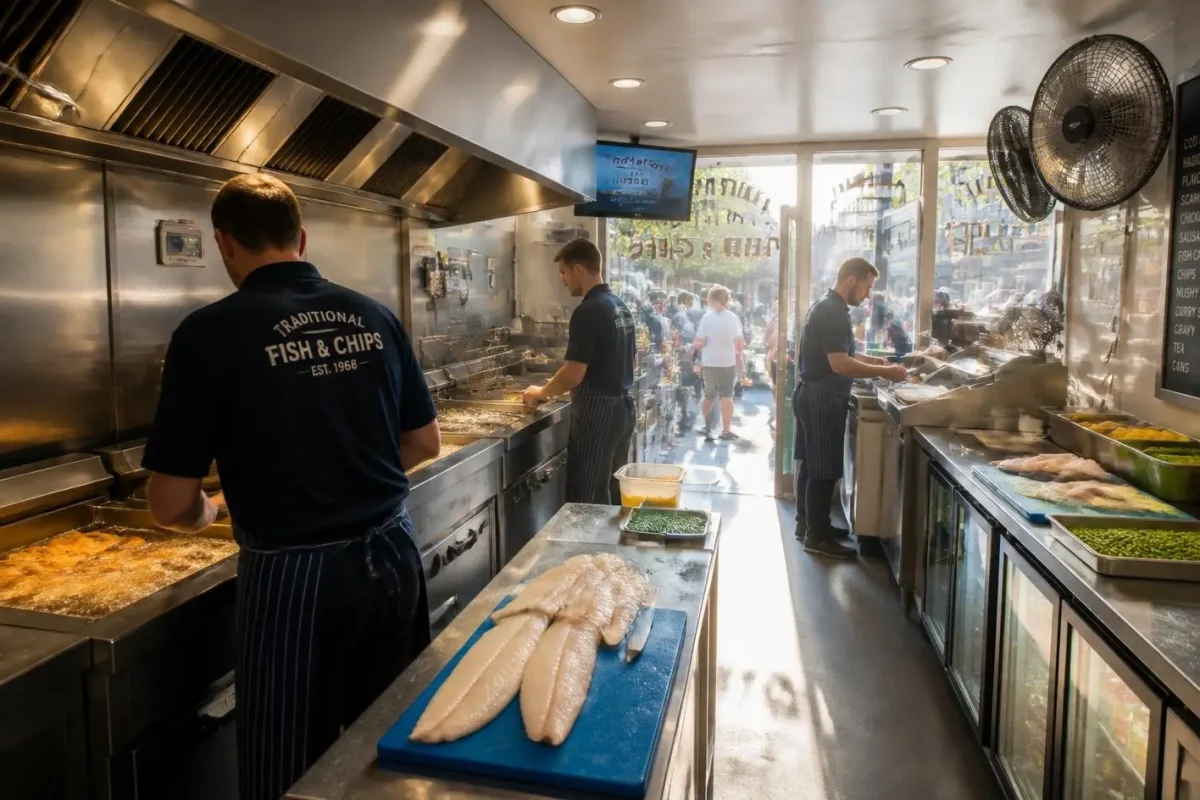
The heatwave impact on UK chippies goes beyond uncomfortable working conditions. Fish and chip shops are facing hotter kitchens, added pressure on staff, greater use of refrigeration and ventilation, possible crop disruption and rising operating costs.
Commercial fryers generate intense heat throughout service. When temperatures exceed 30°C, kitchens can become significantly hotter. Recent reports described staff working beside fryers in “horrendous” conditions, particularly in some independent shops.
Industry representatives have also warned that prolonged hot, dry weather could affect pea and potato supplies, although widespread shortages have not been confirmed.
Key highlights:
- Commercial fryers increase heat in kitchens.
- Staff may face dehydration, fatigue and reduced concentration.
- Cooling equipment may use more electricity.
- Hot, dry weather could affect pea and potato harvests.
- Higher costs may pressure margins and menu prices.
- There is no fixed legal maximum workplace temperature in the UK.
- The impact varies by shop and location.
The main challenge is protecting staff, maintaining food safety and controlling heat-related costs.
How Is the Current UK Heat Wave Affecting Chippies?
The current UK heat wave is affecting chippies through a combination of workforce, equipment, supply-chain and customer-demand pressures.
Many areas are experiencing their third heatwave of 2026. Temperatures were forecast to reach 35°C or 36°C in parts of England, while very warm conditions were expected more widely across the UK.
Main pressures facing shops:
- Kitchens becoming hotter during preparation and service
- Staff requiring more water, breaks and task rotation
- Refrigerators and freezers working in higher ambient temperatures
- Extraction and cooling systems running for longer
- Possible changes to opening or preparation hours
- Supplier warnings involving peas and potatoes
- Customers delaying orders until cooler evening periods
The effect will not be identical everywhere. A modern shop with effective extraction may cope better than a compact takeaway with an older frying range, restricted airflow and only a few employees.
When Will This Heatwave End in the UK, and Why Does the Timing Matter to Chippies?
The most intense temperatures are expected to ease gradually rather than end suddenly. Southern and eastern areas should become somewhat cooler, but very warm conditions may continue as the focus of the heat shifts towards western parts of the country.
The latest UK heatwave outlook forecast a gradual decline after weekend highs, with many places potentially remaining above seasonal averages into the following week.
“It won’t be a straightforward end to the warm weather” – Deputy Chief Forecaster Tom Crabtree
Duration matters because several consecutive hot days can prevent premises and equipment from cooling fully overnight. Staff may also accumulate fatigue across repeated shifts, while refrigerators, freezers and extraction systems remain under sustained load.
Official heat-health alerts for England were due to remain in force until 9pm on Sunday, 12 July 2026. Forecasts and alerts can change, so operators should check current information rather than relying on an earlier headline.
Why Are Chippy Kitchens So Difficult to Work In During Extreme Heat?
Chippy kitchens combine high-temperature cooking equipment, physical work and often limited space. This can make internal conditions much more demanding than the outdoor temperature suggests.
Fryers, Confined Spaces and Limited Airflow
Commercial fryers release radiant heat throughout service. Extraction systems may remove fumes and airborne grease without cooling the entire kitchen, particularly in older premises.
Staff also move continuously between preparation areas, fryers, counters and storage spaces. Uniforms, aprons, humidity and a high work rate can increase the body’s heat load.
Reports from individual chippies show that conditions vary. Some operators have adjusted opening times, provided additional breaks or invested in air conditioning, while others say modern frying ranges and effective extraction make the heat more manageable.
How Can Heat Stress Affect Staff Safety and Performance?
Heat stress can affect concentration, judgement, physical coordination and service speed. It may also increase the likelihood of mistakes when employees are working around hot oil, sharp equipment or slippery floors.
Symptoms can include thirst, headache, dizziness, nausea, cramps, unusual tiredness, fainting and confusion. Serious or worsening symptoms require prompt action rather than an expectation that staff should simply continue working.
Current England heat-health alert information warns that sustained warm weather can produce serious health outcomes, particularly among vulnerable people. The risks inside a hot workplace may require separate controls based on the tasks being performed.
How Is the Heatwave Increasing Costs for UK Fish and Chip Shops?
Extreme heat can increase costs through electricity use, equipment strain, staffing changes, food waste and emergency maintenance.
Heat-related cost pressures:
- Extraction, fans or air conditioning may run for longer.
- Refrigeration equipment must operate in a hotter environment.
- Additional staff cover may be needed for breaks or shorter shifts.
- Equipment faults can result in repairs and lost trading hours.
- Poor temperature control can lead to spoiled stock.
- Reduced opening hours may lower revenue during already difficult periods.
Potential business impact:
| Cost area | Heatwave effect | Possible consequence |
| Electricity | Longer cooling and extraction use | Higher utility bills |
| Refrigeration | Greater operating strain | Faults or maintenance costs |
| Staffing | More breaks or rota changes | Reduced output or extra cover |
| Stock | Greater storage risk | Waste and lost margin |
| Opening hours | Later opening or early closure | Lower daily sales |
| Maintenance | Equipment working under pressure | Emergency repair bills |
Not every chippy will experience every cost. The outcome depends on equipment efficiency, kitchen design, energy tariffs, staffing levels and the length of the hot spell.
Could Hot Weather Cause Mushy-Pea and Potato Supply Problems?
Hot and dry weather can place pressure on agricultural production, but current warnings do not prove that a nationwide mushy-pea or potato shortage is already happening.
Marrowfat peas used for mushy peas depend on suitable growing and harvesting conditions. Potatoes supplied to chippies must also meet requirements involving size, consistency, dry matter and frying performance. Weather-related changes can affect both availability and quality.
An industry representative warned:
“Peas and potatoes, we rely on them. The weather has a massive impact on those things.”
He added that the industry was expecting a difficult year for both crops.
What is confirmed and what remains uncertain?
| Statement | Current status |
| Prolonged heat can affect crops | Established agricultural risk |
| Industry representatives expect pressure | Reported concern |
| Some suppliers may raise prices | Possible outcome |
| Every UK chippy faces a shortage | Not established |
| Mushy peas will disappear nationally | Unsupported claim |
The responsible conclusion is that crop and supplier risks deserve monitoring, while headlines suggesting that all chippies are running out of mushy peas go beyond the available evidence.
Will the Heatwave Push Fish and Chip Prices Even Higher?
The heatwave could contribute to higher menu prices, but increases are not automatic. Each operator must consider ingredient costs, energy consumption, staffing, local competition and customers’ willingness to pay.
Hot weather is also only one part of the cost picture. Chippies already purchase fish, cooking oil, potatoes, peas, packaging and energy in markets where prices can move for several different reasons. Additional refrigeration or cooling expenditure may reduce the amount of margin available to absorb supplier increases.
Consider an illustrative independent shop selling 500 meals each week. Small increases in electricity, potatoes and staffing may appear manageable individually.
Together, however, they can materially reduce weekly profit. The owner may respond by reducing waste, renegotiating supplies or making a modest price adjustment rather than passing every extra cost directly to customers.
This example is illustrative, not a forecast for any particular business. Pricing decisions should be based on verified costs and current cash-flow information.
What Should Chippy Owners Do to Protect Staff and Keep Trading?
Owners should treat extreme heat as a foreseeable workplace and business-continuity risk rather than an occasional inconvenience.
What Does UK Workplace Law Require?
There is no fixed maximum workplace temperature applying to every UK business. However, employers must provide a reasonable indoor temperature, assess risks and introduce suitable controls.
The official workplace temperature legal duties state that heat is a workplace hazard carrying legal obligations like other hazards. Employers should also consult workers when deciding how to manage high temperatures.
A temperature reading alone may not determine whether a workplace is safe. Risk also depends on humidity, radiant heat, workload, clothing, exposure time and individual vulnerability.
Immediate Heat-Control Measures
Regular heat-control measures can help fish and chip shops protect staff, maintain food safety and reduce disruption during periods of extreme hot weather.
The most effective approach is to combine practical workplace adjustments with ongoing monitoring of kitchen conditions.
Practical actions during hot weather:
- Make cool drinking water readily accessible.
- Rotate employees away from fryers where practical.
- Provide more frequent recovery breaks.
- Move preparation work to cooler times.
- Check extraction and ventilation performance.
- Monitor fridge and freezer temperatures.
- Encourage early reporting of heat-related symptoms.
- Review support for vulnerable employees.
- Adjust service or opening hours where necessary.
These controls should respond to the actual workplace. A fan may help air movement, but it will not correct ineffective extraction, excessive radiant heat or failing refrigeration.
Business Continuity and Supply Planning
Operators should arrange maintenance contacts before equipment fails, confirm supplier schedules and identify realistic alternatives for important ingredients. Stock levels should be sufficient for trading needs without creating unnecessary spoilage risk.
A small chippy might move preparation to the morning, open later, rotate counter and fryer duties, check refrigeration more frequently and contact its potato supplier before placing a large order. Recording which measures work can improve future heatwave planning.
Does Hot Weather Increase or Reduce Customer Demand for Fish and Chips?

Hot weather can increase demand at some chippies and reduce it at others. Location, customer habits, opening hours and the severity of the heat all matter.
Seaside and tourist-area businesses may benefit from higher visitor numbers. By contrast, neighbourhood or city-centre shops may find that customers avoid hot meals or postpone orders until later in the evening.
Industry reporting indicates that some owners expect lower trade during the hottest periods, while others anticipate customers arriving near closing time. Operators have responded by opening later, maintaining usual closing times or using air conditioning to keep staff comfortable.
Customer behaviour should therefore be monitored locally. A national temperature forecast cannot tell an individual chippy whether its early-evening footfall will rise or fall.
What Does the Heatwave Mean for the Future of UK Chippies?

The heatwave suggests that temperature resilience may become a permanent part of chippy management.
Older premises may need improved extraction, insulation or air movement. UK Businesses may also benefit from preventive refrigeration maintenance, flexible rotas, alternative suppliers and clearer heat-response procedures.
The heatwave impact on UK chippies demonstrates that workforce wellbeing and commercial resilience are connected. A shop that controls heat effectively is better placed to retain staff, protect food, maintain service and avoid unplanned closures.
For independent operators, the practical goal is not to remove every effect of hot weather. It is to understand the shop’s most important vulnerabilities and reduce them before the next prolonged hot spell.
Conclusion
The heatwave impact on UK chippies is becoming a wider business challenge, affecting staff wellbeing, operating costs, equipment, supply risks and customer demand.
While not every shop faces the same pressures, prolonged periods of extreme heat can expose weaknesses in staffing, ventilation, refrigeration and sourcing.
For independent operators, practical preparation matters: reviewing heat risks, protecting employees, maintaining equipment and monitoring suppliers can support safer, more resilient trading.
As hotter summers become a recurring concern, chippies that plan early will be better placed to protect both people and profitability over time.
Frequently Asked Questions
How Is a Heatwave Officially Defined in the UK?
A meteorological heatwave occurs when a location records or is forecast to record at least three consecutive days at or above its regional temperature threshold. The threshold varies by location.
Is There a Legal Maximum Temperature for Chippy Staff?
No fixed maximum applies to every workplace. Employers must still assess the risks created by heat and provide reasonable controls appropriate to the work and environment.
What Heat-Stress Symptoms Should Employees Report?
Employees should report dizziness, headache, nausea, cramps, severe thirst, unusual fatigue, fainting or confusion. Serious symptoms should be treated promptly.
Are Mushy Peas Already in Short Supply Across the UK?
A nationwide shortage has not been established. Current reporting concerns possible pressure on harvests, supplies and prices.
Why Do Fridges and Freezers Struggle in Hot Weather?
Refrigeration systems must remove more heat when the surrounding air is warmer. This can increase energy consumption and place additional strain on equipment.
Can a Chippy Reduce Its Opening Hours During a Heatwave?
A business can alter trading hours, but it should consider employment arrangements, customer communication, food safety and the operational reasons for the change.
Are Seaside Chippies More Likely to Benefit from Hot Weather?
They may gain from tourism and coastal footfall, but extreme heat can still discourage customers, pressure staff and alter the timing of demand.