

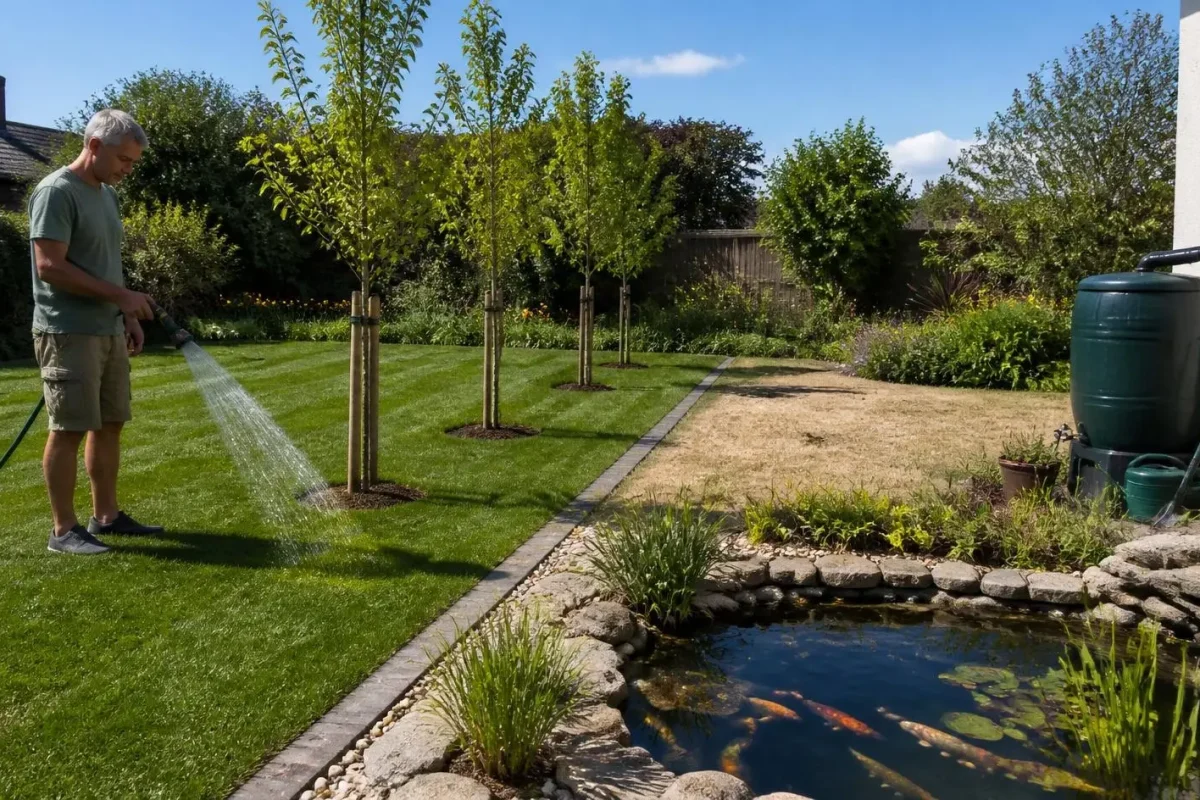
Anglian Water hosepipe ban exemptions allow some households and businesses to continue using a hosepipe for specific purposes, including health and safety, animal welfare, qualifying commercial work, efficient irrigation and the establishment of newly laid turf.
They are not blanket permissions: the activity, water source and conditions attached to the exception all matter.
The Temporary Use Ban became enforceable at 1.01am on 11 July 2026 across the supplier’s region, apart from Hartlepool. It restricts more than ordinary garden hoses and can cover sprinklers, irrigation equipment and mains-fed pressure washers used for prohibited activities.
Key highlights:
- Most statutory exemptions apply automatically when legal conditions are met.
- Businesses do not have a blanket exemption for all activities.
- Hosepipes may be used where necessary for health or animal welfare.
- Newly laid turf may be watered during its first 28 days, subject to conditions.
- Fish ponds may be topped up to protect captive aquatic life.
- Rainwater is generally treated differently from mains water.
- Breaching the ban can lead to fines of up to £1,000.
What Does the Anglian Water Hosepipe Ban 2026 Cover, and Where Does It Apply?

A hosepipe ban is the familiar name for a Temporary Use Ban, a legal mechanism that allows specified uses of water to be restricted during periods of serious supply pressure.
The 2026 restrictions apply across the Anglian Water supply region apart from Hartlepool. Customers should confirm their actual water supplier rather than relying only on county boundaries, particularly where neighbouring properties or districts may have different suppliers.
In the official Temporary Use Ban announcement, Dr Geoff Darch, Head of Strategic Asset Planning, said:
“We are now at the point where we need to ask customers to help by hanging up the hosepipe.”
What can the restrictions cover?
- Watering domestic gardens and established lawns.
- Washing private cars and other private vehicles.
- Filling or maintaining swimming pools and paddling pools.
- Filling domestic ponds where no relevant animal-welfare exception applies.
- Cleaning patios, paths, driveways and exterior domestic surfaces.
- Using a sprinkler or pressure washer for a prohibited purpose.
The legal rules can also treat water transferred through a hose into a container as hosepipe use where it is then applied to a prohibited activity. The restriction therefore focuses on the purpose and method of use, not merely the name of the equipment.
Who Qualifies for Anglian Water Hosepipe Ban Exemptions?
There is no single list of people who may use a hosepipe for anything they choose. The rules are better understood as a combination of statutory exceptions, published concessions and activities that fall outside particular restricted categories.
Statutory Exceptions and Published Concessions
Statutory exceptions arise from the legal framework itself. These include certain uses connected with health or safety and specific protections for aquatic animals.
Published concessions are additional permissions subject to stated conditions. Current guidance also addresses Priority Services customers, efficient irrigation, newly laid turf and particular commercial activities. The current restriction and exception rules should therefore be checked before a customer assumes an activity is permit
How Do the Main Exemptions Compare?
The hosepipe ban includes several exemptions, but they apply only in specific circumstances. The table below provides a simple overview of common activities, their general status and the main conditions that may allow an exception.
Exemptions and exceptions at a glance:
| Activity | General Rule | Possible Exception |
| Watering an established lawn | Not allowed | Health or safety need |
| Watering newly laid turf | Allowed in limited cases | Published conditions apply |
| Washing a private car | Not allowed | Safety-related need |
| Cleaning a commercial vehicle | May be allowed | Genuine business activity |
| Topping up a fish pond | May be allowed | Animal welfare |
| Cleaning a dangerous spill | Allowed if necessary | Health and safety |
| Using drip irrigation | Allowed in some cases | Approved equipment |
| Priority Services customer use | May be allowed | Disability or health-related need |
The safest approach is to identify the exact activity first and then match it to the relevant exception, rather than assuming that a person, occupation or property receives unlimited permission.
Which Activities Remain Prohibited Even When Some Exemptions Exist?
Most routine, non-essential domestic hosepipe use remains restricted. This includes watering established lawns, washing private cars for appearance, filling recreational pools and cleaning patios or outdoor surfaces simply because they look dirty.
A statutory exception should not be stretched beyond its purpose. For example, permission to top up a pond for fish welfare does not permit someone to use the same hosepipe to water an established lawn. Similarly, a health-and-safety exception for removing a dangerous substance does not create general permission to pressure-wash an entire driveway.
Hiring a contractor also does not automatically turn every domestic activity into exempt commercial use. The underlying purpose of the work still matters.
The statutory temporary water-use framework identifies the restricted categories and specific circumstances that sit outside them. It also explains why terms such as “garden”, “private motor vehicle” and “health or safety reasons” matter when deciding whether an activity falls within the
When Can a Hosepipe Be Used for Health, Safety, Disability or Religious Reasons?
A hosepipe may be used in circumstances where the applicable rules recognise a genuine health, safety or qualifying personal need. The exception should normally be limited to what is reasonably necessary to address that need.
Situations that may qualify:
- Removing contamination or a substance that creates a genuine health risk.
- Cleaning an area to reduce a significant slip or safety hazard.
- Using water to protect human or animal health.
- Preventing or controlling disease.
- Making a necessary adjustment where a qualifying health condition or disability prevents a practical alternative.
- Certain uses are connected with qualifying medical treatment or religious observance.
Customers registered on the Priority Services Register may be able to continue using a hosepipe where a health condition or disability means they cannot make reasonable adjustments. Registration itself should not be interpreted as unlimited permission for every restricted activ
The key test is necessity. Ordinary convenience, age alone or a preference for using a hosepipe does not automatically create an exemption.
Can Households Use a Hosepipe for Gardens, New Turf, Animals and Fish Ponds?

Some of the most important Anglian Water hosepipe ban exemptions concern new planting and animal welfare, but the conditions differ significantly.
New Turf, Trees and Water-Efficient Irrigation
Newly laid turf may be watered during its initial establishment period under the published concession, with the 28-day period commonly specified in the current drought-planning framework. Customers should retain evidence of when turf was installed and follow the precise live conditions.
Efficient drip or trickle irrigation can also qualify where the system meets specified requirements, including targeted water delivery and appropriate control equipment. A conventional lawn sprinkler should not automatically be treated as an efficient irrigation system.
When Does Animal Welfare Permit Hosepipe Use?
Essential water use for animal health and welfare can remain permitted. This may include providing drinking water, dealing with disease or hygiene risks and carrying out cleaning that is genuinely necessary for an animal’s health.
Routine cosmetic washing is different from a veterinary or welfare need. The amount of water used should remain proportionate to the reason for the exemption.
Fish Ponds, Aquatic Animals and Oxygenating Fountains
A domestic pond containing captive fish or other aquatic animals can be topped up where necessary for their welfare. A fountain or cascade may also be used where its purpose is to provide sufficient oxygen for fish health.
Common household scenarios:
| Scenario | Likely position | What to check |
| Established lawn turning brown | Restricted | No automatic exemption |
| Turf laid recently | Conditional | Installation date and concession terms |
| New trees or planting | Conditional | Current planting guidance |
| Fish pond losing water | May be permitted | Genuine aquatic-welfare need |
| Wildlife pond without captive aquatic animals | Not automatically exempt | Exact purpose and current rules |
| Drip irrigation system | Conditional | Equipment specifications |
| Animal enclosure requiring hygiene cleaning | May be permitted | Health or welfare necessity |
These allowances should be used narrowly: an exemption for one garden or animal-welfare purpose does not create a general right to use a hosepipe elsewhere.
Are Businesses and Tradespeople Exempt from the Anglian Water Hosepipe Ban?
UK Businesses and tradespeople should not assume they are automatically exempt from the Anglian Water hosepipe ban. Whether a hosepipe can be used depends on the specific activity, its purpose and any published exemptions or concessions.
Some genuine commercial activities may still be permitted, including:
- Cleaning vehicles as part of a commercial business.
- Commercial growing of crops, fruit, vegetables or plants under the relevant conditions.
Professional cleaners, landscapers, gardeners and nurseries should assess each job individually. For example, a landscaping company watering newly installed turf at a customer’s property should rely on the published planting concession rather than the fact that it is carrying out paid work.
Keeping installation records and following the applicable conditions can help demonstrate that the water use is lawful.
How Can Households and Businesses Confirm an Exemption and Avoid Enforcement Action?

Anyone relying on an exception should be able to explain why the activity was permitted. Advance approval is not necessarily required for every statutory exception, but unusual or borderline situations should be checked before significant water use takes place.
Evidence and Records to Keep
Useful evidence may include receipts for turf or plants, dated installation photographs, customer invoices, work orders, risk assessments, veterinary instructions, Priority Services correspondence and records showing that water came from an independent source.
Records should be proportionate. A household topping up a fish pond does not need to create a legal dossier, but clear evidence can help where an activity could easily be mistaken for an ordinary breach.
Do Customers Need to Apply, and What Happens After a Suspected Breach?
Some exceptions operate automatically when all relevant conditions are satisfied. Others may depend on a published concession or personal circumstances. Where the position is uncertain, written clarification is safer than relying on social-media advice.
A person convicted of breaching a Temporary Use Ban can face a fine of up to £1,000. An observed use of a hosepipe does not, however, prove that a breach occurred because an exception, concession or alternative water source may ap
Practical compliance checklist
- Confirm that the property is supplied by the affected water company.
- Identify the exact activity being carried out.
- Check whether the water comes from the restricted mains supply.
- Find the relevant exception or concession.
- Read any time, equipment or necessity conditions.
- Keep reasonable supporting evidence.
- Use no more water than the permitted purpose requires.
A careful, evidence-based approach is particularly important for businesses carrying out visible outdoor work during the ban.
Conclusion
The Anglian Water hosepipe ban exemptions 2026 allow certain essential, welfare-related and qualifying commercial uses to continue, but each exception has limits.
The safest approach is to check the purpose of the activity, the water source and any conditions before using a hosepipe.
Households and businesses should rely on current official guidance, keep evidence where appropriate and minimise mains-water use until the Temporary Use Ban is formally amended or lifted through a formal public announcement.
Frequently Asked Questions
Does having a water meter change the hosepipe ban rules?
No. Paying through a water meter does not remove a Temporary Use Ban, as the restrictions apply to specific water uses rather than the billing method.
Can a pressure washer be used with water from a water butt?
Yes, if it uses harvested rainwater instead of mains water, but both the water source and the purpose should be checked.
Can someone fill a watering can through a hosepipe?
Using a hosepipe to fill a watering can for a restricted purpose may still breach the ban, so it should not be treated as a loophole.
Can newly laid turf be watered after the permitted period ends?
No. Once the permitted period ends, normal restrictions apply unless another valid exemption exists.
Were there Anglian Water hosepipe ban exemptions in 2022?
Anglian Water published drought-planning guidance in 2022, but the current 2026 restriction is described as its first Temporary Use Ban since 1990.
Does heavy rain automatically end the Anglian Water hosepipe ban?
No. The ban remains in force until Anglian Water officially announces that it has been lifted or changed.
Can someone report a neighbour for using a hosepipe?
Yes, but a visible hosepipe alone does not prove a breach, as an exemption or non-mains water source may apply.
Editorial Note:
Temporary Use Ban rules, interpretations and published concessions can change while restrictions remain in force.
This article reflects information checked on 11 July 2026. Readers should verify current guidance before relying on an exemption, particularly where the circumstances are unusual or may carry legal consequences.
How We Checked?
The article was checked against the current hosepipe-restriction overview, restrictions and exceptions guidance, frequently asked questions, the statutory Temporary Use Ban notice, current enforcement information, the Water Use (Temporary Bans) Order 2010 and relevant Water Industry Act provisions.
Claims were separated into statutory rules, supplier-published concessions and practical interpretation to reduce the risk of presenting a conditional allowance as a blanket exemption.