

The State Pension triple lock is a UK government policy that increases the basic and new State Pension each year by the highest of average earnings growth, Consumer Prices Index (CPI) inflation or 2.5%.
It is designed to protect retirement income against inflation while allowing pensioners to benefit from wider wage growth.
For the 2026/27 tax year, the triple lock delivered a 4.8% increase, taking the full new State Pension to £241.30 per week. A further rise of at least 3.9% is indicated for April 2027, although the final percentage has not yet been confirmed.
Our analysis of pension policy, economic figures and household finances also identifies an important development: the government has announced plans to adjust the triple lock from April 2030.
Understanding these changes matters to pensioners, employees, business owners and anyone planning their financial future.
What Is the State Pension Triple Lock?
The State Pension triple lock is a government commitment that determines the annual percentage increase in the UK State Pension.
Introduced in April 2011, the policy was designed to prevent the State Pension from losing purchasing power and falling behind growth in average earnings.
Under the existing system, the government compares three measures:
- Average earnings growth: The annual increase in average employee earnings over the relevant May-to-July period.
- CPI inflation: The annual percentage increase in consumer prices measured in September.
- Minimum guarantee of 2.5%: A guaranteed minimum increase when inflation and earnings growth are lower.
Whichever percentage is highest determines the annual increase in the full new and basic State Pension rates.
For example, if earnings increase by 4%, inflation reaches 3% and the minimum guarantee remains 2.5%, the State Pension increases by 4%.
The arrangement means the State Pension can rise faster than inflation in some years. However, it does not necessarily guarantee that every pensioner receives the same cash increase or that every component of their pension rises by the headline percentage.
How Does the State Pension Triple Lock Work?
The government calculates the annual uprating using economic information published by the Office for National Statistics.
The process normally follows a predictable timetable.
| Stage | Economic information | When it matters |
| 1 | Average earnings growth for May to July | Published in September |
| 2 | CPI inflation for September | Published in October |
| 3 | Minimum increase of 2.5% | Fixed element of the triple lock |
| 4 | Highest percentage selected | Determines the following April’s increase |
| 5 | New pension rates implemented | April of the following year |
Example of a Triple Lock Calculation
Consider three hypothetical economic scenarios.
| Scenario | Earnings growth | CPI inflation | Triple lock increase |
| Strong wage growth | 5.2% | 3.4% | 5.2% |
| High inflation | 3.1% | 6.0% | 6.0% |
| Low economic growth | 1.4% | 1.8% | 2.5% |
These examples demonstrate the three protections.
When wages increase quickly, pensioners can share in those earnings gains. When inflation rises sharply, pension payments can increase to reflect higher prices. When both measures remain below 2.5%, the minimum guarantee applies.
Importantly, the calculations use specific reference periods rather than the average inflation or earnings growth recorded throughout the entire financial year.
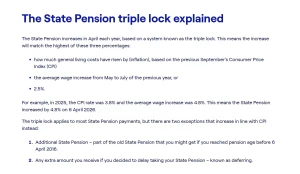
The State Pension triple lock uses average earnings growth, September CPI inflation and a minimum increase of 2.5% to determine annual pension uprating.
How Much Is the State Pension in 2026/27?
The full new State Pension increased by 4.8% from April 2026, while the full basic State Pension received the same percentage increase.
However, the cash increase differs because the two pensions have different starting rates.
| State Pension type | 2025/26 weekly rate | 2026/27 weekly rate | Annual increase |
| Full new State Pension | £230.25 | £241.30 | £574.60 |
| Full basic State Pension | £176.45 | £184.90 | £439.40 |
Annual increases are calculated using 52 weeks at the relevant weekly rates.
A person receiving the full new State Pension therefore receives £11.05 more per week than in the previous tax year.
For the full basic State Pension, the weekly increase is £8.45.
Our financial assessment highlights that the 4.8% headline increase should not be confused with a universal cash payment. Actual entitlement is affected by National Insurance records, historical pension arrangements and any additional pension components.
People born before 1960 may also want to understand the wider State Pension increases and additional support available to older pensioners, including the interaction with Pension Credit.
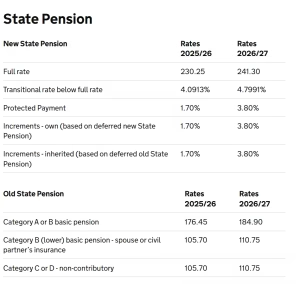
Official Department for Work and Pensions figures confirm the 2026/27 full new State Pension of £241.30 per week and basic State Pension of £184.90.
How Much Could the State Pension Increase in April 2027?
The State Pension is currently expected to increase by at least 3.9% in April 2027, following the release of the relevant average earnings figures in September 2026.
Official statistics show that total average weekly earnings, including bonuses, increased by 3.9% in the three months to July 2026 compared with the same period a year earlier.
Because this exceeds the 2.5% minimum guarantee, the earnings figure establishes the current indicative increase, subject to revisions and the outstanding September inflation figure.
The 3.9% figure would be used unless September CPI inflation proves higher.
Projected State Pension Rates for 2027/28
| Pension type | Current weekly rate | Projected weekly rate | Projected weekly increase |
| Full new State Pension | £241.30 | £250.70 | £9.40 |
| Full basic State Pension | £184.90 | £192.10 | £7.20 |
If these projected rates are adopted, the full new State Pension would reach approximately £13,036.40 when annualised at 52 weeks of the new rate.
The full basic State Pension would reach approximately £9,989.20 on the same basis.
However, an individual’s actual pension entitlement and taxable amount during the 2027/28 financial year may differ because the uprating takes effect part-way through the tax-year calculation.
The September 2026 CPI figure is scheduled for publication on 21 October 2026. It will determine whether inflation exceeds the 3.9% earnings figure.
Until that information is available, the projected amounts should not be described as confirmed government payment rates.
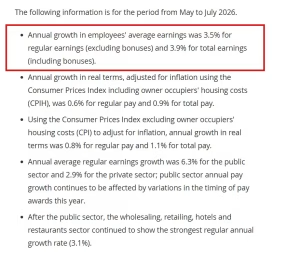
Official earnings statistics show 3.9% total average earnings growth for May to July 2026, providing the current basis for the projected April 2027 State Pension increase.
Is the State Pension Triple Lock Ending in 2030?
The existing State Pension triple lock is scheduled to remain in place until April 2030. However, the government announced plans on 29 September 2026 to introduce an adjusted uprating system from that point.
Under the proposed arrangement, annual pension increases would continue to be protected by the higher of CPI inflation or 2.5%.
There would also be a mechanism designed to maintain the State Pension’s value relative to average earnings over time.
This is an important distinction.
The government’s proposal is not simply to replace the existing triple lock permanently with a basic inflation-or-2.5% formula. The announced system also contains a longer-term connection to earnings.
How Would the Adjusted Triple Lock Work?
| Feature | Current triple lock | Proposed system from April 2030 |
| CPI inflation protection | Yes | Yes |
| Guaranteed minimum increase | 2.5% | 2.5% |
| Annual earnings growth comparison | Yes | No longer applied in the same way |
| Longer-term earnings protection | Achieved through annual comparison | Intended through an earnings-linked adjustment |
| Annual pension increases | Yes | Yes |
| Implementation status | Existing policy | Announced reform requiring legislation |
The key difference is how earnings growth affects annual increases.
Under the current policy, a single year of strong earnings growth can produce an equivalent State Pension increase, even when prices rise much more slowly.
Under the adjusted approach, earnings would remain relevant to the longer-term value of the pension, but not necessarily determine the increase in every individual year.
The detailed legislation and operational calculations are not yet finalised.
Why Is the Government Changing the Triple Lock?
The government has linked its proposed reforms to the financing of a new National Care Service.
Under the announcement, savings generated by changing the uprating mechanism would contribute towards the costs of improving social care for older people.
Government projections estimate that, compared with continuing the current triple lock, the adjusted arrangement could reduce annual State Pension expenditure by approximately:
- £15 billion in 2039/40, measured in nominal prices.
- £50 billion in 2049/50, measured in nominal prices.
Expressed in 2025/26 prices, the corresponding estimated savings are £11 billion and £30 billion.
These are long-term modelling estimates, not guaranteed savings. Actual outcomes will depend on inflation, wages, demographics and future government decisions.
For existing pensioners, slower growth in future payments relative to the current triple lock is different from an immediate reduction in the amount already being paid.
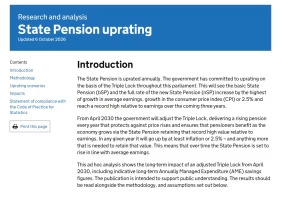
The government’s September 2026 State Pension uprating analysis explains the planned 2030 adjustment and its projected long-term financial effects.
Who Benefits From the State Pension Triple Lock?
The triple lock primarily benefits people receiving the UK’s basic or new State Pension who are eligible for annual uprating.
However, its financial effects vary across different groups.
Existing Pensioners
People currently receiving an eligible State Pension generally receive annual increases automatically.
For households depending heavily on State Pension income, these increases help protect essential spending on food, heating, transport and other living costs.
Employees Approaching Retirement
Workers approaching State Pension age may benefit from higher future pension rates.
However, the State Pension age is also changing, rising from 66 to 67 between 2026 and 2028.
That means some workers will reach entitlement later, even while the weekly pension rate continues to increase.
Anyone preparing to retire should review their pension age and forecast rather than assume that a higher headline State Pension guarantees an earlier retirement.
Self-Employed People and Business Owners
The triple lock also matters to self-employed professionals and company directors who rely on the State Pension as one component of their retirement income.
For example, a self-employed consultant who contributes to a private pension may view the State Pension as a foundation for covering essential retirement expenditure.
However, the triple lock does not directly increase a self-invested personal pension, workplace pension or other private retirement investments.
Private pension outcomes depend on contributions, investment performance, charges and the type of pension arrangement.
From a business financial-planning perspective, it is therefore important to consider the State Pension and private pension savings separately.
Does the Triple Lock Apply to Every Part of the State Pension?
No. One of the most common misunderstandings is that the triple lock increases every element of a pension payment by the same percentage.
The main flat-rate parts of the basic and new State Pension receive the triple-lock uprating.
However, other elements generally follow different rules.
| Pension component | Normal uprating arrangement |
| Full basic State Pension | Triple lock |
| Full new State Pension | Triple lock |
| Additional State Pension, including SERPS | CPI inflation |
| Protected payments above the full new State Pension | CPI inflation |
| Certain deferred pension increments | CPI inflation |
In April 2026, the headline pension rates increased by 4.8%, while several additional components increased by 3.8%, reflecting the relevant CPI figure.
Consequently, someone receiving a combination of basic and Additional State Pension may experience a different overall percentage increase from someone receiving the full new State Pension alone.
This distinction is particularly important when comparing the pension payments of two people who reached State Pension age at different times.
For women affected by historical contribution arrangements, the State Pension entitlement rules and payment calculations for women provide further context.
Will the State Pension Triple Lock Increase Income Tax?
The triple lock can increase the number of pensioners whose taxable income exceeds their Personal Allowance.
This happens because State Pension payments increase annually while the standard Income Tax Personal Allowance has remained frozen.
For the 2026/27 tax year, the standard Personal Allowance is £12,570.
The full new State Pension is £241.30 weekly, equivalent to £12,547.60 over 52 weeks at that rate.
That is just £22.40 below the standard Personal Allowance.
| Financial measure | Annualised amount |
| Standard Personal Allowance | £12,570.00 |
| Full new State Pension, 2026/27 | £12,547.60 |
| Difference below tax threshold | £22.40 |
| Projected new State Pension at £250.70 weekly | £13,036.40 |
| Projected amount above the current allowance | £466.40 |
The 2027/28 figure is an illustration based on 52 weeks at the projected rate. HMRC calculates actual taxable State Pension entitlement using the applicable rates during the tax year.
What Happens if Pensioners Have Other Income?
The State Pension is taxable income, although Income Tax is not normally deducted directly from the State Pension payment itself.
HMRC normally considers it alongside other taxable income, including workplace pensions, private pensions and earnings.
For example, a pensioner with an annualised State Pension of £12,547.60 and another £3,000 in taxable private pension income has total taxable income of £15,547.60.
Assuming the standard Personal Allowance applies and there are no other adjustments, £2,977.60 would fall above the allowance.
A 20% basic-rate calculation on that amount would produce approximately £595.52 in Income Tax.
This is an illustrative calculation rather than a personal tax assessment.
The government has separately committed to protecting people whose only income is their basic or new State Pension from small Income Tax bills arising when that pension passes the Personal Allowance. The detailed treatment from April 2027 remains subject to implementation.
Pensioners with additional income should not assume that this commitment exempts all their retirement earnings.
The interaction between frozen tax thresholds and rising pensions also explains why understanding how the Personal Allowance affects taxable income is increasingly important.
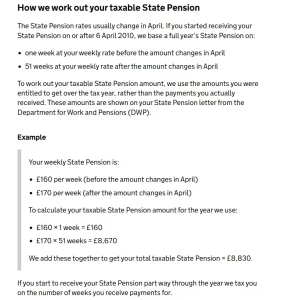
HMRC guidance explains that State Pension income is taxable and how it is assessed alongside other sources of income.
How Does the Triple Lock Affect Inflation and Purchasing Power?
A higher State Pension does not automatically mean that pensioners can afford substantially more goods and services.
The meaningful financial benefit depends on the relationship between pension increases and inflation.
For example, suppose the State Pension increases by 3.9% while annual inflation is 3.1%.
The approximate improvement in purchasing power would be 0.8 percentage points, while the inflation-adjusted gain is approximately 0.78%.
This is because the real increase can be calculated as:
Real income growth = [(1 + Pension increase) ÷ (1 + Inflation)] − 1
In this example, the State Pension rises faster than the overall price index.
However, an individual pensioner’s spending patterns may differ from the national inflation basket.
A household spending a substantial proportion of its income on heating or housing could experience a different cost increase from the reported national CPI rate.
Therefore, the triple lock protects the State Pension against the official inflation measure, but it cannot guarantee that every pensioner’s personal living costs will be fully covered.
Our analysis also suggests that headline increases should be considered alongside the effects of taxation, changes to means-tested benefits and household expenditure.
Why Is the State Pension Triple Lock Important for the UK Economy?
The triple lock has significant consequences beyond individual retirement income.
State Pension spending is one of the largest components of UK public expenditure.
The Institute for Fiscal Studies estimated that State Pension spending was around £154 billion in 2026/27.
That makes even small changes in the annual uprating percentage financially significant.
For example, a difference of one percentage point in the uprating rate can create substantial expenditure differences when applied across millions of pension payments.
Effects on Government Spending
The triple lock creates a predictable annual protection for eligible pension rates, but the cost to government is less predictable.
Inflation and wages can fluctuate significantly from one year to another.
Moreover, the increases compound over time. A comparatively high uprating in one year raises the starting amount on which future increases are calculated.
This means the effects of past uprating decisions can continue influencing government expenditure many years later.
Effects on Businesses and Consumer Spending
Higher State Pension payments can support consumer spending, particularly in communities with larger retired populations.
Pensioners regularly spend on supermarkets, transport, home maintenance, hospitality and local services.
Additional pension income may therefore support demand for certain goods and services.
However, our analysis does not identify a reliable single percentage by which business revenue rises following each State Pension increase.
The effect depends on local demographics, inflation, saving behaviour and how pensioners distribute their spending.
Effects on Younger Workers
The triple lock also raises questions about how retirement protection should be financed over the long term.
Younger workers pay taxes and National Insurance while also saving for their own retirement.
A growing pension bill may increase pressure on future public spending priorities and taxation.
Supporters of the policy argue that a predictable State Pension is important for retirement security. Critics question the long-term cost of a guarantee that can increase pension payments faster than either prices or earnings over successive years.
Both considerations are relevant when assessing intergenerational fairness and the sustainability of public finances.
How Can Pensioners Improve Their Retirement Income Beyond the Triple Lock?
Although the triple lock determines annual uprating, individuals may be able to improve their own retirement position through other arrangements.
The starting point should be identifying actual entitlement rather than relying solely on published full-rate figures.
Check National Insurance Contributions
The new State Pension normally requires at least 10 qualifying National Insurance years for any entitlement.
People starting their National Insurance records after April 2016 will generally need 35 qualifying years for the full new State Pension.
However, people with pre-2016 contribution histories may be affected by transitional and contracting-out rules, so 35 years does not guarantee the full amount in every case.
Some people can increase entitlement through National Insurance credits or voluntary contributions.
Paying to fill a contribution gap should not be treated as automatically worthwhile. A pension forecast should first establish whether an additional qualifying year would actually increase the eventual pension.
Review the State Pension Forecast
The official State Pension forecast service allows eligible users who have not yet claimed to check their estimated entitlement and National Insurance history.
Historical contracting-out information can affect pension calculations.
People concerned about discrepancies can also examine problems involving incorrect State Pension forecasts before making major retirement decisions.
Consider Pension Credit Eligibility
Pension Credit provides means-tested support for qualifying older households.
In 2026/27, the standard minimum income guarantee is £238 weekly for single pensioners and £363.25 for couples.
The final amount awarded depends on income, savings and other circumstances. Additional elements can apply.
Pension Credit is not part of the triple lock, and it should not be confused with an automatic top-up that every pensioner receives.
Qualifying pensioners may also receive additional assistance with housing, Council Tax or heating costs.
For example, Winter Fuel Payment eligibility and its income conditions may be relevant when preparing an annual retirement budget.
Assess Personal and Workplace Pensions
Employees and business owners may also benefit from reviewing private pension contributions.
Workplace pensions, personal pensions and self-invested personal pensions can provide retirement income in addition to the State Pension.
However, investment returns are not protected by the triple lock.
An effective retirement plan should therefore assess investment risk, tax treatment, access ages, charges and the amount of income required throughout retirement.
Does the State Pension Triple Lock Apply to People Living Abroad?
Not every UK State Pension recipient living overseas receives annual increases.
The government pays UK State Pensions to eligible recipients in many countries, but annual uprating depends on the country of residence and applicable international arrangements.
Annual increases are generally available in the European Economic Area, Switzerland and countries with qualifying social security agreements.
However, pensioners living in some countries, including Australia, Canada and New Zealand, do not normally receive annual UK State Pension increases.
These arrangements are often described as frozen pensions.
For example, a pensioner living in a country where annual uprating is not provided may continue receiving a historical weekly State Pension rate even after the headline UK rate increases.
For retirement planning, this is particularly important for people considering moving abroad.
The exchange rate, healthcare costs, tax residency and annual pension uprating rules should all be assessed before making a permanent relocation decision.
What Are the Main Advantages and Limitations of the Triple Lock?
The triple lock provides a clear form of income protection, but it also creates economic trade-offs.
| Advantages | Limitations |
| Protects against measured inflation | Does not reflect every household’s individual cost increases |
| Shares gains from earnings growth | Creates uncertainty in long-term government spending |
| Guarantees at least a 2.5% annual rise | Does not cover every pension component |
| Improves the State Pension over time | Does not guarantee adequate total retirement income |
| Supports confidence in retirement budgeting | Can bring more pensioners into the tax system |
| Helps eligible retirees maintain purchasing power | Does not provide annual uprating in every overseas country |
Our assessment is that the triple lock is best understood as an uprating mechanism rather than a complete retirement-income guarantee.
It helps maintain the value of eligible State Pension payments, but it does not determine whether a household has enough income to meet all of its living costs.
That depends on factors including savings, housing costs, health, pension entitlement and other income.
What Should Pensioners and Businesses Watch Next?
Several developments will determine the future financial significance of the triple lock.
The first is the September 2026 CPI release, scheduled for 21 October 2026. This will establish whether the April 2027 pension increase is governed by the 3.9% earnings figure or a higher inflation figure.
The second is the government’s detailed policy and legislation for the adjusted triple lock planned from April 2030.
The third is the treatment of State Pension income as more pensioners approach or exceed the frozen Personal Allowance.
Finally, businesses and individuals preparing long-term retirement forecasts should avoid assuming that the current triple-lock calculation will remain unchanged indefinitely.
Forecasting should distinguish confirmed pension rates from future projections and proposed policy changes.
What Does the Future Hold for the State Pension Triple Lock?
The State Pension triple lock remains a central part of the UK’s retirement-income system, providing annual increases based on earnings growth, inflation or a guaranteed minimum of 2.5%.
For 2026/27, the policy delivered a 4.8% increase, with the full new State Pension reaching £241.30 per week. The next increase is currently indicated to be at least 3.9%, subject to confirmation following the September 2026 inflation release.
Looking further ahead, the government’s planned April 2030 reforms could change how earnings growth affects annual pension increases.
For pensioners, workers and business owners, the most important consideration is to understand both the protection provided by the current policy and the financial implications of future changes. Regularly reviewing pension entitlements, tax exposure and private retirement savings remains essential for effective long-term financial planning.
Frequently Asked Questions About the State Pension Triple Lock
Is the State Pension triple lock guaranteed every year?
The current government has committed to the existing triple lock until April 2030. An adjusted system has been announced for the period after that, subject to legislation.
What is the minimum State Pension increase under the triple lock?
The minimum increase is 2.5% annually. If earnings growth or September CPI inflation is higher, the largest figure determines the increase.
Will the State Pension increase by 3.9% in April 2027?
At least 3.9% is currently indicated by the relevant earnings figures, but the final increase depends on September 2026 CPI inflation and confirmation of the rates.
Is the triple lock the same as Pension Credit?
No. The triple lock determines increases to eligible State Pension rates. Pension Credit is a separate, means-tested benefit for qualifying older households.
Do private pensions increase through the triple lock?
No. Private and workplace pensions have their own investment and uprating arrangements. The State Pension triple lock does not directly determine those increases.
Will pensioners lose money when the triple lock changes in 2030?
The proposed reform is designed to maintain annual pension increases, but future payments may grow more slowly than they would under the existing triple lock. The final effect depends on legislation and economic conditions.
Can a person receive more than the full new State Pension?
Yes. Certain protected payments and historical arrangements can result in entitlement above the standard full new State Pension rate.