
A woman’s State Pension in 2026/27 depends on her National Insurance record, date of birth and pension history, rather than her gender alone. Some women will receive the full amount, while others may receive less because of missing qualifying years, contracted-out employment or gaps in their NI record.
Older women can also be affected by historic rules linked to marriage, divorce, widowhood and caring responsibilities. This means the exact weekly amount can vary considerably from one woman to another.
The most accurate way to know what a woman is likely to receive is to check her State Pension forecast alongside her National Insurance record.
What Are the State Pension Rates for Women in 2026/27?
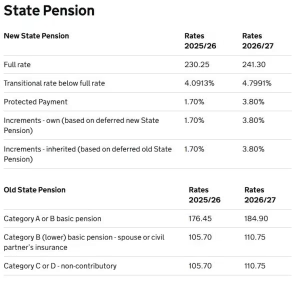
State Pension rates increased again from April 2026. The full new State Pension rose from £230.25 to £241.30 a week, while the full basic State Pension increased from £176.45 to £184.90 a week.
| State Pension Type | 2025/26 Rate | 2026/27 Rate |
| Full New State Pension | £230.25 | £241.30 |
| Full Basic State Pension | £176.45 | £184.90 |
| Lower Category B Basic Pension | £105.70 | £110.75 |
The lower Category B rate relates to particular people covered by historic State Pension rules. It should not be interpreted as a standard pension rate available to every married woman.
Someone reaching State Pension age should therefore not assume that she will automatically receive £241.30 each week. The full amount depends on her individual pension record.
Official UK State Pension rates for 2026/27, including the new and basic State Pension rates.
Which State Pension System Applies to a Woman?
A woman’s date of birth is one of the first things to check because the UK operates both the old basic State Pension and the newer State Pension system.
| Date Of Birth | Main Pension System |
| On Or After 6 April 1953 | New State Pension |
| Before 6 April 1953 | Basic State Pension |
The new State Pension generally depends on an individual’s own National Insurance record.
The old system is more complicated because entitlement can sometimes involve a spouse or civil partner’s National Insurance record, Additional State Pension and historic rules applying to married, divorced or widowed women.
For older pensioners, changes in the basic State Pension and legacy pension arrangements are particularly relevant to the wider State Pension boost before 1960, as the amount someone receives may include more than simply the headline basic pension rate.
How Many National Insurance Years Does a Woman Need for the Full State Pension?
The number of qualifying years required depends on which State Pension system applies.
It is therefore misleading to say that every woman simply needs 35 years of National Insurance contributions.
National Insurance Years Under the New State Pension
A person normally needs at least 10 qualifying years on their National Insurance record to receive any new State Pension.
For someone whose National Insurance record began after April 2016, 35 qualifying years are normally required to receive the full new State Pension.
Qualifying years can potentially be built through:
- Employment where sufficient National Insurance contributions are paid
- Self-Employment where the relevant conditions are met
- National Insurance Credits during eligible periods
- Parenting Or Caring where qualifying credits apply
- Voluntary Contributions used to fill eligible gaps
However, women with National Insurance histories that started before April 2016 can be affected by transitional rules.
Someone who was contracted out of the Additional State Pension before 2016 may need more than 35 qualifying years to reach the full £241.30 rate.
This is why simply counting qualifying years does not always provide an accurate State Pension estimate.
National Insurance Years Under the Basic State Pension
Different requirements apply to women covered by the old basic State Pension.
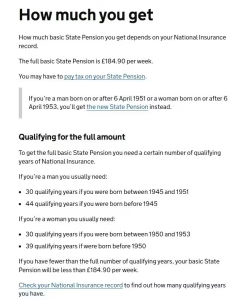
According to GOV.UK, a woman usually needs:
- 30 Qualifying Years if she was born between 1950 and 1953
- 39 Qualifying Years if she was born before 1950
A woman with fewer than the required number of qualifying years may receive less than the full £184.90 weekly basic State Pension.
GOV.UK qualifying National Insurance years required for women under the basic State Pension.
Why Might a Woman Get Less Than £241.30 a Week?
The £241.30 figure is the full new State Pension rate rather than a guaranteed payment for everyone.
A woman’s payment can be lower for several reasons:
- Too Few Qualifying Years: Her National Insurance record may not contain enough qualifying years
- Gaps in Her NI Record: Years spent outside employment may not always be fully covered by contributions or credits
- Contracting Out: Some workplace pension members paid lower National Insurance before April 2016
- Transitional Calculations: Pre-2016 pension rights are not always calculated using a straightforward 35-year formula
- Missing NI Credits: Child Benefit, caring or other eligible credits may not have been recorded correctly
- Historic Record Errors: Older contribution information can sometimes need correcting
Contracted-out years themselves still count as qualifying years, but being contracted out can affect the starting calculation under the new State Pension system.
A State Pension forecast is therefore more reliable than estimating entitlement solely from the number of years a woman remembers working.
Can a Woman Receive More Than £241.30 a Week?
Yes. £241.30 is the standard full new State Pension rate, but some people can receive more.
One reason is a protected payment.
When the new State Pension was introduced in April 2016, previous pension rights were taken into account. If someone’s entitlement under the old arrangements produced an amount above the standard new State Pension, the difference could be preserved as a protected payment.
Deferring a State Pension can also increase future payments.
For someone reaching State Pension age on or after 6 April 2016, regular pension payments can increase by 1% for every nine weeks of qualifying deferral. This is just under 5.8% for 52 weeks. At the full 2026/27 rate of £241.30, GOV.UK gives an example where 52 weeks of deferral produces approximately £13.99 extra per week.
Deferring is not automatically the best financial option for everyone, particularly where benefits, tax and personal circumstances need to be considered.
Do Years Spent Raising Children Or Caring Count Towards a Woman’s State Pension?
Time away from employment does not automatically mean a woman loses State Pension entitlement for those years.
National Insurance credits can protect the records of people who are eligible while raising children, caring for someone, unemployed or unable to work.
For older periods, Home Responsibilities Protection, or HRP, is particularly important.
HRP operated between 6 April 1978 and 5 April 2010. It was intended to protect the State Pension records of parents and carers and was later replaced by National Insurance credits.
A woman could have received HRP where, for example, she was awarded Child Benefit for a child under 16.
There is also a known historical problem affecting some Child Benefit records. If someone claimed Child Benefit before May 2000 but their National Insurance number was not recorded on the claim, the correct HRP may not appear on their National Insurance record. This can affect State Pension entitlement.
Women who believe qualifying caring or parenting years are missing should check their National Insurance record rather than assuming those years have been included correctly.
Could a Woman Have Been Underpaid Her State Pension?
Historic State Pension underpayments have affected tens of thousands of people, including married and widowed women.
The Department for Work and Pensions carried out a correction exercise covering several groups under the old State Pension system.
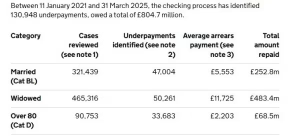
Between 11 January 2021 and 31 March 2025, DWP identified 130,948 underpayments, with a total of £804.7 million owed.
| Category | Underpayments Identified | Average Arrears Payment | Total Amount Repaid |
| Married, Category BL | 47,004 | £5,553 | £252.8 Million |
| Widowed | 50,261 | £11,725 | £483.4 Million |
| Over 80, Category D | 33,683 | £2,203 | £68.5 Million |
The largest average arrears payment shown in this exercise was for the widowed group at £11,725.
The figures do not mean every married or widowed woman has been underpaid. They do show why people covered by historic pension rules should not necessarily assume an older award has always been calculated correctly.
DWP State Pension underpayment figures for married, widowed and over-80 pensioners.
What Should a Woman Do If Home Responsibilities Protection Is Missing?
A woman who believes HRP is missing should first check her National Insurance record.
If she received Child Benefit before May 2000 and the relevant years are absent, she may be able to apply to HMRC for the missing protection to be added.
GOV.UK says that a successful correction can increase a person’s State Pension or leave it unchanged. It should not reduce the pension.
The application may require information such as children’s names and dates of birth, depending on the reason HRP is being claimed.
How Does Marriage Affect a Woman’s State Pension?
Marriage affects the new and old State Pension systems differently.
Women Under the New State Pension
The new State Pension is primarily based on an individual’s own National Insurance record.
Getting married does not generally mean a woman automatically receives part of her husband’s £241.30 State Pension. Her own contribution and credit history is normally what determines her standard entitlement.
There are limited transitional and inheritance rules involving older pension rights, but these should not be confused with a general rule giving every married woman a fixed percentage of her spouse’s pension.
Women Under the Old Basic State Pension
Historic rules can be more important for women who reached State Pension age under the old system.
Some married women with limited pension entitlement in their own right could qualify for an increased basic State Pension based on a spouse or civil partner’s National Insurance contribution record.
At 2026/27 rates, the maximum lower Category B basic pension is £110.75 per week where the relevant conditions are satisfied. Royal London notes that this is 60% of the full £184.90 basic State Pension.
These are legacy rules. They should not be applied to women receiving the modern new State Pension without checking whether the relevant transitional conditions are met.
Does the Married Woman’s Stamp Affect State Pension?
Some older women may remember the Married Woman’s Reduced Rate Election, often informally called the married woman’s stamp.
Women who chose this arrangement paid National Insurance at a reduced rate and could be affected by special State Pension rules later.
For qualifying women, GOV.UK states that special transitional rules can produce an amount broadly equivalent to:
- £110.75 A Week where the woman is married and the qualifying conditions involving her husband are met
- £184.90 A Week in qualifying widowhood or divorce circumstances
Additional State Pension built up before 6 April 2016 can potentially be added to this amount.
These provisions apply only to particular historic cases. They do not mean women can newly choose to pay the married woman’s reduced National Insurance rate today.
What Happens To a Woman’s State Pension After Divorce?
Divorce can be relevant under the old State Pension rules.
For a divorced woman covered by those arrangements, the National Insurance record of an ex-spouse or ex-civil partner may sometimes be substituted for her own record up to the date of the divorce when calculating basic State Pension entitlement.
Where a woman has been divorced more than once, Royal London explains that the record of the most recent former spouse or civil partner normally applies for this calculation.
This is an old-system provision and should not be interpreted as meaning every divorced woman under the new State Pension can claim a share of an ex-husband’s pension.
What Happens To a Woman’s State Pension If She Is Widowed?
Widowhood can affect State Pension entitlement, particularly where either spouse has pension rights under the old system.
Under qualifying historic rules, a widow may be able to substitute the National Insurance contribution record of her late spouse or civil partner when calculating her basic State Pension.
Royal London explains that if the late spouse had a full contribution record, the widow may in many old-system cases qualify for up to 100% of the basic State Pension, rather than the lower amount that may have applied while the couple were married.
Depending on the circumstances, a surviving spouse may also be able to inherit certain:
- Additional State Pension Rights
- Protected Payments
- Deferred State Pension Entitlement
The exact rules depend heavily on when both partners reached State Pension age and the pension rights they built up.
What Is the Over-80 Pension for Women?
The Over-80 Pension is another old-system provision and should not be confused with the lower Category B married person’s pension.
For 2026/27, the Category D non-contributory rate is £110.75 per week.
Under the old rules, a person may potentially qualify where:
- They Are Aged 80 Or Over
- Their Basic State Pension Is Below £110.75 A Week Or They Receive No Basic State Pension
- They Meet The Relevant UK Residence Conditions
- They Reached State Pension Age Before 6 April 2016
Royal London states that qualifying people generally need to have been resident in England, Scotland or Wales for at least 10 years out of a specified 20-year period and meet the ordinary residence conditions.
The identical £110.75 figure can make the rules confusing, but Category D and the lower Category B pension are separate provisions.
At What Age Can a Woman Claim the State Pension in 2026?
Women no longer have a separate State Pension age from men.
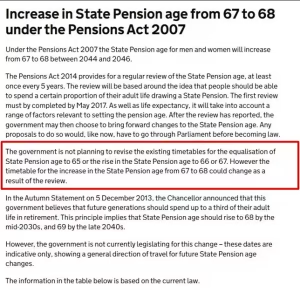
The State Pension age is now beginning its legislated increase from 66 to 67, with the change being phased in between 2026 and 2028.
This means it is no longer accurate to assume that every woman reaching retirement age in 2026 can claim State Pension automatically on her 66th birthday.
For people born between 6 April 1960 and 5 March 1961, the age rises gradually.
| Date Of Birth | State Pension Age |
| 6 April 1960 To 5 May 1960 | 66 Years And 1 Month |
| 6 May 1960 To 5 June 1960 | 66 Years And 2 Months |
| 6 June 1960 To 5 July 1960 | 66 Years And 3 Months |
| 6 July 1960 To 5 August 1960 | 66 Years And 4 Months |
| 6 August 1960 To 5 September 1960 | 66 Years And 5 Months |
| 6 September 1960 To 5 October 1960 | 66 Years And 6 Months |
| 6 October 1960 To 5 November 1960 | 66 Years And 7 Months |
| 6 November 1960 To 5 December 1960 | 66 Years And 8 Months |
| 6 December 1960 To 5 January 1961 | 66 Years And 9 Months |
| 6 January 1961 To 5 February 1961 | 66 Years And 10 Months |
| 6 February 1961 To 5 March 1961 | 66 Years And 11 Months |
| 6 March 1961 Onwards Within The Legislated Range | 67 |
The exact State Pension date therefore needs to be checked using the person’s full date of birth.
Official State Pension age timetable showing the increase from 66 to 67 between 2026 and 2028.
Why Did the State Pension Increase in April 2026?
The full new State Pension increased by 4.8% for 2026/27, rising from £230.25 to £241.30 per week.
The full basic State Pension similarly increased from £176.45 to £184.90.
The new and basic State Pensions are protected by the Triple Lock under current policy. The relevant pension rate rises by the highest of:
- Average Earnings Growth
- Consumer Prices Index Inflation
- 5%
GOV.UK confirms these three measures as the basis for annual increases to the new State Pension.
The effect of this mechanism extends beyond a single tax year because future uprating can significantly change retirement income over time. The State Pension Triple Lock therefore remains an important factor when considering both the current 2026 rate and how pension payments could change in future years.
Is a Woman’s State Pension Taxable in 2026/27?
Yes. State Pension is taxable income.
Tax is not normally deducted from the State Pension before it is paid. Instead, HMRC considers the pension together with other taxable income to determine whether Income Tax is due.
The standard Personal Allowance for 2026/27 is £12,570.
The full new State Pension over 52 weeks is:
£241.30 × 52 = £12,547.60
That leaves only £22.40 between the simple 52-week equivalent and the standard £12,570 Personal Allowance.
However, HMRC’s actual taxable State Pension calculation can differ from simply multiplying the current weekly rate by 52 because pension rates normally change during the tax year and HMRC uses the amount a person was entitled to receive.
Other taxable income can include:
- Workplace Pension Income
- Personal Pension Income
- Employment Or Self-Employment Income
- Rental Income
- Taxable Savings And Investment Income
- Certain Taxable Benefits
A woman receiving the full State Pension plus other taxable income may therefore have an Income Tax liability even where the State Pension itself is paid without tax being deducted.
Can a Woman Receive Pension Credit As Well As State Pension?
Yes. State Pension and Pension Credit are different payments.
Pension Credit is means-tested and can provide additional support to people over State Pension age with lower incomes.
For 2026/27, Guarantee Credit can top weekly income up to:
| Circumstance | 2026/27 Standard Amount |
| Single Person | £238.00 A Week |
| Couple | £363.25 A Week |
These are standard minimum levels. A person with income above these figures can sometimes still qualify where additional amounts or circumstances apply, such as disability, caring responsibilities or certain housing costs.
State Pension counts as income when Pension Credit entitlement is assessed.
Receiving less than the full £241.30 State Pension therefore does not automatically mean someone will receive Pension Credit, but women on lower retirement incomes may benefit from checking eligibility.
How Can a Woman Check Exactly How Much State Pension She Will Get?
The headline £241.30 rate is useful, but the only reliable way to understand an individual’s position is to check her own records.
A woman approaching State Pension age should consider the following:
- Check Her State Pension Age: The transition from 66 to 67 means the exact claim date depends on date of birth.
- Get A State Pension Forecast: The forecast shows how much State Pension she is currently expected to receive.
- Check Her National Insurance Record: Look at the number of qualifying years and any incomplete years.
- Check Parenting And Caring Credits: Child Benefit, National Insurance credits and historic HRP can affect entitlement.
- Investigate Missing HRP: This is particularly relevant where Child Benefit was claimed before May 2000.
- Check Contracted-Out Employment: Workplace pension membership before April 2016 can affect the new State Pension calculation.
- Consider Historic Marriage Rules: Women covered by the old system may need to consider spouse-based entitlement.
- Check Divorce Or Widowhood Rights: Old-system pension calculations can change following divorce or the death of a spouse or civil partner.
- Check Before Paying Voluntary NI: Filling a National Insurance gap does not always increase the State Pension, particularly for people affected by transitional rules.
GOV.UK recommends using a State Pension forecast to see both the expected pension amount and relevant National Insurance information.
Frequently Asked Questions
How Much Is the Full State Pension for a Woman in 2026?
The full new State Pension is £241.30 per week for 2026/27. The actual amount a woman receives depends on her National Insurance record and pension history.
Do Women Get the Same State Pension as Men?
Yes. There is no separate modern State Pension rate based on gender. Historic rules can still produce different outcomes for some women covered by the old pension system.
How Many NI Years Does a Woman Need for a Full State Pension?
Someone whose National Insurance record began after April 2016 normally needs 35 qualifying years for the full new State Pension. Different rules can apply to pre-2016 records.
Can a Woman Get a State Pension With Less Than 35 Years of NI?
Yes. At least 10 qualifying years are normally required to receive any new State Pension, although fewer than 35 years will generally result in a lower amount where the record began after April 2016.
Can a Married Woman Claim On Her Husband’s State Pension?
Under the new State Pension, entitlement is generally based on the woman’s own NI record. Some women covered by older pension rules can have entitlement linked to their spouse or civil partner’s contribution history.
Can a Divorced Woman Claim Using Her Ex-Husband’s NI Record?
Under qualifying old State Pension rules, a divorced woman may be able to substitute her former spouse’s NI record up to the date of divorce when her basic State Pension is calculated.
Can a Woman Get More Than £241.30 a Week?
Yes. Protected pre-2016 pension rights or increases resulting from State Pension deferral can result in payments above the standard full new State Pension rate.