

For years, many UK retirement advisers encouraged people to spend their ISA savings before withdrawing money from their private pensions.
The reasoning was largely based on inheritance tax: pension funds could often be passed to beneficiaries outside the deceased person’s taxable estate, while ISAs generally formed part of that estate.
However, significant changes to UK inheritance tax rules have challenged this traditional retirement strategy.
From 6 April 2027, most unused pension funds and pension death benefits will be included in inheritance tax calculations, potentially increasing the amount families pay when someone dies.
This has encouraged some retirees to consider spending their pensions before their ISAs, particularly those hoping to reduce the inheritance tax burden on their children.
But does withdrawing pension money first genuinely improve the financial outcome?
Our analysis of the tax rules and published retirement-planning research suggests that the answer depends heavily on personal income tax rates, beneficiaries’ circumstances, investment returns and the value of the estate.
Research reported by investment platform AJ Bell demonstrates that prioritising pension withdrawals could, under certain assumptions, leave beneficiaries approximately £225,000 worse off despite reducing the inheritance tax bill.
Meanwhile, the Financial Conduct Authority reported that £91.24 billion was withdrawn from pension pots during 2025–26, representing a 21.7% increase compared with the previous year.
These figures illustrate why the decision is becoming increasingly important for households approaching retirement.
Should You Spend Your Pension Before Your ISA?
Spending a pension before an ISA can be beneficial in certain circumstances, but it is not automatically the most tax-efficient retirement strategy.
Private pension withdrawals are generally subject to income tax after any available tax-free entitlement has been used. By contrast, withdrawals from an ordinary Cash ISA or Stocks and Shares ISA do not attract income tax or capital gains tax.
From April 2027, both unused pension funds and ISA investments can potentially contribute to inheritance tax liabilities.
The main differences are:
| Financial Consideration | Spending Pension First | Spending ISA First |
| Income tax on withdrawal | Usually payable on taxable pension withdrawals | No income tax |
| Tax-free withdrawal allowance | Usually up to 25%, subject to limits | Entire eligible ISA withdrawal is tax-free |
| Inheritance tax from April 2027 | Most unused pension funds included in estate calculations | ISA assets normally included in estate |
| Future investment growth | Less pension wealth remains invested | More pension wealth remains invested |
| Impact on annual taxable income | Can increase taxable income significantly | Normally no increase |
| Financial flexibility | Subject to pension access rules | Generally accessible, subject to account terms |
| Potential benefit for heirs | May reduce future taxable pension wealth | May preserve more capital through lower withdrawal taxes |
The key consideration is not simply which account generates the smallest inheritance tax bill.
It is which combination of withdrawals leaves the retiree financially secure while preserving the greatest possible after-tax family wealth.
Why Are Retirees Reconsidering the Order of Pension and ISA Withdrawals?
The traditional approach to retirement withdrawals was influenced by the favourable inheritance tax treatment of defined contribution pension schemes.
Historically, many discretionary pension death benefits were excluded from the deceased person’s estate for inheritance tax purposes.
For individuals with substantial pension pots, this created an opportunity to preserve pension investments while funding retirement through savings accounts, ISAs and other assets.
That strategy became less straightforward after the government announced changes to pension inheritance tax in the October 2024 Budget.
The legislation was subsequently introduced through Finance Act 2026, with the principal changes taking effect from 6 April 2027.
According to HMRC’s estimates published in November 2025:
- Approximately 10,500 estates are expected to become liable for inheritance tax that would not otherwise have been payable.
- Around 38,500 estates are expected to face higher inheritance tax liabilities.
- The average additional inheritance tax liability among affected estates is estimated at approximately £34,000.
These estimates are based on projected estate values and do not fully account for behavioural changes in retirement withdrawals.
Retirees may respond by increasing pension withdrawals, gifting assets earlier or changing how they structure their retirement income.
However, withdrawing pension funds without calculating the income tax consequences can prove expensive.
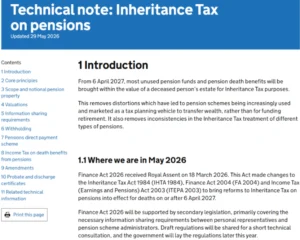
HMRC confirms that most unused pension funds and pension death benefits will enter inheritance tax calculations from 6 April 2027.
What Are the Main Tax Implications of Spending a Pension Before an ISA?
Three major tax considerations determine whether pension-first withdrawals are financially worthwhile: income tax during retirement, inheritance tax after death and the investment growth sacrificed when money is withdrawn.
1. Income Tax on Pension Withdrawals
Most individuals can take up to 25% of their qualifying pension savings as tax-free cash, usually subject to a standard lump sum allowance of £268,275.
The remaining pension withdrawals are generally added to taxable income.
This means somebody receiving the State Pension, rental income or workplace pension payments could face higher tax deductions when making additional pension withdrawals.
For example, a retiree already paying income tax at 40% who withdraws £50,000 entirely from the taxable portion of a pension would ordinarily pay £20,000 in income tax on that withdrawal, assuming the entire amount falls within the same tax band.
They would retain £30,000.
Withdrawing the same £50,000 from an ordinary ISA would not create an income tax charge.
This difference becomes particularly important when someone makes repeated withdrawals over several years.
The standard Personal Allowance remains £12,570 for 2026–27, although it may be reduced for higher-income individuals.
The interaction between taxable pension income and available allowances is explored further in our analysis of the HMRC Personal Allowance and tax-free savings rules.
Scottish taxpayers should also account for Scotland’s separate income tax bands on pension income.
2. Inheritance Tax on Remaining Pension Savings
From April 2027, most unused pension funds will be considered when calculating the inheritance tax liability of an estate.
The standard inheritance tax rate is 40% on the taxable estate above available thresholds, subject to exemptions and reliefs.
The principal thresholds include:
| Inheritance Tax Allowance | Amount |
| Standard nil-rate band | £325,000 |
| Residence nil-rate band, where eligible | £175,000 |
| Potential combined allowance for an individual | £500,000 |
| Potential combined allowance for qualifying married couples or civil partners | £1,000,000 |
| Standard inheritance tax rate | 40% |
| Estate value at which residence nil-rate band taper begins | £2 million |
The £1 million allowance for couples is not automatic. It depends on the availability and transferability of the relevant allowances, together with the qualifying property conditions.
The residence nil-rate band is also reduced by £1 for every £2 that the estate exceeds £2 million.
This is especially relevant to wealthier households whose combined pensions, property and investments may exceed that threshold.
3. Lost Investment Growth
Tax is only one part of the retirement withdrawal calculation.
When money is withdrawn from a pension, that capital can no longer generate investment returns within the pension unless it is replaced through further permitted contributions.
Consider £100,000 left invested for 15 years at an assumed annual growth rate of 5%.
Its theoretical value would increase to approximately £207,900 before charges.
If that capital is withdrawn and spent immediately, the opportunity to achieve those returns disappears.
Although investment performance is uncertain and returns are never guaranteed, the compounding effect can materially change the inheritance ultimately received by beneficiaries.
This explains why comparing income tax and inheritance tax alone may produce a misleading conclusion.
How Will the April 2027 Pension Inheritance Tax Rules Work?
Under the new rules, most unused pension savings will be treated as part of the deceased person’s estate for inheritance tax purposes.
The changes principally affect deaths occurring on or after 6 April 2027.
An individual who dies before that date will generally remain subject to the previous rules, even if their pension benefits are distributed after the implementation date.
The reforms will affect many defined contribution pensions, including personal pensions, workplace defined contribution arrangements and SIPPs.
Certain benefits remain excluded, including qualifying death-in-service benefits and specified dependant pension benefits.
The new rules also preserve relevant inheritance tax exemptions for qualifying transfers to spouses, civil partners and charities.
HMRC’s official technical explanation of inheritance tax on pensions provides the legislative background and implementation arrangements.
Who Will Be Responsible for Paying the Tax?
Personal representatives administering an estate will generally be responsible for reporting and paying the inheritance tax due.
Where pension benefits are included in the calculation, additional information will need to be obtained from pension scheme administrators.
The new arrangements also allow certain pension benefits to be withheld or used directly to settle inheritance tax liabilities.
This introduces an administrative consideration for families dealing with an estate containing multiple pension arrangements.
Retirees with several pensions should therefore maintain accurate records of pension providers, scheme details and beneficiary nominations.
Could Beneficiaries Pay Both Inheritance Tax and Income Tax on a Pension?
Yes. In some circumstances, inherited pension money may be exposed to both inheritance tax and income tax.
However, the outcome depends on the age of the pension holder at death, the beneficiary’s tax position, the type of pension benefit and the available estate exemptions.
The distinction between death before and after age 75 is particularly important.
| Age at Death | Inheritance Tax From April 2027 | Income Tax for Beneficiaries |
| Under 75 | May apply where the estate is taxable | Many qualifying pension benefits can be income-tax-free, subject to conditions and allowances |
| 75 or older | May apply where the estate is taxable | Inherited pension withdrawals are generally taxable at the beneficiary’s applicable rate |
Where inheritance tax has already been paid on pension death benefits, HMRC’s rules are designed to ensure that the amount used to settle that tax is not also treated as taxable pension income for the beneficiary.
Example: A £100,000 Inherited Pension
Imagine that a £100,000 pension death benefit is fully exposed to inheritance tax at 40%, with no available exemptions or nil-rate band to shelter it.
The calculations could look like this:
| Calculation | Basic-Rate Beneficiary | Beneficiary Taxed at 45% |
| Pension death benefit | £100,000 | £100,000 |
| Inheritance tax at 40% | £40,000 | £40,000 |
| Amount remaining | £60,000 | £60,000 |
| Illustrative income tax on remaining amount | £12,000 | £27,000 |
| Net inheritance received | £48,000 | £33,000 |
| Combined effective tax burden | 52% | 67% |
This is a simplified illustration assuming the deceased dies aged 75 or older, the full benefit bears 40% inheritance tax and the remaining taxable pension income is wholly subject to the specified beneficiary tax rate.
It does not mean every inherited pension will lose 52% or 67% to taxation.
In practice, estate allowances, spouse exemptions, the beneficiary’s income and the timing of pension withdrawals can substantially alter the outcome.
For beneficiaries, spreading taxable inherited pension withdrawals over multiple tax years may sometimes reduce the income tax liability compared with taking the entire balance immediately.
Could Spending Your Pension First Leave Your Family £225,000 Worse Off?
Recent financial modelling reported by AJ Bell demonstrates why minimising inheritance tax does not necessarily maximise the amount beneficiaries receive.
The illustrative case considers a retiree with:
| Financial Detail | Illustrative Amount |
| Private pension | £1,500,000 |
| ISA investments | £1,000,000 |
| Combined savings | £2,500,000 |
| Annual retirement income required after tax | £50,000 |
| Retirement period | 15 years |
| Retiree’s assumed income tax position | Higher-rate taxpayer |
| Beneficiary’s income tax position | Basic-rate taxpayer |
The analysis compared two different withdrawal strategies: spending pension money first and spending ISA investments first.
Although pension-first withdrawals reduced the eventual inheritance tax bill by almost £30,000, the analysis indicated that beneficiaries could nevertheless receive approximately £225,000 less.
The ISA-first strategy produced a final inheritance exceeding £2 million, compared with approximately £1.8 million under the pension-first approach.
The difference reflects the combined effect of income tax paid during retirement and the investment growth no longer achieved on withdrawn pension assets.
Josh Croft, of AJ Bell, captured the central issue:
“A smaller tax bill doesn’t necessarily mean a bigger inheritance.”
His observation highlights a common weakness in inheritance-focused retirement planning.
Paying income tax earlier to avoid a potential inheritance tax liability later does not always improve the family’s overall financial position.
These figures represent a particular modelling scenario, not a guaranteed £225,000 loss for everyone who spends their pension first. Different retirement periods, investment performance, tax rates and estate structures could produce very different results.
How Much Pension Must You Withdraw to Receive the Same Income as an ISA?
A useful way to compare pension and ISA withdrawals is to calculate how much gross capital is required to fund a particular amount of spending.
Suppose a retiree needs £30,000 after tax.
If the money comes from an ordinary ISA, the withdrawal can be exactly £30,000.
If it comes from the taxable portion of a pension, the gross withdrawal may need to be considerably larger.
| Source of Retirement Income | Gross Withdrawal Required | Illustrative Income Tax | Net Income |
| ISA | £30,000 | £0 | £30,000 |
| Taxable pension at 20% | £37,500 | £7,500 | £30,000 |
| Taxable pension at 40% | £50,000 | £20,000 | £30,000 |
| Taxable pension at 45% | Approximately £54,545 | Approximately £24,545 | £30,000 |
These calculations assume that the entire pension withdrawal falls within one specified tax band and that no additional tax-free pension cash is available.
Real-world tax calculations may involve multiple bands, allowances and different Scottish rates.
Nevertheless, the underlying principle is clear.
A retiree paying higher-rate income tax could need to withdraw significantly more pension capital than ISA capital to meet the same living expenses.
That difference can accumulate substantially over a retirement lasting 20 or 30 years.
When Could Spending a Pension Before an ISA Make Financial Sense?
Although pension-first withdrawals are not universally beneficial, several circumstances may justify this approach.
Retirees With Lower Income Tax Rates
Individuals who can withdraw pension income while remaining within their Personal Allowance or lower tax bands may reduce the cost of accessing their pension.
For example, someone retiring before reaching State Pension age may have several years with relatively little taxable income.
Using some pension savings during those years could be more tax-efficient than waiting until State Pension payments begin and consume part of the available Personal Allowance.
Families With Beneficiaries Paying Higher Tax Rates
The tax position of beneficiaries can also change the calculation.
Andy Butcher, of Raymond James, has highlighted that where beneficiaries pay additional-rate income tax, retirees may have opportunities to withdraw pension funds at lower personal tax rates and potentially make gifts.
However, this depends on whether the assets can be transferred efficiently and whether the retiree can afford to give them away.
A beneficiary paying a higher tax rate is not, by itself, a reason to accelerate pension withdrawals.
Retirees With Substantial Wealth Outside Their Pensions
For households with considerable property wealth, investments and other financial assets, there may be greater flexibility to withdraw pension money without threatening retirement security.
The position is different for someone whose pension represents the majority of their available resources.
Andrew Tully, of Nucleus Financial, has cautioned that changing retirement withdrawal strategies must be balanced against the need to maintain sufficient income in later life.
This consideration becomes increasingly important when accounting for inflation, healthcare expenses and potential care costs.
When Is Spending an ISA Before a Pension More Tax-Efficient?
ISA-first withdrawals may be advantageous where pension withdrawals would otherwise create significant income tax liabilities.
This can apply particularly to higher-rate taxpayers who already receive substantial taxable retirement income.
Preserving the pension may allow the remaining investments to continue growing within the tax-advantaged pension arrangement.
Meanwhile, using ISA money allows the retiree to meet spending requirements without immediately increasing taxable income.
However, the ISA-first approach should also be assessed against the potential inheritance tax liability on the remaining pension under the 2027 rules.
The most efficient withdrawal strategy may therefore involve using a combination of accounts.
| Retirement Situation | Strategy Worth Considering | Main Reason |
| Retiree with unused Personal Allowance | Pension withdrawals | Opportunity to use available tax-free income |
| Higher-rate taxpayer | ISA withdrawals or blended approach | Avoid unnecessarily high pension withdrawal tax |
| Large estate exposed to IHT | Model pension withdrawals and gifts | Potential estate reduction |
| Beneficiaries paying additional-rate tax | Compare earlier withdrawals with inherited pension taxation | Different marginal tax rates |
| Retiree with limited savings | Preserve adequate pension income | Long-term financial security |
| Individual retiring before State Pension age | Phased pension withdrawals | Potentially lower-income retirement years |
No single approach is guaranteed to produce the best outcome for every household.
Is Taking the 25% Tax-Free Pension Lump Sum a Better Option?
Taking tax-free pension cash can be an important component of retirement planning, but it should not be confused with a guaranteed inheritance tax saving.
Under the general rules, individuals can normally take up to 25% of their qualifying pension savings tax-free, subject to the standard lump sum allowance of £268,275 unless protected rights apply.
For example, someone with a £400,000 eligible pension could potentially take £100,000 as tax-free cash.
However, withdrawing the money does not automatically remove it from their estate for inheritance tax purposes.
If the £100,000 is transferred into a bank account or ISA and remains owned by the individual at death, it will ordinarily still be included in the estate calculation.
A more meaningful inheritance tax reduction may occur where the money is genuinely spent or gifted under qualifying rules.
But that brings its own financial and tax considerations.
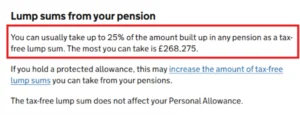
GOV.UK explains the standard 25% tax-free pension lump sum and the £268,275 lump sum allowance.
Why Phased Pension Withdrawals May Be More Effective?
Instead of taking all available tax-free cash immediately, some retirees can access their pensions in stages.
This can help preserve investment flexibility and control taxable income.
Depending on the arrangement, phased crystallisation or uncrystallised funds pension lump sums can provide access to tax-free cash alongside taxable pension payments.
However, certain types of flexible pension withdrawals can trigger the Money Purchase Annual Allowance.
For 2026–27, the Money Purchase Annual Allowance is £10,000, restricting the amount of future tax-relieved defined contribution pension saving without triggering an annual allowance charge.
Someone who continues working or contributing to a pension should consider this before making taxable flexible withdrawals.
Can Gifting Pension Withdrawals Reduce Inheritance Tax?
Gifting is another option for individuals who want to reduce the value of their estate.
Instead of retaining pension withdrawals in personal accounts, retirees may transfer money to family members during their lifetime.
However, the tax treatment depends on the type and timing of the gifts.
Annual Gift Allowances
HMRC provides several inheritance tax exemptions.
| Type of Gift | Exemption |
| Annual gift exemption | £3,000 per tax year |
| Small gifts | Up to £250 per recipient, subject to conditions |
| Wedding gift to a child | £5,000 |
| Wedding gift to a grandchild or great-grandchild | £2,500 |
| Wedding gift to another person | £1,000 |
| Qualifying regular gifts from surplus income | No fixed monetary ceiling |
| Other qualifying outright lifetime gifts | Potentially outside the estate after seven years |
The £3,000 annual exemption can be carried forward for one tax year if unused.
Couples may each use their own annual exemptions.
Gifts Out of Normal Expenditure
Regular gifts made from surplus income may qualify for an inheritance tax exemption without the same seven-year waiting period.
For example, a retiree receiving consistent pension income might make regular contributions towards a grandchild’s education.
To qualify, the payments must generally form part of the person’s normal expenditure, be made from income and leave sufficient income to maintain their usual standard of living.
An important distinction exists between recurring pension income and capital withdrawals from pension funds.
Not every lump sum taken from a pension automatically qualifies as income for the purposes of this exemption.
Retirees should maintain detailed records of income, expenditure and gifts and seek specialist advice where substantial sums are involved.
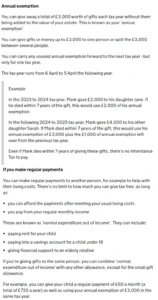
HMRC explains the £3,000 annual inheritance tax gift exemption and qualifying gifts made from regular income.
Should Pension Withdrawals Be Placed Into a Trust?
Some families may explore trusts as part of broader estate planning.
However, placing money into a trust does not automatically remove inheritance tax liabilities.
Different trust structures can create immediate tax charges, periodic inheritance tax charges and administrative obligations.
The decision should reflect the family’s financial objectives, including asset ownership, beneficiary rights and access restrictions.
Our examination of common mistakes when setting up a family trust fund explains why selecting the appropriate legal arrangement matters as much as the potential tax advantage.
How Did Budget 2026 Change ISA Tax Planning?
The Budget announced on 28 October 2026 introduced important developments for savers.
One of the most significant was the reversal of the previously planned reduction in the Cash ISA allowance.
The earlier proposal would have limited annual Cash ISA subscriptions to £12,000 for people under 65 from April 2027.
The government has now reversed that plan, retaining the £20,000 annual Cash ISA limit.
The Budget also announced higher income tax rates on taxable savings income outside ISAs from 6 April 2027.
| Savings Income Tax Rate | Current Standard Rate | Announced Rate From April 2027 |
| Basic savings rate | 20% | 24% |
| Higher savings rate | 40% | 44% |
| Additional savings rate | 45% | 49% |
These new rates will apply to taxable savings income, rather than ordinary tax-free ISA interest.
They should not be confused with the rates applied to pension withdrawal income.
The announced changes strengthen the case for considering ISA allowances and savings taxation alongside pension drawdown decisions.
For example, a retiree who withdraws pension money and deposits it in an ordinary taxable savings account could face income tax when withdrawing the pension and potentially further tax on subsequent savings interest.
That outcome may be less attractive than leaving pension assets invested or maintaining savings within an ISA.
However, placing withdrawn pension money into an ISA remains subject to ISA subscription limits and does not automatically eliminate future inheritance tax.
The Budget position is set out in the government’s official Budget 2026 publication.
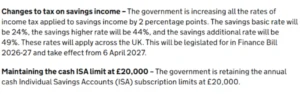
Budget 2026 confirms that the Cash ISA allowance will remain at £20,000 and sets out higher savings income tax rates from April 2027.
Does an ISA Become Taxable When Someone Dies?
An ISA’s income tax advantages do not mean that its balance is automatically exempt from inheritance tax.
Cash and investments held in an ISA normally form part of the deceased account holder’s estate.
However, ISAs can generally continue receiving income tax and capital gains tax protection during a limited estate administration period.
Surviving spouses and civil partners may also qualify for an Additional Permitted Subscription, allowing additional ISA contributions linked to the deceased partner’s ISA value, subject to HMRC’s conditions.
This can help preserve the tax-efficient savings position of the surviving partner.
The spouse or civil partner inheritance tax exemption can also be relevant, making the tax position of married couples different from that of unmarried partners.
These distinctions should be considered when designing a family retirement strategy.
What Other Factors Should Influence Pension and ISA Withdrawal Decisions?
Tax calculations are important, but they should not determine retirement decisions in isolation.
State Pension Income
State Pension payments are generally taxable, even though tax is not normally deducted directly before payment.
As an individual’s State Pension income increases, it may use more of their Personal Allowance and affect the rate charged on private pension withdrawals.
For couples, the total income position can be particularly important.
The discussion of State Pension entitlement for married couples provides additional context on how separate entitlements influence household retirement income.
Long-Term Care and Emergency Expenses
A retiree who withdraws pension savings rapidly to reduce an anticipated inheritance tax bill may weaken their financial security.
Potential future expenses include private medical treatment, home adaptations, long-term care and financial support for dependent relatives.
The amount retained for retirement should be assessed before considering how much to preserve for inheritance.
Beneficiaries’ Income Tax Rates
The tax rate paid by a beneficiary may differ considerably from that paid by the pension holder.
This can affect whether withdrawing pension funds before death creates a genuine family tax advantage.
For example, a basic-rate retiree may have a different opportunity to make lifetime gifts than a higher-rate retiree with beneficiaries in lower tax bands.
Investment Performance and Portfolio Risk
A pension and a Stocks and Shares ISA may hold similar investments, but withdrawing assets can alter the overall investment strategy.
Selling investments during a market downturn may also crystallise losses and reduce the potential recovery of the remaining portfolio.
A cash-flow strategy should therefore be coordinated with asset allocation, investment risk and liquidity requirements.
Retirement Length
Someone retiring at 55 may need to fund several decades without employment income.
The withdrawal strategy appropriate for that individual could be very different from one used by somebody retiring at 75 with guaranteed pension income and substantial additional assets.
A shorter expected retirement period should not automatically be assumed, particularly where a spouse or dependent family member may continue relying on pension income.
What Is the Most Tax-Efficient Way to Spend Pension and ISA Savings?
For many retirees, a blended withdrawal strategy is worth examining rather than relying exclusively on pension-first or ISA-first withdrawals.
Such a strategy considers the available Personal Allowance, income tax bands, tax-free pension cash, ISA assets and inheritance tax exposure together.
For example, someone could use pension withdrawals to take advantage of an otherwise unused income tax allowance while meeting additional spending requirements from ISA savings.
A higher-income retiree might instead limit taxable pension withdrawals to avoid moving unnecessarily into a higher tax band.
Other households may decide that regularly gifting affordable surplus income provides a better inheritance tax outcome than aggressively withdrawing pension savings.
The appropriate approach depends on the numbers rather than the label attached to the strategy.
Before taking a substantial withdrawal, it is sensible to:
- Establish the total value of pensions, ISAs, property and other assets.
- Calculate expected income from the State Pension and guaranteed retirement arrangements.
- Identify the income tax rate that would apply to additional pension withdrawals.
- Estimate future inheritance tax liabilities under the April 2027 rules.
- Review beneficiaries’ likely tax positions.
- Model retirement expenditure under different investment return assumptions.
- Maintain an accessible emergency reserve.
- Consider regulated financial advice where the estate or pension position is complex.
As Jason Hollands, managing director at Evelyn Partners, observed when discussing the changing savings tax environment, practical opportunities exist to manage tax, but the appropriate approach depends on individual circumstances.
That principle applies equally to retirement withdrawal sequencing.
Frequently Asked Questions
Is it better to spend a pension or ISA first?
It depends on income tax rates, inheritance tax exposure and retirement income requirements. ISA withdrawals are generally tax-free, while taxable pension withdrawals can increase annual income tax liabilities.
Will pensions be subject to inheritance tax from 2027?
Yes. Most unused pension funds and pension death benefits will be included in inheritance tax calculations for deaths occurring on or after 6 April 2027, subject to exemptions and reliefs.
Does withdrawing pension money avoid inheritance tax?
Not automatically. Money withdrawn from a pension can remain part of the estate if it is retained in a bank account, ISA or another personally owned asset.
Can I withdraw 25% of my pension tax-free?
Usually, yes. Most individuals can take up to 25% of eligible pension savings tax-free, subject to the standard lump sum allowance of £268,275 unless protected allowances apply.
Do beneficiaries pay income tax on inherited pension money?
The answer depends principally on the pension holder’s age at death and the type of benefit. Death at age 75 or over normally means pension withdrawals are taxable at the beneficiary’s applicable income tax rate.
Can spending my ISA first reduce my overall tax bill?
Potentially. Using ISA withdrawals to fund retirement can avoid triggering additional pension income tax while preserving pension investments, although future inheritance tax must also be considered.
What happens if I leave my ISA to my spouse?
ISA investments normally form part of the estate, but spouse or civil partner inheritance tax exemptions may apply. The surviving partner may also qualify for an Additional Permitted ISA Subscription.
Should I withdraw my entire pension before April 2027?
Generally, withdrawing an entire pension solely because of the new inheritance tax rules could be costly. Large withdrawals may trigger substantial income tax, and the remaining cash may still be included in the estate.