
The Capita DWP payroll contract has become one of the most controversial government outsourcing agreements of 2026, following the decision to appoint Capita to deliver payroll, human resources and other back-office services for approximately 250,000 civil servants.
The Department for Work and Pensions (DWP) leads the Synergy programme, which also covers the Home Office, Ministry of Justice and Department for Environment, Food and Rural Affairs (Defra).
Although widely described as a £700 million contract, official documents disclose different financial measures, including Capita’s £370 million order-book value and a government estimate of £873.4 million for the maximum contract period, including optional services.
The agreement has attracted considerable scrutiny because of Capita’s difficulties administering Civil Service pensions, concerns over its procurement process and an ongoing legal challenge from rival supplier Sopra Steria.
A parliamentary investigation in July 2026 questioned the government’s oversight of shared services. An October government response subsequently outlined additional safeguards intended to protect payroll operations during the transfer.
What Is the Capita DWP Payroll Contract?
The Capita DWP payroll contract forms part of the government’s Synergy Business Process Services (BPS) programme, a major initiative designed to modernise administrative functions across several government departments.
Capita was selected in February 2026 as the preferred bidder and subsequently confirmed that it would deliver the contract.
The objective is to consolidate outdated administrative arrangements into a more consistent shared-services model using cloud technology, automation and standardised business processes.
The agreement covers considerably more than salary payments.
| Contract detail | Confirmed information |
| Contract name | Synergy Business Process Services |
| Lead department | Department for Work and Pensions |
| Selected supplier | Capita plc |
| Departments covered | DWP, Home Office, MoJ and Defra |
| Workforce affected | Approximately 250,000 civil servants |
| Contract term | Seven years, with three optional one-year extensions |
| Capita’s disclosed order-book value | £370 million |
| Widely reported contract figure | Approximately £700 million |
| Government’s maximum potential value | £873.4 million, including optional services |
| Operational rollout | Planned from 2027, subject to readiness |
| Main services | Payroll, HR, recruitment, finance, procurement and service desk support |
The government wants to simplify administration while reducing the expense of maintaining older systems.
However, bringing payroll operations for such a large workforce into a shared model also creates operational risks, particularly during data migration and system implementation.
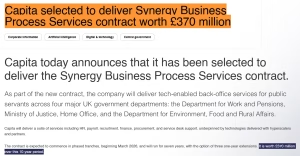
Capita confirms its selection for the Synergy Business Process Services contract, covering payroll and administrative functions across four government departments.
How Much Is the Capita DWP Payroll Contract Worth?
The financial value has been one of the most confusing elements of the agreement because different publications and official documents use different figures.
The widely reported £700 million amount should not be treated as equivalent to Capita’s recognised contract value.
Understanding the £370m, £700m and £873.4m Figures
| Financial figure | What it represents |
| £370 million | Capita’s IFRS 15 transaction price, reported as its order-book value over ten years |
| Approximately £700 million | Figure widely used in initial reporting and trade union statements |
| £873.4 million | Government’s estimated maximum ten-year contract value, including optional services |
| Approximately £2 billion | Total undiscounted costs of the wider Synergy programme, not solely Capita’s contract |
| £746.4 million | Planned investment costs across the wider programme |
| £1,315.4 million | Estimated future running costs across the programme |
Capita’s announcement explains that its £370 million order-book valuation excludes additional change and expansion services expected during the contract.
Meanwhile, the government’s April 2026 business case places the potential ten-year value of the Business Process Services contract at £873.4 million.
These estimates have different accounting boundaries and assumptions. The higher number does not represent a guaranteed payment to Capita.
This distinction is particularly important for taxpayers assessing the government’s financial commitment and for investors evaluating Capita’s future revenue.
The government also estimates that the wider Synergy programme could generate a net present value of £582 million, with a benefit-cost ratio of 1.9.
These are projected economic outcomes rather than savings already achieved.
Why Did the DWP Choose Capita for the Payroll Contract?
The DWP selected Capita through a competitive procurement process involving negotiations with suppliers and assessments of service delivery, financial cost and implementation risks.
The competition began in September 2024, with final tenders received in June 2025.
According to the published government business case, the evaluation was weighted:
- 70% for quality, including the proposed service solution and delivery arrangements.
- 30% for price, reflecting the commercial cost of the proposed services.
The government argued that combining operations across departments would help improve efficiency, standardise processes and reduce dependence on outdated systems.
Why the Government Favoured Shared Services?
Several existing administrative platforms were approaching the end of their supported operating lives.
Maintaining separate systems across departments creates duplicated expenditure and makes it harder to introduce consistent financial reporting and workforce processes.
The Synergy programme is intended to address these issues through a common operating model.
Its proposed benefits include improved payroll processing, more consistent employee records, stronger reporting, reduced administrative duplication and greater use of self-service technology.
The government’s April business case forecast that participating departments could pay approximately 35% less for services after rollout.
However, achieving this reduction depends on implementation costs, operational stability and the eventual performance of the new arrangements.
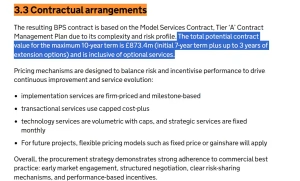
The government’s Synergy business case sets out procurement arrangements, estimated contract expenditure and expected financial benefits.
Which Government Departments Will Be Affected?
The contract covers four major departments and associated public bodies within the Synergy cluster.
| Department | Main responsibilities | Relevance to Synergy |
| Department for Work and Pensions | Benefits, pensions and employment services | Lead department and major workforce participant |
| Home Office | Immigration, security and policing policy | HR, payroll and financial administration |
| Ministry of Justice | Courts, prisons and justice services | Shared employee and financial processes |
| Defra | Environmental, agricultural and rural policy | Standardised administrative functions |
The government’s business case also identifies 98 in-scope arm’s-length bodies associated with these departments.
The scale makes Synergy one of the largest public-sector administrative transformation programmes in the UK.
However, it is important to distinguish civil service employee payroll from welfare-benefit payments.
The contract concerns government employees and back-office functions. It does not mean Capita has taken over the direct payment of Universal Credit, Personal Independence Payment or the State Pension to claimants.
When Will Capita Start Managing DWP Payroll?
Capita’s original announcement referred to phased contract commencement beginning in March 2026.
However, contract commencement and the transfer of live payroll services are different milestones.
The company’s subsequent financial reporting indicated that Synergy service delivery would commence in summer 2027, while the government’s April business case referred to service deployment beginning in August 2027.
This means employees should not assume that Capita became responsible for every salary payment immediately after the contract announcement.
Capita DWP Contract Timeline
| Date | Major development |
| September 2024 | Procurement competition advertised |
| January–May 2025 | Supplier negotiations undertaken |
| June 2025 | Final tenders received |
| February 2026 | Capita named preferred bidder |
| March 2026 | Capita confirmed contract selection |
| April 2026 | Government published the Synergy business case |
| July 2026 | Public Accounts Committee raised concerns about shared-services delivery |
| August 2026 | Legal challenge reported as heading towards a potential 2028 trial |
| October 2026 | Government response provided further procurement and service-continuity assurances |
| Summer 2027 | Capita’s reported planned start of operational service delivery |
| August 2027 onward | Service deployment anticipated under the published programme plan |
The actual transfer of services is expected to depend on testing, departmental readiness and formal approval.
In its October 2026 response, the government confirmed that final decisions about switching services would remain under programme control rather than being determined solely by Capita.
Why Are Trade Unions Opposing the Capita DWP Payroll Contract?
Trade unions have raised serious objections, particularly because Capita was already facing criticism over its administration of the Civil Service Pension Scheme.
The Public and Commercial Services Union (PCS), which represents civil servants and public-sector employees, questioned whether the company should be entrusted with payroll operations affecting approximately 250,000 people.
PCS general secretary Fran Heathcote argued that the decision exposed employees to unnecessary financial risks.
Her publicly reported comments linked the contract decision to the ongoing pension administration problems and emphasised that delayed salary payments could leave employees struggling with essential household bills.
The union’s central concern is straightforward: payroll is a critical operational service, and employees depend on receiving the correct amount on the correct date.
An administrative failure can affect mortgage payments, rent, loan repayments and everyday expenses.
Concerns About Capita’s Civil Service Pension Performance
Capita’s administration of the Civil Service Pension Scheme has faced criticism over delayed retirement payments, processing backlogs and communication problems.
The pension administration contract is separate from the new Synergy payroll agreement, but its performance has influenced confidence in the company’s ability to manage another major public-sector service.
Concerns raised by unions and parliamentary committees include:
- Delays affecting people waiting for pension payments.
- Backlogs in processing retirement cases.
- Difficulties obtaining timely and reliable information.
- Questions about workforce capacity and implementation planning.
- The financial impact on individuals when essential payments are delayed.
The distinction between employment payroll and pension administration matters because the two functions have different processes and contractual arrangements.
Nevertheless, both depend on accurate records, dependable processing and effective customer support.
For further context on the consequences of administrative pension-data errors, the separate problem of incorrect State Pension forecasts illustrates why accurate government financial records are important, although it is not part of the Capita contract.
What Did Parliament Say About the Capita Payroll Deal?
Parliamentary scrutiny intensified during 2026.
In July, the House of Commons Public Accounts Committee published a report warning that the wider government shared-services programme was facing delays, complicated governance arrangements and insufficient clarity over its expected financial benefits.
Committee chair Sir Geoffrey Clifton-Brown MP questioned whether the programme could succeed without substantial improvements to its oversight.
In his published assessment, he said the programme was affected by:
“division between departments, a lack of overall leadership, and overcomplicated systems.”
His criticism concerned the overall shared-services strategy as well as the risks associated with Capita’s involvement.
The committee also questioned why government departments were using different delivery models, with some outsourcing administrative operations while others retained them internally.
One important issue was whether outsourcing to Capita represented better value for money than delivering services in-house.
The 40% Pricing Concern
The committee requested clarification about reports suggesting Capita’s bid had been substantially below the government’s estimated cost of delivering the service.
In its response published in October 2026, the government stated that both competing bids were more than 35% below its original should-cost model.
It said the model had deliberately used conservative assumptions before procurement results became available.
The government maintained that Capita’s offer had been assessed for sustainability and deliverability, rather than selected on price alone.
This response provides important context, but it does not resolve every criticism about the procurement process.
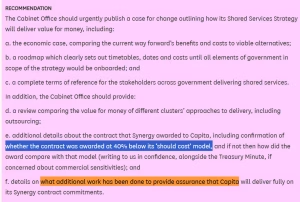
The Public Accounts Committee raised concerns about the government’s shared-services strategy and requested additional assurance over Capita’s contract.
Is the Capita DWP Payroll Contract Facing a Legal Challenge?
Yes. The award has been challenged by Sopra Steria, the competing supplier associated with the existing Shared Services Connected Limited arrangements.
The legal dispute concerns the procurement process, including allegations about the pricing and assessment of Capita’s bid.
Sopra Steria has questioned whether the contract was awarded in accordance with the applicable procurement rules and whether the winning offer was sufficiently assessed for deliverability.
The government has defended the process and rejected the suggestion that price alone determined the outcome.
Reporting in August 2026 indicated that a trial was scheduled for early 2028, subject to possible settlement discussions.
In October, further reporting confirmed that the dispute remained ongoing.
No final court judgment establishing a procurement breach was identified as of 4 November 2026.
Consequently, the allegations should not be presented as proven wrongdoing.
The legal challenge also does not automatically establish that the contract has been cancelled or that payroll services have already been disrupted.
What Safeguards Has the Government Introduced?
Following parliamentary concerns, the government outlined additional measures intended to reduce operational and financial risks.
Its October response referred to contract-management arrangements, readiness checks and procedures for dealing with supplier performance problems.
These include:
| Safeguard | Intended purpose |
| Milestone-based payments | Link payments to agreed delivery stages |
| Service credits | Provide contractual remedies for specified performance failures |
| Rectification plans | Require action when service standards are not achieved |
| Step-in rights | Allow intervention under specified contractual circumstances |
| Termination provisions | Provide options if serious contractual issues arise |
| Payroll testing | Identify errors before services are transferred |
| Departmental go-live approval | Prevent transfers before readiness requirements are met |
| Incumbent supplier transition arrangements | Support continuity while services move between providers |
The government also confirmed that Shared Services Connected Limited and Capita would need to cooperate during the transition.
Crucially, departmental transfers are not intended to proceed until the agreed service, payroll, data and operational-readiness conditions have been satisfied.
These safeguards demonstrate that the government recognises the risk involved in transferring critical payroll services.
Their effectiveness will ultimately depend on how they are implemented and enforced.
How Could the Contract Affect Civil Servants’ Salaries?
The Capita agreement is an administrative services contract, not a new civil service pay agreement.
It does not automatically change employees’ contractual salary rates, pension entitlements, pay-award percentages or employment terms.
However, changing payroll providers can introduce operational challenges.
These could include:
- Incorrect salary or allowance calculations.
- Problems transferring tax codes and National Insurance information.
- Delays processing overtime or backdated pay.
- Incorrect pension contribution deductions.
- Difficulties updating employee bank details.
- Temporary disruption to payroll enquiries.
These are potential transition risks, not evidence that they have occurred under the new Synergy arrangement.
Civil servants should continue following official departmental payroll communications and report discrepancies through their employer’s established HR or payroll channels.
A useful comparison is the administration of negotiated salary increases in local government. Even after a pay agreement is finalised, the implementation of a pay rise through payroll can differ between employers.
The Synergy contract involves a much larger technology transition, making payroll accuracy and continuity particularly important.
Could the Capita Contract Reduce Government Spending?
Reducing administrative costs is a central reason for developing the Synergy programme.
The government’s April 2026 business case estimated approximately £2.41 billion in programme savings and benefits over the appraisal period.
The financial appraisal included expected reductions in existing service-running costs alongside other cashable benefits.
Government’s Financial Forecast
| Financial measure | Published estimate |
| Total programme costs | Approximately £2.06 billion |
| Investment costs | £746.4 million |
| Future running costs | £1,315.4 million |
| Savings and benefits | £2,411.6 million |
| Forecast net cash flow | £349.8 million |
| Economic net present value | £582 million |
| Benefit-cost ratio | 1.9 |
| Expected reduction in service costs after rollout | Approximately 35% |
| Estimated programme funding shortfall | £107.3 million |
These are forecast figures from the business case, not independently verified realised savings.
The distinction matters because substantial savings are expected only after the programme becomes operational and existing administrative systems are replaced.
The business case projected that savings would begin in 2027/28, with the overall programme reaching its expected financial payback point in January 2034.
When previously incurred costs are included, the projected payback moves to August 2035.
The programme also faces a potential £107.3 million investment funding shortfall, illustrating the continuing pressure on its financial assumptions.
What Does the Capita Contract Mean for Government Outsourcing?
Beyond payroll administration, the agreement highlights the wider debate about outsourcing essential public services.
Supporters of outsourcing argue that specialist providers can introduce technology, operational expertise and efficiencies that would be costly for individual departments to develop independently.
Critics question whether the anticipated savings adequately compensate for financial, operational and accountability risks.
The Capita contract places these competing arguments under particular scrutiny because it combines a large workforce, a complex IT transformation and a supplier already facing criticism over another public-sector administration contract.
For procurement professionals, the outcome is likely to provide lessons about assessing unusually competitive bids, managing supplier transitions and establishing enforceable service standards.
For public-sector employers, the most important measure is not simply whether operating costs fall. It is whether employees continue receiving accurate and timely payments during and after the transformation.
The government’s longer-term financial goals cannot be separated from the reliability of the services being delivered.
What Happens Next With the Capita DWP Payroll Contract?
The contract is expected to remain under scrutiny as implementation progresses through 2027.
Important developments to monitor include:
- Payroll migration readiness: Confirmation that data, processes and payroll calculations have passed required testing.
- Departmental transfer dates: Official announcements identifying when individual departments will move to the new arrangements.
- Performance reporting: Evidence that Capita is meeting agreed operational and service standards.
- Legal proceedings: Further developments in Sopra Steria’s procurement challenge.
- Financial performance: Updated information about implementation costs, contract expenditure and achieved savings.
- Employee experience: Feedback about payroll accuracy, support availability and resolution of payment errors.
These milestones will help determine whether Synergy delivers the improvements and financial benefits described in its business case.
Conclusion
The Capita DWP payroll contract represents a significant transformation of UK government administration, covering approximately 250,000 civil servants across four major departments.
Although the agreement promises modern technology, greater efficiency and reduced administrative costs, its implementation faces substantial scrutiny.
Questions about procurement, Capita’s pension administration performance, contractual safeguards and the ongoing legal challenge remain important.
The government has provided additional assurances, but the practical success of the agreement will depend on payroll accuracy, operational readiness and transparent performance reporting.
For civil servants and taxpayers, the essential test will be whether the transition delivers reliable services alongside measurable financial savings.
Frequently Asked Questions
Has Capita Won the DWP Payroll Contract?
Yes. Capita was selected to deliver the Synergy Business Process Services contract in 2026. The arrangement covers payroll and additional administrative services across four government departments.
Is the Capita DWP Contract Worth £700 Million?
Approximately £700 million was widely reported, but different official valuations exist. Capita disclosed £370 million in order-book value, while the government estimated a maximum potential contract value of £873.4 million.
How Many Civil Servants Will the Contract Affect?
Approximately 250,000 civil servants are within the scope of the Synergy programme. This includes employees across the DWP, Home Office, Ministry of Justice and Defra.
When Will Capita Take Over DWP Payroll?
The planned operational rollout begins in 2027, with individual transfers dependent on testing and readiness approvals. The contract announcement in 2026 did not mean every employee’s payroll immediately transferred.
Why Are Unions Against the Capita Contract?
Unions are concerned about Capita’s performance administering Civil Service pensions and the potential consequences of payroll failures. They have called for greater assurance and accountability.
Will Capita’s Contract Affect Universal Credit or PIP Payments?
The Synergy contract concerns civil service employee payroll and administrative services. It does not constitute a transfer of responsibility for paying Universal Credit or PIP to Capita.
Has the Capita Payroll Contract Been Cancelled?
No confirmed cancellation was identified as of 4 November 2026. Although the award faces a legal challenge and parliamentary scrutiny, the planned transition remains subject to implementation and readiness requirements.
Could Capita Lose the DWP Payroll Contract?
A future legal ruling, serious contractual breach or other contractual process could affect the agreement. However, such an outcome should not be treated as confirmed or inevitable.
Will Civil Servants Receive Their Salaries From Capita?
Capita is contracted to provide payroll administration services. Civil servants remain employees of their respective departments, and the outsourcing arrangement does not by itself transfer their employment to Capita.