
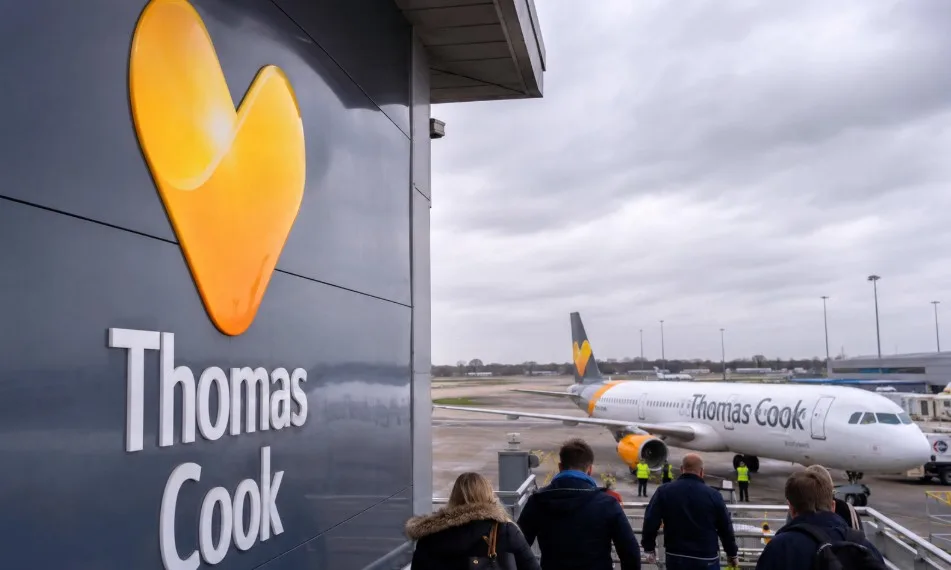
Yes. The original Thomas Cook Group went bust in September 2019 after entering compulsory liquidation, causing all flights and holiday bookings to stop immediately. The collapse marked the end of one of Britain’s oldest and most recognisable travel companies after 178 years in business.
The company failed due to a combination of rising debt, changing travel habits, increased competition from online booking platforms and budget airlines, political uncertainty, and unsuccessful rescue negotiations.
Its collapse triggered the UK’s largest peacetime repatriation effort, known as Operation Matterhorn, to bring stranded holidaymakers back home.
Although the original Thomas Cook company no longer exists, the brand itself survived. Chinese tourism group Fosun later purchased the Thomas Cook name and relaunched it as an online travel agency, while Hays Travel acquired many of its former high street stores.
This article explains exactly why Thomas Cook collapsed, what happened during its final days, how customers were affected, and whether the company still exists today.
How Did Thomas Cook Become One of Britain’s Biggest Travel Companies?
Thomas Cook began in 1841 when businessman and Baptist preacher Thomas Cook organised railway excursions in England. Over time, the company expanded into international tourism and became one of the pioneers of the package holiday industry.
For decades, Thomas Cook was considered one of the most trusted names in British travel. The company operated airlines, hotels, resorts, cruises, and travel agencies across multiple countries.
By 2018, the company had:
| Thomas Cook Before Collapse | Details |
| Founded | 1841 |
| Countries Operated In | 16+ |
| Annual Revenue | £9.6 billion |
| Employees Worldwide | 21,000+ |
| UK Employees | Around 9,000 |
| Customers Per Year | Nearly 20 million |
The company’s package holidays became especially popular with British families looking for affordable travel abroad. However, while Thomas Cook was once an industry leader, the travel market changed rapidly during the 2000s and 2010s.
What Went Wrong for Thomas Cook Before 2019?
Thomas Cook struggled to keep up with changing consumer behaviour and modern travel trends. More travellers began booking flights, hotels, and experiences separately through online platforms rather than relying on traditional travel agencies.
Budget airlines such as easyJet, Ryanair, and Jet2 also transformed the market by offering cheaper and more flexible travel options.
Several major issues slowly weakened Thomas Cook’s position:
- Growing competition from online booking websites
- Reduced demand for traditional package holidays
- Declining use of high street travel agencies
- Rising operational costs
- Increasing pressure from low-cost airlines
A travel industry consultant described the problem clearly:
“I could see that traditional travel firms were losing relevance with younger travellers. Customers wanted flexibility and instant online booking rather than fixed package deals sold in stores.”
The company continued operating large numbers of physical travel shops while competitors invested heavily in digital booking systems and online customer experiences.
At the same time, websites like Airbnb changed the accommodation market by giving travellers more independent options.
Why Did Thomas Cook Collapse Financially?
Although changing travel habits hurt the company, debt was ultimately the biggest reason behind Thomas Cook’s collapse.
By 2019, Thomas Cook had accumulated around £1.7 billion in debt. The company spent enormous amounts of money simply servicing interest payments rather than improving the business.
One of the biggest financial mistakes was the 2007 merger with MyTravel Group. The merger added significant financial pressure at a time when the travel industry was already changing rapidly.
Major Financial Problems Facing Thomas Cook
| Financial Issue | Impact on the Company |
| £1.7 billion debt | Severe financial pressure |
| High interest payments | Reduced profitability |
| Falling customer bookings | Lower revenue |
| Costly merger deals | Increased liabilities |
| Weak cash flow | Difficulty funding operations |
Reports later showed that from 2011 onwards, the company paid more than £1.2 billion in interest payments alone.
Brexit uncertainty also added further pressure. The weakening pound reduced British travellers’ spending power abroad, while political uncertainty affected holiday demand.
An aviation finance analyst explained the issue in simple terms:
“Thomas Cook was carrying debt levels that became impossible to manage in a highly competitive market. Once bookings slowed down, the business simply did not have enough flexibility left financially.”
How Did Global Events Make the Situation Worse?
Several external events made Thomas Cook’s financial problems even more difficult to overcome. Turkey had become one of the company’s most popular destinations, but political unrest and security concerns in the country caused tourism demand to fall sharply.
This reduced bookings and damaged profits. The European heatwave during 2018 also affected the business unexpectedly. Many travellers decided to remain in the UK instead of booking overseas holidays.
At the same time, economic uncertainty across Europe weakened consumer confidence.
External Factors That Hurt Thomas Cook
| External Event | Effect on Business |
| Political unrest in Turkey | Fewer holiday bookings |
| Brexit uncertainty | Lower UK consumer confidence |
| Weak British pound | Higher travel costs abroad |
| 2018 European heatwave | Reduced overseas demand |
| Rising fuel costs | Increased airline expenses |
All of these problems arrived while the company was already struggling with heavy debt and declining competitiveness.
What Happened During the Final Days of Thomas Cook?
In August 2019, Thomas Cook attempted to secure a rescue package worth around £900 million. The deal involved Fosun Tourism Group and the company’s creditors.
Under the proposal, Fosun would inject significant funding into the business in exchange for major ownership stakes in both the airline and tour operator divisions.
However, the rescue effort collapsed after creditors requested an additional £200 million to support the business during quieter winter months.
Timeline of Thomas Cook’s Final Days
| Date | Event |
| August 2019 | £900 million rescue package proposed |
| September 2019 | Creditors requested extra funding |
| 21 September 2019 | Emergency negotiations held |
| 23 September 2019 | Thomas Cook entered liquidation |
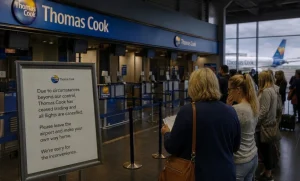
After negotiations failed, the UK Civil Aviation Authority announced that Thomas Cook had ceased trading with immediate effect.
Peter Fankhauser, the company’s chief executive, later described the collapse as “a matter of profound regret”.
What Was the Immediate Impact of the Collapse?
The collapse caused immediate disruption across the travel industry. Flights were cancelled, holidays stopped abruptly, and thousands of customers became stranded overseas.
The UK government and Civil Aviation Authority launched Operation Matterhorn, the country’s largest peacetime repatriation programme. Approximately 140,000 British holidaymakers were flown home from destinations around the world.
The collapse also affected:
- Employees who lost their jobs
- Hotels waiting for unpaid invoices
- Travel agencies linked to Thomas Cook
- Airlines and aircraft leasing firms
Customers protected under the ATOL scheme were eligible for refunds and replacement travel arrangements. Many travellers were initially confused about what would happen to their holidays.
A family affected by the collapse explained the experience:
“We were sitting in our hotel lobby reading headlines online and suddenly realised our return flight no longer existed. Nobody expected a company like Thomas Cook to disappear overnight.”
How Did the Collapse Affect the Travel Industry?
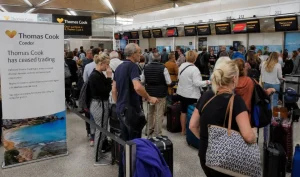
Thomas Cook’s collapse created financial problems across Europe’s tourism sector. Popular destinations such as Spain, Greece, Turkey, and the Canary Islands depended heavily on Thomas Cook customers. Many hotels had exclusive agreements with the company and experienced major revenue losses after the collapse.
The sudden disappearance of Thomas Cook’s airline operations also reduced the number of available seats in the market, leading to higher flight prices.
Areas Most Affected by the Collapse
| Sector | Impact |
| Hotels | Booking losses |
| Airlines | Reduced seat availability |
| Travel agencies | Market disruption |
| Tourism destinations | Lower visitor numbers |
| Employees | Thousands of job losses |
Competitors such as TUI and Jet2 benefited from the reduced competition and gained additional market share. Meanwhile, Hays Travel purchased all 555 Thomas Cook high street stores in the UK and offered jobs to thousands of former employees.
The collapse also highlighted the long-term decline of traditional high street travel agencies as more consumers moved online.
What Happened to the Thomas Cook Brand Afterwards?
Although the original Thomas Cook Group disappeared, the brand itself survived. Fosun Tourism Group purchased the Thomas Cook name, along with hotel brands including Casa Cook and Cook’s Club.
Instead of rebuilding the traditional high street travel agency model, Fosun relaunched Thomas Cook as an online travel business focused on digital bookings.
At the same time:
- Hays Travel took over Thomas Cook’s former retail stores
- Thomas Cook India continued operating separately
- The Thomas Cook brand remained active in selected markets
The new version of Thomas Cook operates very differently from the original company that collapsed in 2019.
Is Thomas Cook Still Operating Today?
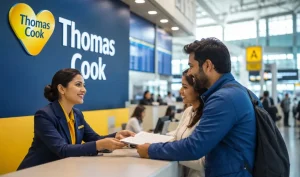
Yes, but not in the same form as before. The original Thomas Cook Group that entered liquidation in 2019 no longer exists. However, the Thomas Cook brand continues operating as an online travel agency under Fosun Tourism Group ownership.
Customers can still book holidays using the Thomas Cook website, but the company no longer operates the extensive high street network or airline business that once defined the brand.
This distinction often causes confusion because many people assume the current online business is the same company that existed before 2019.
What Can Businesses Learn From the Thomas Cook Collapse?
Thomas Cook’s collapse is widely viewed as a warning about the dangers of failing to adapt to changing markets. The company remained heavily dependent on traditional travel models while consumer behaviour evolved rapidly.
Key Lessons From the Collapse
| Business Problem | Effect on Thomas Cook | Lesson |
| High debt levels | Financial instability | Maintain sustainable borrowing |
| Slow digital transformation | Loss of customers | Invest in technology |
| Reliance on high street stores | Reduced competitiveness | Adapt to changing habits |
| External economic shocks | Falling demand | Build financial resilience |
The collapse also demonstrated how quickly even long-established companies can fail when market conditions change faster than the business itself.
Conclusion
Yes, Thomas Cook did go bust in September 2019 after entering compulsory liquidation following failed rescue negotiations and years of financial pressure.
The company collapsed due to a combination of massive debt, increased competition from online travel businesses and low-cost airlines, changing consumer behaviour, Brexit uncertainty, and wider economic challenges.
Its downfall triggered one of the largest travel disruptions in UK history and affected customers, employees, hotels, airlines, and tourism businesses worldwide.
However, while the original Thomas Cook Group no longer exists, the brand itself continues operating today under Fosun Tourism Group as an online travel agency.
The collapse remains one of the most significant examples of how rapidly changing industries can challenge even the most historic and recognisable businesses.
FAQs
When did Thomas Cook officially stop trading?
Thomas Cook officially ceased trading on 23 September 2019 after entering compulsory liquidation.
Did customers receive refunds after the collapse?
Many customers protected under the ATOL scheme received refunds or replacement travel arrangements through the Civil Aviation Authority.
Who owns the Thomas Cook brand today?
The Thomas Cook brand is currently owned by Fosun Tourism Group, a Chinese tourism company.
Why was Thomas Cook carrying so much debt?
The company accumulated debt through mergers, operational costs, declining profits, and long-term financial obligations.
How many people were affected by the collapse?
Around 140,000 British travellers abroad were affected immediately, while thousands of employees also lost their jobs.
Is Thomas Cook still a British company?
The current Thomas Cook online business is owned by Fosun Tourism Group rather than the original British company.
Did Brexit contribute to Thomas Cook’s collapse?
Brexit uncertainty played a role by weakening consumer confidence and reducing spending power for British travellers abroad.