

Wimbledon appears to have generated a gross surplus of approximately £54 million from the 2025 Championships, calculated from the £48.6 million paid to the LTA as its 90% share.
Its turnover for the financial year ending July 2025 was around £423 million. This means the estimated tournament surplus represented roughly 12.8% of turnover before considering how the retained share was used.
The £48.6 million transferred to the LTA was 4% lower than the previous year’s £50.4 million gross payment, even though Wimbledon’s overall revenue continued to grow.
Wimbledon Financial Summary:
| Financial measure | Latest available figure | What it means |
| Wimbledon turnover | Approximately £423 million | Revenue reported for the year ending 31 July 2025 |
| Estimated gross tournament surplus | Approximately £54 million | Calculated from the LTA’s 90% share |
| Wimbledon surplus paid to the LTA | £48.6 million | Funding received by the LTA in 2025 |
| LTA share of relevant surplus | 90% | Long-standing distribution arrangement |
| Estimated amount retained by Wimbledon | Approximately £5.4 million | Remaining 10% before other accounting considerations |
| 2025 Wimbledon prize money | £53.5 million | Total player prize fund |
| 2026 Wimbledon prize money | £64.2 million | A 20% annual increase |
| 2026 singles champions’ prize | £3.6 million each | Paid to the ladies’ and gentlemen’s champions |
The latest Championship company accounts cover the period ending 31 July 2025 and were filed at Companies House on 24 April 2026.
Is Wimbledon’s Profit Really £54 Million?
Approximately £54 million is a reasonable estimate of Wimbledon’s gross Championship surplus, rather than a simple net-profit figure.
The calculation is:
£48.6 million ÷ 90% = £54 million
The LTA’s 2025 financial report describes its Wimbledon income as a gross surplus of £48.6 million, representing 90% of the applicable Championship surplus. The calculation therefore indicates a total of approximately £54 million before the distribution.
This distinction is important because several different financial figures may appear in discussions about Wimbledon:
- Turnover is the total income generated before expenses.
- Operating profit is income remaining after operating costs.
- Profit before tax includes financing and other accounting items.
- Tournament surplus is the amount determined under the Wimbledon–LTA arrangement.
- Cash retained may differ from reported accounting profit.
The terms cannot always be used interchangeably.
How Has Wimbledon’s Revenue and Surplus Changed?
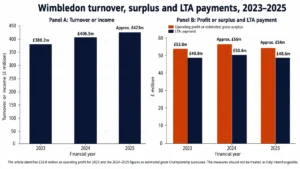
Wimbledon’s turnover has increased substantially over recent years, although its surplus has not risen at exactly the same rate.
| Financial year | Reported turnover or income | Operating profit or estimated surplus | LTA payment |
| 2023 | £380.2 million | £53.8 million operating profit | £48.8 million |
| 2024 | £406.5 million | Approximately £56 million gross surplus | £50.4 million |
| 2025 | Approximately £423 million | Approximately £54 million gross surplus | £48.6 million |
The figures show an important business trend: higher revenue does not automatically produce higher profit.
Turnover increased from approximately £380 million in 2023 to £423 million in 2025, but the gross surplus distributed through the LTA arrangement fell slightly between 2024 and 2025. This suggests that tournament costs, prize money, investment and other financial commitments were also rising.
Where Does Wimbledon Make Its Money?
Wimbledon has several major revenue streams rather than relying only on ticket sales.
Broadcasting Rights
Broadcasting is one of Wimbledon’s most valuable sources of income. The tournament attracts viewers across the UK and international markets, allowing the All England Club to negotiate valuable television and digital-media agreements.
Its media partners have included the BBC in the UK and major international broadcasters in markets such as the United States.
Broadcasting income is commercially attractive because Wimbledon can reach millions of viewers without substantially increasing the physical capacity of the grounds.
Sponsorship and Official Partnerships
Wimbledon works with a carefully selected group of commercial partners. These agreements can cover:
- Financial services
- Automotive services
- Technology and data
- Beverages
- Clothing and sporting equipment
- Timekeeping
- Travel and hospitality
The tournament traditionally limits visible advertising around its courts. This scarcity can strengthen the perceived value and exclusivity of official partnerships.
Ticket Sales
Ticketing remains an important source of revenue. Wimbledon sells access through several channels, including:
- The public ballot
- The Queue
- Hospitality packages
- Debenture tickets
- Returned and resale tickets
- Official travel packages
Centre Court and No.1 Court debentures are particularly significant because they provide long-term funding while giving holders premium access to the tournament.
Hospitality
Corporate hospitality packages generate more income per visitor than standard admission tickets. Packages may combine premium seats with dining, private facilities and entertainment.
Hospitality helps Wimbledon monetise strong demand from businesses and high-spending spectators without changing the general public ballot system.
Food, Drink and Merchandise
Visitors also spend money on refreshments, clothing, towels, accessories and official souvenirs.
These sales are unlikely to rival broadcasting income, but they add meaningful revenue across hundreds of thousands of spectator visits.
Licensing and Digital Activities
The Wimbledon name, visual identity and archive have global commercial value. Licensing, content distribution, digital products and official merchandise allow the organisation to earn income beyond the physical tournament grounds.
What Are Wimbledon’s Main Costs?
Turnover of £423 million does not mean Wimbledon keeps anything close to that amount as profit. Organising a Grand Slam tournament involves substantial expenditure.
Major costs include:
- Player prize money
- Temporary and permanent staff
- Security and crowd management
- Court preparation and grounds maintenance
- Broadcasting infrastructure
- Technology and data systems
- Catering and hospitality
- Insurance
- Marketing and communications
- Building maintenance
- Long-term redevelopment projects
- Payments supporting British tennis
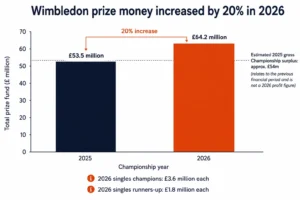
In 2025, Wimbledon awarded £53.5 million in prize money. The amount increased by 20% to £64.2 million for 2026, with both singles champions receiving £3.6 million.
The 2026 prize fund alone was therefore larger than Wimbledon’s estimated £54 million gross surplus for the previous financial period. This illustrates why revenue and profit should not be confused.
How Much Does Wimbledon Pay to the LTA?
The LTA received a gross Wimbledon surplus payment of £48.6 million in 2025, including £0.5 million of withholding tax.
That was down from £50.4 million in 2024. The LTA said the Wimbledon surplus represented 46.5% of its total income in 2025, compared with nearly 60% in 2018.
The money helps finance British tennis at multiple levels, including:
- Grassroots participation programmes
- Public tennis facilities
- Coaching and workforce development
- British professional tournaments
- Performance pathways
- Support for emerging players
- Disability and inclusive tennis programmes
The LTA reported that more than 5.8 million adults played tennis during summer 2025, while annual children’s participation exceeded four million. Wimbledon funding is one of several resources used to support these activities.
Why Does the LTA Receive 90% of Wimbledon’s Surplus?
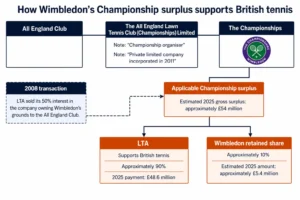
The arrangement reflects the historic relationship between the All England Club and the LTA.
The Championships are organised through a management structure involving both organisations. Under their long-standing agreement, the LTA receives approximately 90% of the applicable annual Championship surplus.
The current financial relationship is linked to a transaction agreed in 2008, under which the LTA sold its 50% interest in the company owning Wimbledon’s grounds to the All England Club. The agreement was structured to provide British tennis with continuing access to most of the Championship surplus.
This means Wimbledon’s commercial success supports the wider development of the sport rather than providing dividends to conventional investors.
Does Wimbledon Have Shareholders?
Several separate legal entities are involved in Wimbledon’s operations, including the Championship organiser and businesses connected with the grounds and debenture financing.
The Championship company is registered as The All England Lawn Tennis Club (Championships) Limited, a private limited company incorporated in 2011. Its principal activity is classified as “other sports activities”.
Nevertheless, Wimbledon does not operate like an ordinary investor-owned entertainment company. It describes itself as a not-for-profit organisation, with financial surpluses reinvested in tennis rather than paid as external shareholder dividends.
Practical Example: What Happens to £100 of Wimbledon Revenue?
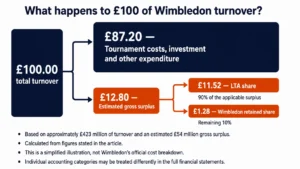
Using the 2025 figures, the following simplified example shows why revenue should not be mistaken for profit.
For every £100 of turnover:
| Illustrative allocation | Approximate amount |
| Tournament costs, investment and other expenditure | £87.20 |
| Gross surplus | £12.80 |
| LTA’s share of that surplus | £11.52 |
| Wimbledon’s retained share | £1.28 |
This example is calculated from £423 million of turnover and an estimated gross surplus of £54 million.
It is not Wimbledon’s official cost breakdown, and individual accounting categories may be treated differently in its full financial statements.
However, it demonstrates that most of the money generated by the tournament is spent or reinvested rather than retained as unrestricted profit.
Is Wimbledon More Profitable Than Other Grand Slams?
Direct comparison is difficult because the Australian Open, French Open, US Open and Wimbledon have different:
- Ownership structures
- Accounting periods
- Reporting standards
- Venue arrangements
- Government relationships
- Prize-money policies
- Infrastructure obligations
- Revenue-sharing agreements
Wimbledon’s commercial strength is clear from its £423 million turnover, but profit margins alone do not provide a complete comparison.
A tournament investing heavily in facilities or paying more prize money may report a lower surplus despite generating higher revenue. Similarly, organisations may define tournament income and operating expenditure differently.
Could Wimbledon Make More Profit?
In theory, Wimbledon could potentially increase its financial surplus by raising ticket prices, adding more sponsorship inventory, increasing venue capacity or reducing expenditure.
In practice, the All England Club balances commercial growth against several competing priorities:
- Protecting Wimbledon’s traditional identity
- Keeping some tickets accessible to the public
- Increasing player compensation
- Investing in facilities and technology
- Funding British tennis
- Managing operational and security costs
- Limiting excessive commercial branding
The organisation has also pursued a major expansion of its Wimbledon Park estate. Proposed facilities include additional grass courts and a new show court, which could allow qualifying matches to be held closer to the main venue and increase future attendance.
Such development may create additional revenue opportunities, but major construction and infrastructure projects also require considerable upfront investment.
What About Wimbledon’s Profit in 2026?
Wimbledon’s final revenue, profit and tournament-surplus figures for 2026 have not yet been published.
The Championships company’s next accounts will cover the year ending 31 July 2026, but Companies House states that these accounts are not due until 30 April 2027. The latest available statutory accounts still cover the year ending 31 July 2025.
Therefore, the article should not claim that Wimbledon made £54 million profit in 2026. That estimate relates to the previous reporting period.
Confirmed Wimbledon Financial Figures for 2026
| 2026 financial measure | Confirmed figure | Status |
| Total prize fund | £64.2 million | Confirmed |
| Increase from 2025 | 20% | Confirmed by Wimbledon |
| Singles champions’ prize | £3.6 million each | Confirmed |
| Singles runners-up prize | £1.8 million each | Confirmed |
| Total tournament revenue | Not yet published | Awaiting accounts |
| Operating profit | Not yet published | Awaiting accounts |
| Championship surplus | Not yet published | Awaiting accounts |
| Payment to the LTA | Not yet published | Expected in later reporting |
Wimbledon confirmed a record £64.2 million prize fund for the 2026 Championships, representing a 20% increase compared with 2025. The ladies’ and gentlemen’s singles champions received £3.6 million each.
Can Wimbledon’s 2026 Profit Be Estimated?
A responsible estimate cannot yet be made from prize money and ticket prices alone. Wimbledon also earns money from broadcasting rights, sponsorships, hospitality, debentures, licensing, merchandise and food and drink sales.
Its expenses include tournament delivery, security, staffing, media infrastructure, court maintenance, player payments and long-term capital investment.
Although higher ticket prices and commercial income may have supported revenue growth, the £10.7 million increase in prize money would also have raised tournament costs.
Wimbledon’s official 2026 ticket-price schedule confirms the prices charged, but it does not reveal the number or type of tickets sold or the resulting total ticket income.
Final Takeaway
So, how much profit does Wimbledon make? Based on the latest available financial information, the 2025 Championships generated approximately £423 million in turnover and an estimated £54 million gross surplus.
Around £48.6 million, equivalent to 90% of that calculated surplus, went to the LTA to help fund British tennis. The remaining amount was retained within Wimbledon’s structure rather than distributed to conventional investors.
Wimbledon is therefore a highly valuable commercial sporting event, but its business model is designed around reinvestment. Broadcasting, ticketing, hospitality, sponsorship and licensing generate substantial revenue, while prize money, tournament operations, infrastructure and grassroots tennis absorb most of the money earned.
FAQs
How much money does Wimbledon make each year?
Wimbledon generated turnover of approximately £423 million in the financial year ending 31 July 2025. Turnover represents total income rather than profit.
How much profit did Wimbledon make in 2025?
The available LTA figure suggests a gross Championship surplus of approximately £54 million. This is calculated from the LTA receiving £48.6 million as its 90% share.
What was Wimbledon’s profit margin?
Using turnover of £423 million and an estimated £54 million surplus, the implied gross surplus margin was approximately 12.8%. This is an indicative calculation, not a separately reported net-profit margin.
Who receives Wimbledon’s profits?
The LTA receives around 90% of the applicable Championship surplus. Wimbledon retains the remaining share and reinvests money in the tournament, facilities and tennis.
How much does Wimbledon make from ticket sales?
Wimbledon does not provide a simple public breakdown showing exactly how much of its annual turnover comes from standard ticket sales alone. Tickets, hospitality and debentures form part of a broader revenue model that also includes broadcasting, sponsorship and licensing.
How much does Wimbledon pay in prize money?
The total prize fund was £53.5 million in 2025. It rose by 20% to £64.2 million for the 2026 Championships.
Does Wimbledon pay tax?
Companies associated with Wimbledon are subject to relevant UK accounting and tax rules. The precise tax treatment depends on the entity, activity and financial period. Tournament surplus, withholding tax and taxable company profit are not necessarily identical figures.
Is Wimbledon a charity?
The Championship organiser itself is not a charity. However, the separate Wimbledon Foundation is a registered charity supporting community and social-impact programmes. Wimbledon states that it donates more than £4 million annually to charitable causes.