
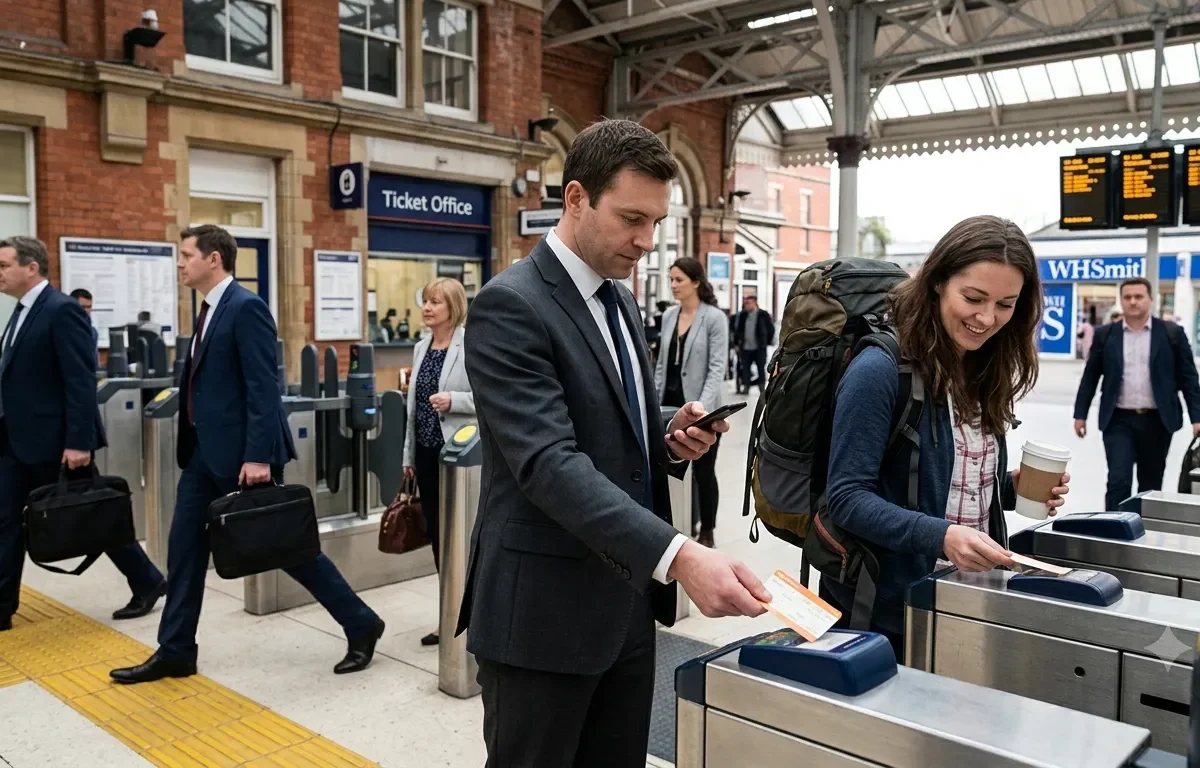
In the UK, ordinary train tickets are zero-rated for VAT at 0%. This means train travel is not VAT-exempt: it remains within the VAT system, but VAT is charged at a rate of zero.
For a passenger or business buying a normal National Rail ticket, the practical result is straightforward.
If a train ticket costs £100, the VAT charged on the fare is £0. A VAT-registered business therefore cannot calculate 20% VAT backwards from the ticket price and reclaim it.
The legal basis sits within Schedule 8, Group 8 of the Value Added Tax Act 1994, while HMRC explains the passenger-transport rules in VAT Notice 744A, particularly sections 2, 3, 4 and 9.
What Is the VAT Rate on Train Tickets in the UK?
For an ordinary UK passenger rail journey, the VAT rate is generally 0%.
HMRC VAT Notice 744A says domestic passenger transport can be zero-rated where the vehicle is designed or adapted to carry at least 10 passengers. Normal passenger trains comfortably satisfy this requirement.
HMRC specifically includes excursions by train, including steam railways, among examples of passenger transport capable of qualifying for zero-rating.
A simple example is:
| Ticket cost | VAT rate | VAT charged | Total paid |
| £100 | 0% | £0 | £100 |
There is no additional £20 VAT charge on the ticket.
The same basic passenger-transport rule normally applies whether the ticket is an Advance, Anytime, Off-Peak or other standard rail fare.
What Law Makes Train Tickets Zero-Rated?
The underlying legislative authority is the Value Added Tax Act 1994, Schedule 8, Group 8, item 4.
HMRC’s internal VAT manual explains that item 4 provides zero-rating for passenger transport in qualifying vehicles and for certain international passenger transport.
HMRC VAT Notice 744A then provides the practical guidance businesses and transport operators use. Important sections include:
- Section 2.1: General liability of passenger transport.
- Section 3: Transport partly inside and outside the UK.
- Section 4.1: Domestic transport in vehicles with at least 10 seats.
- Section 4.7: Taxis, limousines and hire cars.
- Section 9: Incidental and ancillary passenger services.
This is why the answer is not simply that trains have “no VAT”. Rail fares are generally taxable supplies charged at the zero rate.
Are Train Tickets VAT Exempt or Zero-Rated?
Train tickets are normally zero-rated rather than exempt.
The distinction matters.
A zero-rated supply remains a taxable supply within the VAT system. An exempt supply is outside taxable turnover for many VAT purposes and can restrict the supplier’s recovery of related input VAT.
HMRC confirms that businesses making zero-rated taxable supplies can generally recover eligible VAT incurred on costs relating to those supplies, subject to the normal input-tax rules.
That creates an important difference between the passenger and the train operator.
| VAT position | Passenger buying ticket | Train operator |
| Train fare | Pays 0% VAT | Makes a zero-rated taxable supply |
| VAT on ticket | £0 | Accounts for fare at 0% |
| Input VAT | Nothing to reclaim from fare | May reclaim eligible VAT on qualifying business costs |
For example, a railway operator may incur VAT on equipment, professional services, maintenance supplies or other taxable purchases.
Because the operator makes taxable supplies, including zero-rated passenger transport, eligible input VAT may generally still be recoverable.
That would not necessarily be the case if the transport service were VAT-exempt.
Can a Business Reclaim VAT on Train Tickets?
A VAT-registered business normally cannot reclaim VAT on an ordinary UK train fare because the VAT charged is £0.
Suppose a director buys a £120 train ticket to attend a business meeting.
The correct treatment is:
- Travel expense: £120.
- VAT rate: 0%.
- Input VAT: £0.
- Amount potentially deductible as a business expense: £120, subject to the normal tax rules.
VAT registration does not allow the business to invent VAT that was never charged.
Wrong Way vs Right Way to Record a £120 Ticket
| Method | Net expense | VAT | Total | Correct? |
| Divide £120 by 1.20 | £100 | £20 | £120 | No |
| Record at 0% VAT | £120 | £0 | £120 | Yes |
The first calculation would only make sense where £120 represented a VAT-inclusive price subject to the 20% standard rate.
A zero-rated rail ticket does not contain hidden 20% VAT.
Can Train Tickets Still Be Claimed as a Business Expense?
Yes. Whether an expense is deductible for Income Tax or Corporation Tax is a separate question from whether VAT can be reclaimed.
A qualifying train journey undertaken for business purposes may still be recorded as a travel expense even though the VAT component is £0.
For example, a consultant travelling from Birmingham to London specifically to meet a client may potentially claim the train fare as a business expense where the normal tax conditions are met.
Ordinary commuting and private journeys need different treatment.
Companies reviewing travel alongside other deductible costs can compare them with other allowable business expenses when calculating taxable company profits.
VAT recovery and tax deductibility should therefore not be confused:
0% VAT does not mean the cost cannot be a business expense.
Are Season Tickets Subject to VAT?
A normal rail season ticket is generally zero-rated because it represents payment for qualifying passenger transport.
Buying travel for a week, month or year rather than buying individual tickets for every journey does not normally change the underlying VAT treatment.
However, businesses should still consider whether the journeys themselves qualify as business travel for Income Tax, Corporation Tax or employee-benefit purposes.
An employer paying for an employee’s normal home-to-work season ticket can create separate employment-tax consequences even though the rail transport itself is zero-rated.
Is There VAT on Railcards?
Railcards also have a strong connection with zero-rated rail transport.
HMRC’s guidance on the VAT concept known as a two-part tariff refers to the British Railways Student Card case.
The court treated the initial payment for the discount card and the later discounted rail fares as part of a single supply of passenger transport rather than treating the card merely as a separate discount service.
As a result, a railcard fee that forms part of an arrangement for obtaining discounted qualifying rail travel can generally follow the VAT treatment of that transport.
Where a commercial membership product combines rail discounts with unrelated benefits, however, the supplier’s documentation should be checked rather than assuming the whole product is automatically zero-rated.
Is There VAT on First-Class Train Tickets?
Ordinary first-class rail travel is generally subject to the same 0% VAT treatment as standard-class passenger transport.
Paying more for a larger seat, quieter carriage or first-class environment does not by itself turn the transport into a standard-rated service.
Some facilities included within the fare may also be considered incidental or integral to the passenger transport.
Where a separately identifiable service is sold independently, however, its own VAT treatment must be considered.
Is There VAT on Train Booking Fees?
Booking and administration fees should be examined separately from the train fare.
HMRC states that an intermediary making arrangements for qualifying zero-rated passenger transport may itself be able to zero-rate the arrangement service in certain circumstances.
However, different treatment can apply when:
- A supplier acts as principal rather than agent.
- The charge relates to an additional service.
- The transaction falls within the Tour Operators Margin Scheme.
- A fee does not form part of arranging the zero-rated passenger transport.
A typical booking could therefore contain:
| Charge | Typical approach |
| Rail fare | Normally 0% |
| Seat reservation forming part of fare | Normally follows fare |
| Booking or administration fee | Check invoice |
| Separate insurance or additional product | Apply its own VAT rules |
| Separate catering purchase | Normally standard-rated |
Businesses should use the VAT actually shown on the supplier’s documentation rather than applying a blanket 0% or 20% rate to every charge in a rail booking.
Is There VAT on Station Parking and Left-Luggage?
Yes, these are important exceptions.
HMRC says separately supplied services such as car parking, cycle storage, left-luggage facilities and lost-property services are normally ancillary rather than part of the passenger transport supply.
They are therefore normally standard-rated where supplied in the UK.
For example:
| Rail-related cost | Typical VAT treatment |
| Train fare | 0% |
| Station car parking | 20% |
| Left-luggage facility | 20% |
| Cycle storage charged separately | 20% |
| Platform ticket | 20% |
| Seat reservation supplement to zero-rated fare | Usually follows fare at 0% |
This means a business trip can contain both zero-rated and standard-rated expenses.
If a traveller pays £80 for a train ticket and £12 including VAT for station parking, the train ticket has no VAT to reclaim while the parking charge may contain recoverable VAT if the normal business and invoice requirements are satisfied.
Is Food and Drink Bought on a Train Subject to VAT?
For a domestic UK journey, separately purchased on-board catering is normally standard-rated at 20%.
That can include a coffee, sandwich, snack or meal bought separately from a buffet car or trolley.
HMRC VAT Notice 744A identifies separately supplied meals, snacks and drinks as ancillary services that are normally standard-rated.
VAT Notice 709/1 also states that separate catering supplied on a train is standard-rated, subject to special rules concerning certain international journeys.
So a passenger could have:
- £60 train fare — 0% VAT.
- £4.80 coffee — normally 20% VAT.
- £10 station parking — normally 20% VAT.
The entire trip should not be entered into accounting software using one VAT rate.
What About Meals Included in First Class?
A separate catering purchase is different from a facility that forms an integral part of the class of travel.
HMRC allows certain passenger perks to form part of the transport supply where they are included in the ticket price, no discount is offered for refusing them, and the benefit forms an integral part of the transportation.
This means complimentary food included automatically with a qualifying first-class ticket should not automatically be treated in the same way as a separately purchased buffet-car meal.
The precise structure of the fare and service matters.
Are Dining Trains and Steam Railway Tickets Zero-Rated?
Many genuine heritage and steam railway journeys can qualify for zero-rating.
HMRC specifically recognises excursions by train, including steam railways, as potentially zero-rated passenger transport.
However, the VAT position can change where the main purpose of the product is a dining, entertainment or leisure experience rather than transportation.
HMRC discusses products marketed as “dine on the line” or “steam and cuisine”. Where the rail journey is incidental to a substantial dining experience, the overall supply may be standard-rated.
Depending on the structure, there can also be separate supplies with different VAT rates.
The key question is therefore not simply whether a train is involved.
It is what the customer is actually buying.
What About Charter Trains or Hiring an Entire Carriage?
Hiring an entire train or carriage does not automatically mean that VAT must be charged at 20%.
HMRC says it does not matter whether the operator receives payment from individual passengers or receives a bulk payment for a whole group. Qualifying passenger transport can still receive zero-rating.
A business chartering a train for employees or guests may therefore still be buying zero-rated passenger transport where:
- The operator provides the train with the necessary crew.
- Passengers are genuinely transported.
- The train satisfies the normal passenger-capacity rules.
- The supply is not primarily an entertainment, catering or other standard-rated package.
The position changes where the arrangement is not actually passenger transport.
HMRC states that hiring a vehicle without a driver or crew is a supply of the means of transport rather than passenger transport.
Similarly, providing a vehicle with crew for a non-passenger purpose, such as filming, does not qualify merely because the vehicle happens to be a train.
A private charter containing substantial dining or entertainment can also require further analysis.
Therefore, companies hiring a whole train or carriage should examine the contract rather than assuming either 0% or 20% automatically applies.
How Does Train VAT Compare With Other Transport?
The broad UK rule is that passenger transport in a vehicle, ship or aircraft designed or adapted to carry at least 10 passengers can normally qualify for zero-rating.
Smaller passenger vehicles are usually standard-rated unless another specific relief applies.
| Transport | Typical UK VAT treatment | Important point |
| Train | 0% | Normal passenger trains qualify |
| Bus | 0% | Usually has capacity for 10+ passengers |
| Coach | 0% | Usually qualifies under capacity rule |
| Passenger ferry | 0% | Qualifying passenger transport |
| Scheduled flight | 0% | Zero-rated regardless of aircraft capacity |
| Taxi | 20% if supplied by VAT-registered taxable supplier | Usually carries fewer than 10 |
| Private hire car | 20% if supplied by VAT-registered taxable supplier | Same basic passenger-capacity rule |
| Uber/private-hire journey | Generally standard-rated where taxable supplier is VAT registered | Actual supplier and VAT status matter |
| Limousine with 10+ seats | Potentially 0% | Physical passenger capacity determines treatment |
| Small limousine under 10 seats | Normally 20% | Unless another relief applies |
HMRC specifically states that taxis and hire cars are standard-rated unless the vehicle has at least 10 seats.
A taxi driver or small private-hire supplier that is not required or registered to charge VAT may not add VAT to the customer’s fare. That does not make taxi travel a zero-rated category; it means the supplier may not be charging VAT because of its VAT status.
What About Flights and Air Passenger Duty?
Scheduled passenger flights are generally zero-rated for VAT, and HMRC states that this applies irrespective of the aircraft’s passenger capacity.
Air travel can instead attract Air Passenger Duty (APD) where the statutory conditions apply.
APD is a different tax. HMRC notes that the duty is charged to the airline and may be passed on to passengers. Where it is included as part of the fare, it follows the VAT treatment of that fare for VAT purposes.
It should therefore not be described as VAT charged on the plane ticket.
Is There VAT on Oyster and Contactless TfL Travel?
Using Oyster or contactless does not create a separate VAT treatment. They are methods of paying for the underlying journey.
Ordinary journeys on high-capacity passenger services such as London buses, the Tube, DLR, London Overground and most Elizabeth line services generally fall within passenger-transport rules that result in zero-rating.
Therefore, paying by contactless rather than buying a paper ticket does not suddenly create 20% VAT.
TfL allows users to access journey and payment history through an Oyster or contactless account, which can be useful evidence for business-expense records.
Special transport services can have different VAT rules, so the underlying form of transport should still be considered.
What About International Train Tickets and Eurostar?
International train travel requires consideration of where the transport physically takes place.
HMRC says that where passenger transport takes place both inside and outside the UK:
- The part supplied within the UK is within the scope of UK VAT.
- The UK portion of qualifying international passenger transport is zero-rated.
- The portion taking place outside the UK is outside the scope of UK VAT.
- Local VAT or similar taxes may potentially apply under another country’s rules.
HMRC specifically confirms that international passenger-transport zero-rating includes journeys through the Channel Tunnel.
What Changed After Brexit?
The current version of VAT Notice 744A applies to supplies made from 1 January 2021.
HMRC updated the guidance on 31 December 2020 because the Brexit transition period had ended.
For present-day Eurostar accounting, businesses should therefore rely on current UK post-transition VAT rules rather than old articles written under the previous EU framework.
For a London-to-Paris journey, the UK portion is treated under the UK international passenger-transport rules. Transport outside the UK is outside the scope of UK VAT, although the tax treatment applicable in another jurisdiction is a separate matter.
Businesses should use the supplier’s documentation when dealing with international rail costs rather than attempting to calculate foreign or UK VAT simply by splitting the ticket price themselves.
Do Businesses Need a VAT Receipt for Train Travel?
Businesses should keep evidence of the expense, although an ordinary zero-rated train fare contains no input VAT to reclaim.
Useful records can include:
- The train ticket.
- E-ticket or digital ticket.
- Booking confirmation.
- Expense receipt.
- Date and route.
- Amount paid.
- Payment record.
- Business reason for the journey.
Where a booking includes a separate standard-rated item, such as parking, catering or an administration service, appropriate VAT evidence becomes important if the business intends to reclaim VAT.
The records remain valuable even where VAT is £0 because the business may need to substantiate the expense for Corporation Tax, Income Tax, employee-expense or bookkeeping purposes.
How Should Train Tickets Be Recorded in Accounts?
For a straightforward £100 UK business train ticket, the accounting entry would normally record:
Travel expense: £100
VAT: £0
Total: £100
Where the accounting platform provides different tax codes, the business should normally use the appropriate zero-rated purchase code, rather than treating the fare as standard-rated and extracting VAT.
Businesses using small business accounting software should also record separately itemised standard-rated expenses rather than combining an entire journey under one VAT code.
For example:
| Expense | Gross cost | VAT treatment |
| Train fare | £100 | 0% |
| Station parking | £18 | Normally 20% |
| Coffee on domestic train | £4.80 | Normally 20% |
| Total trip spending | £122.80 | Mixed VAT treatment |
The business should not simply mark the complete £122.80 as either zero-rated or standard-rated.
FAQs
Is there VAT on UK train tickets?
Yes, technically train fares are within the VAT system, but ordinary UK passenger train tickets are generally zero-rated at 0%.
Are train tickets VAT exempt?
No. Normal qualifying rail passenger transport is zero-rated rather than VAT-exempt.
Can a business reclaim 20% VAT on train tickets?
No. An ordinary zero-rated rail fare contains £0 VAT, so there is no VAT to reclaim.
Are season train tickets subject to VAT?
Ordinary qualifying season tickets generally follow the underlying passenger transport and are zero-rated.
Is there VAT on a Railcard?
A railcard forming part of an arrangement to obtain discounted qualifying train travel can follow the treatment of the passenger transport. HMRC’s two-part tariff guidance cites the British Railways Student Card case as an example.
Is there VAT on first-class train tickets?
Normal first-class passenger rail fares are generally zero-rated in the same way as standard-class tickets.
Is there VAT on train booking fees?
Not necessarily. The treatment depends on the nature of the fee and whether the supplier is acting as an agent, principal or supplying another separate service.
Is station parking subject to VAT?
Separately supplied station car parking is normally standard-rated, so it may contain 20% VAT even though the rail fare is zero-rated.
Is left-luggage subject to VAT?
Yes. HMRC lists separately supplied left-luggage facilities among services that are normally standard-rated.
Is food on a train subject to VAT?
Separately purchased catering on a domestic UK train, such as a coffee or sandwich from the trolley or buffet, is normally standard-rated at 20%.
Is there VAT on an Uber or taxi journey?
Taxi and private-hire passenger transport in vehicles with fewer than 10 seats is normally standard-rated. Whether VAT is actually charged depends on the VAT status and structure of the supplier providing the journey.
Do buses and coaches have VAT?
Passenger transport in vehicles designed or adapted for at least 10 passengers is generally zero-rated, which covers most ordinary buses and coaches.