

The State Pension Increase Campaign is not a single official government scheme. It refers to several active campaigns and petitions pushing for higher pension payments, a lower State Pension age and stronger protection for future increases.
None of the major campaign demands has been approved so far.
The full new State Pension remains £241.30 a week in 2026/27, while the Government has rejected both the proposal for a £14,500 minimum State Pension and the campaign to reduce State Pension age to 65.
However, both campaigns remain active, and the State Pension age petition has already attracted more than 80,000 signatures, keeping the issue under political pressure.
What Are The Main State Pension Campaigns In 2026?
Two major State Pension petitions are currently attracting attention in 2026, although they are calling for different changes.
The first is the Minimum State Pension campaign, which calls for the State Pension to be worth at least £14,500 a year, based on the National Minimum Wage rate for workers under 18. As of 15 October 2026, the petition has 28,690 signatures.
It has already passed the 10,000-signature threshold and received a formal Government response.
A second and larger petition is calling for the State Pension age to be reduced to 65.
As of October 2026, the campaign has reached 81,745 signatures, putting it much closer to the 100,000-signature level at which a petition can be considered for debate in Parliament.
| Campaign | What It Is Asking For | Signatures As Of October 2026 | Government Position |
| Minimum State Pension Campaign | Increase State Pension to at least £14,500 a year | 28,690 | No plans to link State Pension to the under-18 minimum wage |
| State Pension Age 65 Campaign | Reduce State Pension age to 65 | 81,745 | No plans to lower State Pension age |
Neither campaign has changed State Pension entitlement so far. However, the level of support shows the growing public pressure around pension adequacy and retirement age, while the Government’s official position on both proposals remains unchanged.
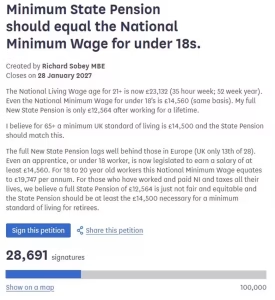
Live UK Parliament petition showing support for the £14,500 minimum State Pension campaign.
Why Are Campaigners Calling For The State Pension To Increase To £14,500?
One of the most prominent current campaigns was created by Richard Sobey MBE and calls for the minimum State Pension to equal at least the National Minimum Wage applying to workers under 18.
The petition argues that an under-18 worker earning the minimum wage for 35 hours a week over 52 weeks would receive £14,560 a year.
It compares this with a full new State Pension of around £12,500 a year and argues that people who have worked, paid tax and made National Insurance contributions over their working lives should receive at least £14,500 in retirement.
The petition was published on 28 July 2026 and is scheduled to close on 28 January 2027. It passed 10,000 signatures in August, which triggered a formal Government response.
How Much Would £14,500 Mean Per Week?
A pension of £14,500 a year would work out at approximately:
£14,500 ÷ 52 = £278.85 per week
That can be compared with the current 2026/27 full new State Pension of £241.30 per week.
| Amount | Weekly | Annual Approximation |
| Full New State Pension 2026/27 | £241.30 | £12,547.60 |
| Campaign Proposal | £278.85 | £14,500 |
| Approximate Difference | £37.55 | £1,952.40 |
The campaign is therefore asking for a substantial increase above the current full rate rather than simply the normal annual Triple Lock uprating.
What Has The Government Said About The £14,500 State Pension Campaign?
The Government formally responded on 11 September 2026 and said it has no plans to make the State Pension equal to the National Minimum Wage for under-18s.
Its response stressed that State Pension and minimum wage serve different purposes.
The minimum wage regulates pay for employment, whereas the State Pension is part of the retirement income system alongside workplace pensions, private savings and other forms of support.
The Government also pointed to the current Triple Lock and said more than £186 billion would be spent directly on State Pension and pensioner benefits in Great Britain during 2026/27.
It highlighted Pension Credit, Winter Fuel Payment and other support available to eligible pensioners.
This distinction matters for households facing financial pressure.
Pension increases are only one part of retirement support, while eligibility for Pension Credit and other cost-of-living support in 2026 can affect the overall amount of help a lower-income pensioner receives.
The petition remains open despite the Government’s response, meaning people can continue signing it until its closing date. However, the Government response means there is currently no approved £14,500 State Pension.
Is There A Campaign To Reduce The State Pension Age To 65?
Yes. A separate petition created by Michelle Gill calls for the State Pension age to be reduced to 65 for everyone.
The campaign argues that some people aged between 65 and 67 experience poor health, caring responsibilities and limited employment opportunities.
It also argues that allowing earlier retirement could create employment opportunities for younger people.
The petition was published on 16 September 2026 and is scheduled to remain open until 16 March 2027.
As of 15 October 2026, it has reached 81,745 signatures, making it much closer to the 100,000-signature level than the £14,500 pension campaign. The figure is live and can continue changing while the petition remains open.
The Government responded on 13 October 2026, stating that it has no plans to lower the State Pension age.
It also confirmed that the State Pension age is currently moving gradually from 66 to 67. This process began in April 2026 and is due to finish in March 2028.
The Government said the Third State Pension Age Review is considering the appropriate pension age for future decades, taking account of factors including life expectancy, sustainability and fairness between generations.
What Happens If The State Pension Age Petition Reaches 100,000 Signatures?
A petition reaching 100,000 signatures does not automatically change the State Pension age.
The UK Parliament petition system generally works in stages:
- 10,000 Signatures: The Government responds to the petition
- 100,000 Signatures: The petition is considered for a debate in Parliament
- Parliamentary Debate: MPs can discuss the proposal and Government policy
- Policy Decision: The Government would still have to decide whether to pursue a change
- Legislation: Where required, Parliament would need to approve changes to existing law
The age-65 petition has already passed the first threshold and received its Government response.
If it reaches 100,000 signatures, it can be considered for debate, but Parliament’s petition page makes clear that this threshold is about consideration for debate, not automatic approval.
Therefore, even if the campaign reaches 100,000 signatures, people approaching retirement should continue planning around the State Pension age that applies under current law unless an official change is announced.
What Is The Current State Pension In 2026/27?
The State Pension already increased in April 2026.
The full new State Pension rose from £230.25 to £241.30 per week, while the full basic State Pension increased from £176.45 to £184.90 per week.
| State Pension | 2025/26 | 2026/27 | Weekly Increase |
| Full New State Pension | £230.25 | £241.30 | £11.05 |
| Full Basic State Pension | £176.45 | £184.90 | £8.45 |
The increase was 4.8%, reflecting the relevant earnings measure used under the Triple Lock for the April 2026 uprating.
These are full headline rates. Individual pension payments can be different depending on National Insurance history and, particularly for people with pre-April 2016 records, transitional pension rules and additional pension components.
The State Pension is also taxable income. Someone receiving the full new State Pension gets approximately £12,547.60 over 52 weeks, before considering any other taxable income.
As State Pension income rises, the interaction between pension payments and the tax system is becoming increasingly important, particularly for pensioners affected by HMRC pensioner tax increases and changing tax liabilities.
Could The State Pension Increase Again In April 2027?
Yes. Another annual State Pension uprating is expected from April 2027 under the current Triple Lock, but the final percentage has not yet been officially confirmed as of 15 October 2026.
One important part of the calculation is already known.
The Office for National Statistics reported that annual growth in employees’ total average earnings was 3.9% during May to July 2026. Regular earnings excluding bonuses grew by 3.5%.
The May-to-July average earnings measure is relevant to the Triple Lock comparison. The other key figure is September CPI inflation.
However, the ONS has scheduled its September 2026 inflation release for 21 October 2026, meaning that figure was not yet published at the time of writing.
What Figures Will Decide The April 2027 Increase?
Under the existing Triple Lock, the basic State Pension and full new State Pension increase according to the highest of:
- Average Earnings Growth
- September CPI Inflation
- 5%
With the relevant earnings figure at 3.9%, that currently provides an important benchmark. If September CPI is higher, inflation could instead become the determining part of the Triple Lock.
Until the inflation figure is published and the Government formally confirms the 2027/28 rates, any exact weekly pension amount for April 2027 should be treated as an estimate rather than a guaranteed payment.
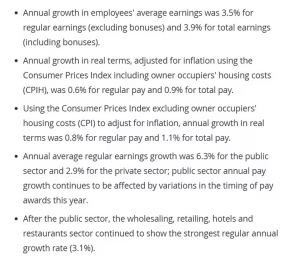
ONS earnings data showing 3.5% regular pay growth and 3.9% total pay growth.
Is The State Pension Triple Lock Changing From 2030?
Yes. This is now an announced Government policy rather than simply a campaign proposal.
The Government confirmed that the existing Triple Lock will remain in place throughout the current Parliament, but an adjusted Triple Lock will operate from April 2030.
Under the existing system, State Pension rises by whichever is highest of:
- Inflation
- 5%
- Average Earnings Growth
The Government says the full new State Pension is expected to rise by more than £2,000 over the course of this Parliament and reach a record level relative to earnings.
How Will The Adjusted Triple Lock Work?
From April 2030, the basic and full new State Pension will rise each year by the highest of:
- Inflation
- 5%
- The Amount Needed To Return Or Maintain The State Pension’s Value Relative To Earnings
The change means earnings will no longer operate in exactly the same way as under the present Triple Lock. Instead, the Government intends the pension to maintain its long-term relationship with earnings rather than continually grow faster than wages.
Current pensioners will continue under the existing Triple Lock until April 2030. After that point, their pensions will move to the adjusted system and will continue to increase annually.
GOV.UK Triple Lock reform factsheet explaining the planned State Pension uprating changes from April 2030.
State Pension Campaign Proposals Vs Current Government Policy
Several different figures and proposals are being discussed at the same time, which can make it difficult to separate an official change from a campaign demand.
| Issue | Campaign Or Proposal | Current Government Position |
| Minimum State Pension | At least £14,500 a year | No direct minimum-wage link planned |
| State Pension Age | Reduce to 65 | No plans to lower it |
| April 2027 Increase | Higher pension expected under Triple Lock | Final percentage not yet confirmed |
| Triple Lock Until 2030 | Maintain current protection | Current system remains during this Parliament |
| Triple Lock From 2030 | Future pension protection | Adjusted Triple Lock announced |
The same distinction should be applied when pension-related proposals circulate online.
For example, reports surrounding a £12,500 pension advance proposal should not be confused with a payment that every pensioner can currently claim. A proposed scheme, petition or campaign only becomes relevant to entitlement once an official policy is approved and implemented.
Could The Government Change Its Position On The State Pension Campaign?
Yes, government policy can change in the future, but neither of the two major petitions currently guarantees such a change.
The Government’s statement that it has “no plans” to introduce a policy describes its present position. It does not permanently prevent a future government, Parliament or the current administration from reconsidering pension policy.
Campaigns can influence that process by:
- Building Public Support
- Attracting Parliamentary Attention
- Encouraging MPs To Raise The Issue
- Producing Parliamentary Debate
- Keeping Pension Policy In The Public Spotlight
However, campaign success should not be measured only by petition signatures. An actual State Pension change requires an official decision and, where necessary, legislation or regulations.
For pensioners, the safest distinction is:
Campaign → Government Consideration → Policy Decision → Legal Change → New Pension Entitlement
Only the later stages can directly alter what someone receives.
Why Does The Government Not Directly Link State Pension To Minimum Wage?
The £14,500 campaign compares retirement income with the legal minimum wage, but the Government argues that the two systems have different purposes.
The National Minimum Wage is designed to set a legal minimum hourly rate for eligible workers. State Pension is a retirement benefit whose entitlement depends largely on a person’s National Insurance record.
The Government also considers the State Pension as one part of a wider retirement income system, which can include:
- Workplace Pensions
- Private Pensions
- Personal Savings
- Pension Credit
- Housing Support
- Winter Fuel Payment
- Other Benefits Where Eligible
It has also warned that direct international comparisons between pension systems can be misleading because countries have different tax systems, living costs, occupational pension arrangements and social benefits.
That does not prevent campaigners from arguing that the current pension is inadequate. It explains why the Government has rejected the idea that State Pension should automatically match a particular minimum-wage rate.
State Pension Increase Campaign Timeline
| Date | Development |
| 28 July 2026 | £14,500 minimum State Pension petition published |
| 27 August 2026 | Petition passes 10,000 signatures and qualifies for a Government response |
| 11 September 2026 | Government rejects a direct State Pension link to the under-18 minimum wage |
| 15 September 2026 | ONS reports 3.9% total earnings growth for May to July 2026 |
| 16 September 2026 | State Pension age 65 petition published |
| 29 September 2026 | Government publishes State Pension uprating analysis |
| 1 October 2026 | Age-65 petition passes 10,000 signatures |
| 6 October 2026 | Triple Lock reform factsheet updated |
| 13 October 2026 | Government responds to age-65 campaign |
| 21 October 2026 | September CPI inflation data scheduled for publication |
| 28 January 2027 | £14,500 petition due to close |
| 16 March 2027 | State Pension age 65 petition due to close |
The timeline shows why the State Pension campaign story is still developing. The two petitions remain open, the April 2027 uprating has not yet been fully determined, and the longer-term Triple Lock policy has only recently been clarified.
What Should Pensioners Do While The Campaigns Are Ongoing?
Pensioners should base household budgets on confirmed entitlement rather than campaign figures.
A £14,500 campaign target does not mean a pension will rise to £14,500, and an 81,000-plus-signature petition does not mean State Pension age has fallen to 65.
Before acting on a pension-related claim, check:
- Whether The Announcement Comes From The Government Or DWP
- Whether The Amount Is Confirmed Or Proposed
- Which Tax Year The Figure Applies To
- Whether It Is The Full New Or Basic State Pension
- Whether The Figure Is Weekly Or Annual
- Whether Individual National Insurance Records Affect Entitlement
- Whether Extra Income Could Have Tax Consequences
Tax is particularly relevant as pension income rises. The State Pension is taxable even though Income Tax is normally collected through other income or later HMRC calculations rather than being deducted directly from each pension payment.
Pensioners receiving unexpected calculations should therefore pay attention to official HMRC assessment letters and tax calculations rather than assuming every change in take-home income comes directly from DWP.
For now, the clearest position is that campaigns are creating political pressure, but the £14,500 pension and State Pension age of 65 have not been approved.
FAQs
Is The State Pension Increasing To £14,500 A Year?
No confirmed policy currently raises the State Pension to £14,500 a year. That amount comes from an active parliamentary petition that the Government has said it does not currently plan to adopt.
Has The Government Approved The State Pension Increase Campaign?
No. The Government has responded to the minimum-wage State Pension petition but rejected a direct link between State Pension and the National Minimum Wage for under-18s.
Will The State Pension Age Be Reduced To 65?
There is currently no approved reduction to 65. The Government said on 13 October 2026 that it has no plans to lower State Pension age, while the existing age is gradually moving from 66 to 67.
How Many Signatures Does The State Pension Age Petition Have?
As of 15 October 2026, the petition has 81,745 signatures. The number is live and can continue to rise while the petition remains open until 16 March 2027.
What Happens When A Petition Reaches 100,000 Signatures?
A petition reaching 100,000 signatures is considered for debate in Parliament. It does not automatically become law and does not guarantee that the Government will introduce the requested policy.
How Much Could The State Pension Rise In April 2027?
The final increase has not yet been confirmed. May-to-July 2026 total earnings growth was 3.9%, while the September CPI figure needed for the Triple Lock comparison is due to be published on 21 October 2026.
Is The Triple Lock Being Scrapped In 2030?
No. The Government has announced an adjusted Triple Lock from April 2030 rather than ending annual protection altogether. Pension increases will continue to be protected against inflation and the 2.5% floor, with a mechanism designed to maintain the State Pension’s value relative to earnings over time.