
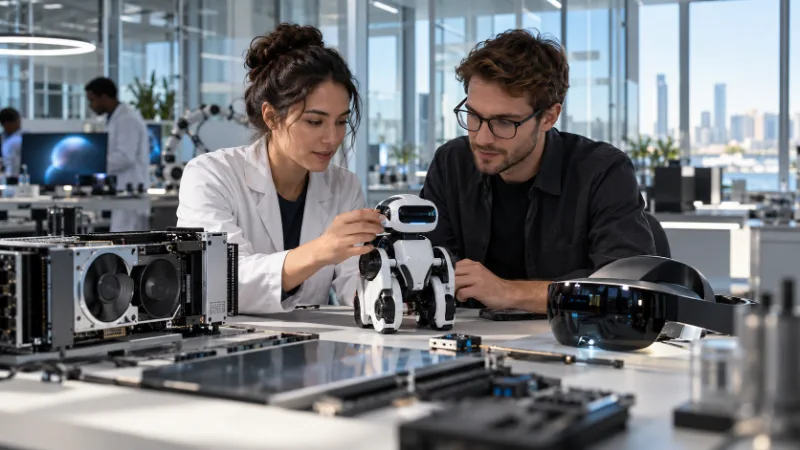
The latest in tech from AlienSync in 2026 reflects a wider shift towards artificial intelligence, connected software, automated workflows, cloud technology, digital security and applications that can communicate more effectively with each other.
AlienSync has developed a visible presence as a technology-focused content platform covering subjects including AI, apps, software, blockchain, digital platforms and emerging technology.
At the same time, some AlienSync material discusses synchronisation systems, connected applications and branded technology concepts.
That creates an important distinction for readers.
AlienSync’s technology publishing activity is clearly visible, while some descriptions of individual products, platforms and capabilities should be treated as concepts or claims unless their commercial availability can be independently established.
For businesses, however, the trends surrounding AlienSync are highly relevant because they reflect many of the technological changes already influencing modern workplaces.
What Is the Latest in Tech From AlienSync?
The latest AlienSync technology coverage largely falls into several interconnected areas:
| Technology Area | Current Direction | Why It Matters |
| Artificial intelligence | AI becoming integrated into everyday software | Can automate repetitive work and support decision-making |
| Software integration | Connecting multiple applications | Reduces duplicate work and fragmented information |
| Automation | Trigger-based digital workflows | Can improve productivity |
| Cloud technology | Online applications and data access | Supports flexible and remote working |
| Cybersecurity | Stronger account and data protection | Becomes more important as applications connect |
| Social technology | Managing activity across several platforms | Helps businesses coordinate digital communication |
| Data management | Synchronisation, backup and recovery | Helps maintain reliable information |
| Apps | More connected digital services | Can simplify everyday workflows |
| Blockchain | Continued experimentation with decentralised systems | May support specialised digital applications |
The most significant trend is not necessarily the arrival of one completely new technology.
Instead, technologies that were previously separate are increasingly being combined.
Artificial intelligence can connect with productivity software. Accounting applications can connect with banking systems. Marketing platforms can connect with customer databases. Social platforms can connect with scheduling and analytics software.
The result is an increasingly interconnected digital business environment.
Is AlienSync a Technology Website or a Software Platform?

This is one of the most important questions surrounding AlienSync.
AlienSync is clearly visible as a technology-content website covering areas such as:
- Artificial intelligence
- Apps
- Software
- Digital platforms
- Blockchain
- Cryptocurrency
- Social technology
- Security
- Gaming
- Emerging technology
Some AlienSync content also describes the name as being connected with software synchronisation and systems that bring different applications together.
However, readers should distinguish between an editorial description of how a technology could operate and evidence that a fully developed commercial platform offering every described capability is currently available.
This does not mean AlienSync’s technology discussions lack value.
It simply means businesses should apply the same due diligence they would use when evaluating any emerging technology platform.
Before adopting software for important business functions, companies should verify its functionality, security arrangements, support, pricing, compatibility and data policies.
Software Integration Is Becoming More Important
One of the strongest themes associated with the latest in tech from AlienSync is software integration.
Modern organisations frequently use dozens of digital tools.
A small business might use separate systems for:
- Accounting
- Customer relationship management
- Social media
- Project management
- Payments
- Stock management
- Analytics
- File storage
- Communications
If these applications cannot exchange information, employees often have to transfer data manually.
That creates unnecessary work.
For example, an employee might receive a customer order through one system, manually copy the information into accounting software and then enter it again into a delivery or stock-management platform.
An integrated workflow could potentially automate much of that process.
This is already common in financial management. Modern business accounting software for small businesses increasingly integrates with banking, invoicing, payroll, eCommerce and other operational tools.
What Does Synchronisation Actually Mean?
Synchronisation means keeping information consistent across different systems, applications or devices.
Consider a business that updates a customer’s contact details.
Without synchronisation, that change might have to be repeated manually inside:
- The CRM
- Accounting software
- Marketing software
- Customer support software
- Order-management software
With properly configured integration, a change made in one authorised system could automatically update other connected applications.
That can create several benefits:
- Less repetitive work: Employees spend less time copying information between systems.
- Fewer inconsistencies: Automated data movement can reduce situations where different applications contain different versions of the same information.
- Faster workflows: Information can move between departments without waiting for someone to transfer it manually.
- Better reporting: Connected systems can provide a broader picture of business activity.
However, integration also creates risks.
If incorrect information is synchronised automatically, an error can spread across several systems rapidly. Businesses therefore need validation, permissions and monitoring rather than assuming that more automation is always better.
Artificial Intelligence Is Moving Beyond Standalone Chatbots
Artificial intelligence is another major theme surrounding AlienSync’s technology coverage.
The significant development in 2026 is the movement from standalone AI tools towards embedded AI.
Instead of visiting a separate AI application, users increasingly encounter AI inside software they already use.
AI can potentially help businesses:
- Draft documents
- Analyse data
- Categorise information
- Summarise meetings
- Create marketing content
- Handle routine customer enquiries
- Detect unusual activity
- Analyse financial information
- Automate administrative processes
- Search large collections of documents
The more important development is what happens when AI becomes part of an automated workflow.
Imagine a customer sends a support request.
An integrated system could potentially:
- Receive the message.
- Identify the subject using AI.
- Categorise its urgency.
- Retrieve relevant customer information.
- Create a suggested response.
- Assign the case to the correct employee.
- Record the interaction automatically.
That is significantly different from simply asking a chatbot a question.
AI Orchestration Could Become a Major Business Trend
AI orchestration refers to coordinating AI models with applications, databases and business rules.
Instead of one AI system performing an isolated task, multiple services can work together.
For example:
Customer submits form → CRM records lead → AI analyses enquiry → lead receives category → sales representative receives notification.
The attraction is obvious.
Businesses can reduce repetitive administration while making information available more quickly.
It also explains why AI automation is increasingly appearing among promising business opportunities in the UK, particularly as companies seek specialists capable of connecting existing software with newer AI systems.
But AI orchestration requires careful governance.
Organisations need to determine:
- What data AI can access
- Which actions can happen automatically
- Which decisions require human approval
- How errors are detected
- Who remains responsible for the final outcome
- What happens when an integration fails
Automation without those controls can create as many problems as it solves.
Cybersecurity Becomes More Important When Software Connects
Connected software introduces a basic security challenge.
Every new integration creates another relationship between systems.
That relationship may involve:
- Login credentials
- API access
- Customer information
- Business records
- Financial data
- Employee information
- Authentication tokens
- Cloud storage
If one connected service is compromised, attackers may attempt to use that access to move into other systems.
Businesses therefore need to consider security at the integration level, not merely at the application level.
Important controls can include:
- Multi-factor authentication
- Role-based access
- Limited permissions
- Encryption
- Activity logging
- Regular credential reviews
- Backup systems
- Account removal procedures
- Security monitoring
A useful principle is to give each application only the access it genuinely requires.
An integration that only needs customer names and order numbers, for example, should not automatically receive access to an entire business database.
Data Backup and Recovery Cannot Be Ignored
Synchronisation should not be confused with backup.
They perform different functions.
A synchronised system keeps information consistent across connected platforms.
A backup preserves a recoverable copy of information.
The difference becomes important when something goes wrong.
If incorrect data is synchronised across several applications, synchronisation alone may simply reproduce the error everywhere.
A separate backup may be needed to restore the original information.
Businesses using highly connected technology environments should therefore think about:
- Backup frequency
- Recovery procedures
- Data retention
- Version history
- Business continuity
- System outages
- Failed integrations
New technology is valuable only when organisations can recover when something fails.
Social Media Technology Is Becoming More Connected
AlienSync also discusses the intersection between software and social platforms.
Social media management previously required users to visit individual platforms separately.
Businesses can now use connected systems to coordinate:
- Publishing
- Scheduling
- Content production
- Customer interactions
- Analytics
- Advertising
- Reporting
- Approval workflows
AI can also become part of these processes.
For example, an organisation could use AI to create initial content ideas before staff review and approve them for publication.
The important word is review.
Businesses should not assume every AI-generated post is accurate, appropriate or aligned with brand requirements.
Human oversight remains particularly important when content relates to:
- Financial information
- Legal claims
- Health information
- Customer complaints
- Public statements
- Sensitive corporate announcements
Cloud Technology Remains the Foundation
Many modern technology trends would be much harder to implement without cloud computing.
Cloud-based applications allow businesses to access software and information through internet-connected services instead of relying entirely on programs stored on individual computers.
That supports:
- Remote working
- Cross-device access
- Automatic software updates
- Team collaboration
- Centralised information
- Software integrations
- Scalable storage
- AI services
Cloud infrastructure also makes it easier for applications to exchange information.
However, businesses still need to understand where information is stored, who can access it and how accounts are protected.
Convenience should not replace governance.
What About AlienSync’s Named Technology Concepts?
AlienSync material has previously referenced names associated with technology concepts or product-style announcements.
These types of descriptions can make AlienSync appear to be a conventional technology manufacturer or software ecosystem.
Readers should be careful about interpreting them.
A technology name appearing in editorial material is not necessarily equivalent to a widely distributed commercial product with established customers, public technical documentation and broad market availability.
Businesses evaluating any AlienSync-branded technology should therefore look for practical evidence such as:
- Clear product documentation
- Demonstrable functionality
- Transparent pricing
- Support arrangements
- Privacy information
- Security documentation
- Compatibility requirements
- Real deployment information
The same standard should apply to any unfamiliar technology provider.
How Could These Technologies Affect Small Businesses?
The trends covered by AlienSync have practical implications for SMEs.
Administrative Work Could Become More Automated
Tasks involving data entry, scheduling, reporting and routine communication may increasingly be automated.
Teams Could Use Fewer Manual Handoffs
Connected applications can move information between departments automatically.
AI Could Become a Standard Software Feature
AI may gradually become something employees use inside existing business platforms rather than through dedicated AI applications.
Cybersecurity Requirements Will Increase
More connections between platforms create more points that businesses need to protect.
Technology Skills Will Become More Valuable
Companies may increasingly need staff or consultants who understand automation, integrations, AI and data management.
Could AI Reduce Employment?
Automation can change how companies structure particular jobs.
The effect varies significantly between industries and occupations.
Some tasks may disappear, while others may change rather than vanish completely. New roles can also emerge around AI implementation, data governance, software integration and security.
Recent examples of AI-driven workforce changes demonstrate why businesses and employees are paying closer attention to how automation may reshape certain functions.
The key distinction is between automating tasks and replacing entire jobs.
Many occupations involve numerous responsibilities, only some of which are suitable for automation.
What Should Businesses Check Before Adopting Emerging Technology?
Companies should avoid selecting technology simply because it is new.
Before adopting an unfamiliar system, decision-makers should ask:
| Question | Why It Matters |
| What business problem does it solve? | Prevents unnecessary software purchases |
| Does it integrate with existing systems? | Reduces compatibility problems |
| What data does it access? | Helps assess privacy risks |
| Can permissions be limited? | Reduces unnecessary access |
| What happens if the service fails? | Supports business continuity |
| Can data be exported? | Reduces platform dependency |
| Are backups available? | Helps recover information |
| Who controls automated actions? | Establishes accountability |
| Can employees review AI outputs? | Reduces automation errors |
| Is the technology sufficiently documented? | Helps verify claims |
Technology should improve a business process rather than create another layer of complexity.
What Is Most Important About AlienSync’s Technology Coverage?

The most useful message emerging from the latest in tech from AlienSync is that modern technology is becoming increasingly interconnected.
Artificial intelligence is connecting with software.
Software is connecting with cloud services.
Cloud systems are connecting with business data.
Social networks are connecting with marketing platforms.
Accounting systems are connecting with banks.
Customer databases are connecting with automation tools.
This interconnected environment can dramatically improve efficiency, but it also makes reliability, security and governance more important.
The future of business technology is therefore not simply about obtaining more applications.
It is about making the right applications work together safely.
What Should Readers Watch Next From AlienSync?
Readers following AlienSync should pay particular attention to several areas during 2026 and beyond.
More Practical AI Integrations
The most interesting developments will involve AI performing useful work inside existing business processes rather than operating as an isolated tool.
Greater Transparency Around Technology Products
If AlienSync expands beyond editorial technology coverage, clearer technical documentation, product availability and practical demonstrations would make individual technology claims easier to evaluate.
Stronger Security Controls
As platforms become interconnected, permission management and authentication will become increasingly important.
Smarter Automation
Automation is likely to become more contextual, with systems responding to events rather than simply following fixed schedules.
Better Cross-Platform Data Management
Companies will continue looking for ways to maintain consistent information across multiple applications.
FAQs About the Latest in Tech From AlienSync
What is the latest in tech from AlienSync?
The latest in tech from AlienSync covers areas including artificial intelligence, software integration, apps, cloud technology, automation, cybersecurity, social platforms and other emerging digital developments.
Is AlienSync an AI company?
AlienSync is most clearly identifiable as a technology-content platform covering AI alongside several other technology subjects. Some of its content also describes synchronisation and technology concepts, but readers should distinguish editorial descriptions from verified commercial product availability.
What does AlienSync mean by synchronisation?
Synchronisation generally refers to keeping data or actions consistent between connected applications, platforms or devices. This can reduce the need to enter the same information manually in several places.
Why is AI important to AlienSync’s technology coverage?
AI increasingly works alongside other software rather than operating independently. When connected to business applications, AI can potentially assist with analysis, communication, automation and administrative tasks.
Is software integration useful for small businesses?
Yes, when it solves a genuine operational problem. Integrating accounting, CRM, payment, eCommerce and other systems can reduce manual administration, although unnecessary integrations can also increase complexity.
Are connected applications safe?
They can be, but businesses need appropriate authentication, restricted permissions, security monitoring and recovery procedures. Every additional connection can potentially expand the amount of data accessible through a system.
Is synchronisation the same as backing up data?
No. Synchronisation keeps information consistent between systems, while a backup creates a recoverable copy. Businesses often need both.
What should businesses verify before adopting new technology?
Businesses should check functionality, security, compatibility, pricing, data handling, support, backup arrangements and whether the product actually solves an operational problem.
Will AI replace business software?
Probably not in the straightforward sense of replacing all software. AI is increasingly being incorporated into existing business applications, making traditional software more automated and responsive.
What should readers watch next from AlienSync?
The most useful developments to watch are practical AI integrations, clearer software documentation, stronger security controls, improved cross-platform synchronisation and examples showing how emerging technology performs in real-world situations.