

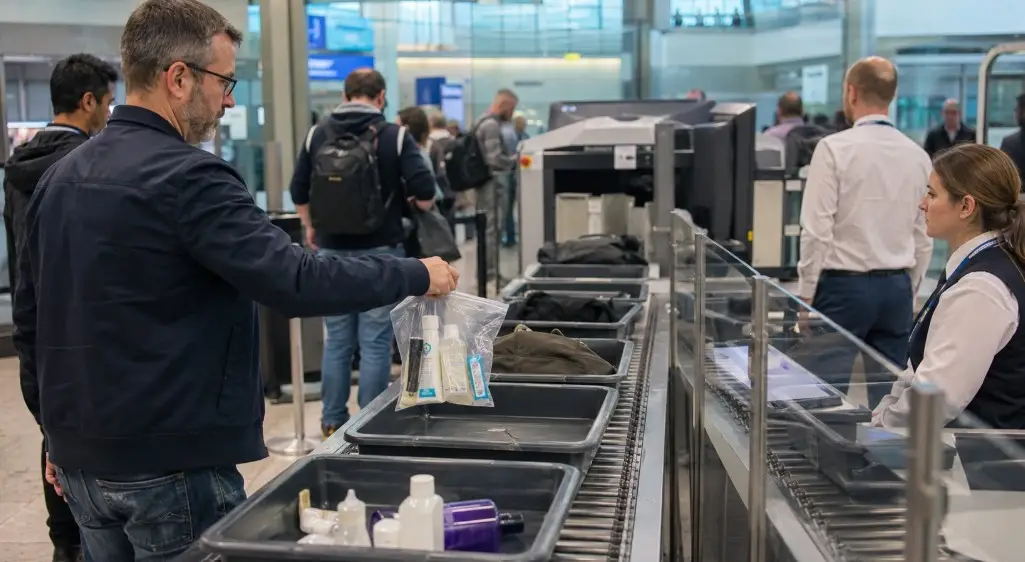
Seven UK airports now allow passengers to carry individual liquid containers of up to two litres through security, but the change is not nationwide. Heathrow, Gatwick, Edinburgh, Birmingham, Bristol, Belfast International and Belfast City apply the relaxed limit, while most other UK airports continue to restrict each container to 100ml.
The crucial distinction is that new security scanners do not always remove the size limit. Some airports let travellers keep liquids and electronics inside their cabin bags while still enforcing the 100ml rule. Passengers must therefore check every departure, connecting and return airport separately.
Key Takeaways:
- Seven UK airports currently permit liquid containers of up to two litres.
- Seventeen major airports are reported to retain the 100ml container limit.
- A half-full container larger than the permitted size can still be refused.
- Return and connecting airports may apply different restrictions.
The airport operating the security checkpoint determines which liquid rules apply at that stage of the journey.
Which UK Airports Have Lifted the 100ml Liquid Limit?
Current official guidance and July 2026 reporting identify seven airports where passengers can take containers holding up to two litres through security.
UK Airports Allowing Larger Liquid Containers:
| Airport | Maximum Container Size | Liquids Stay in Bag? | Important Restriction |
| Heathrow | 2 litres each | Yes | Metal and insulated bottles must be empty |
| Gatwick | 2 litres each | Yes | Metal and double-walled containers must be empty |
| Edinburgh | 2 litres each | Yes | Metallic and double-walled containers must be empty |
| Birmingham | 2 litres each | Yes | Anything larger belongs in checked baggage |
| Bristol | 2 litres each | Yes | Metal drinks bottles must be empty |
| Belfast International | 2 litres each | Yes | Follow security staff instructions |
| Belfast City | 2 litres each | Yes | Return-airport rules may differ |
Heathrow applies the two-litre allowance at Terminals 2, 3, 4 and 5. Edinburgh permits multiple liquid containers with no stated combined liquid limit, provided each container holds no more than two litres.
Gatwick, Bristol and Edinburgh also state that metal, vacuum-insulated or double-walled bottles must be empty before screening. Birmingham and both Belfast airports permit liquids, gels and pastes of up to two litres to remain in cabin baggage.
These allowances apply at the named departure airports and should not be assumed to cover another airport later in the journey.
Which UK Airports Still Enforce the 100ml Liquid Rule?
A July 2026 comparison lists 17 major airports where containers must still be 100ml or less. This is a reported comparison rather than a permanent government register, so individual airport instructions remain decisive.
Airports Retaining the 100ml Restriction
The current UK liquids guidance says most airports do not permit containers larger than 100ml, even when they are only partly full. A 200ml bottle containing just 50ml can consequently be refused because its maximum capacity exceeds the limit.
At airports requiring a traditional liquids bag, containers must fit into one transparent, resealable bag holding no more than one litre. The bag should measure approximately 20cm by 20cm, close completely and be limited to one per passenger.
Manchester expects more than 5.7 million passengers between 17 July and 1 September 2026, over 120,000 a day, after handling more than three million passengers in a record June. Despite its upgraded scanners, its 100ml container limit remains in place throughout the summer.
Can Passengers Keep 100ml Liquids Inside Their Bags?
Yes, at several upgraded airports. Manchester, London Luton, London City and Teesside permit compliant liquids to remain inside hand luggage and no longer require a separate plastic bag, but larger containers remain prohibited.
London City and Teesside are particularly important examples because both previously announced the removal of the 100ml limit. Their current passenger instructions have reverted to containers of no more than 100ml, showing why older announcements should not be treated as current travel guidance.
Why Do Liquid Rules Differ Between UK Airports?

Next-generation CT scanners create detailed three-dimensional images of cabin-bag contents, allowing security officers to inspect liquids and electronics without passengers routinely removing them. However, installation, testing, regulatory approval and full terminal deployment are separate stages.
Edinburgh lifted the restriction after a £24 million security project involving eight new X-ray machines. Its security hall now has eight lanes, two more than before, and uses advanced screening equipment to allow liquids and large electronics to remain in bags.
Gordon Dewar, the airport’s chief executive, said:
“This is a big day for our passengers and the airport team – we are delighted to be able to lift this rule.”
He also warned passengers to check their return airport because the rules are not uniform.
The original 100ml restriction was introduced in 2006. Stop-start implementation since then has left some airports with modern scanners but without permission to accept larger containers.
What Counts as a Liquid Under UK Airport Security Rules?
Airport liquid restrictions cover anything that can be poured, spread, sprayed or squeezed, not simply bottled drinks.
Items Commonly Treated as Liquids
- All drinks, including water.
- Soup, jam, honey, sauces and syrups.
- Creams, lotions, oils and liquid cosmetics.
- Perfume, mascara and lip gloss.
- Toothpaste and other pastes.
- Hair gel, shower gel and similar products.
- Shaving foam, hairspray and spray deodorant.
- Contact-lens solution and comparable mixtures.
- Liquid-filled toys, snow globes and some “squishy” toys.
Manchester specifically warns that gel-filled children’s toys may fall within the liquid rule and should go in hold baggage when their contents exceed 100ml.
Frozen liquids are not permitted in cabin baggage under general UK guidance, while frozen foodstuffs are also prohibited at airports such as Gatwick and Edinburgh. Security staff may refuse any item they consider dangerous even when it would normally be allowed.
Which Liquid Exemptions Apply at UK Airports?
Essential medicines, liquids for special dietary requirements, baby milk and baby food may be carried in containers of up to two litres through all UK airports. Exempt items can still be inspected, opened or tested at security.
Essential Medicines and Special Dietary Liquids
Passengers may carry liquid medicine needed for the journey, including a reasonable amount for possible delays. The liquid medicine screening requirements explain that supporting evidence may include a prescription label or a letter from a medical professional, particularly for containers exceeding the ordinary airport limit.
Travellers should keep medicines accessible and tell security officers about any item that may require separate screening.
How Are Baby Milk and Baby Food Treated?
Baby milk, sterilised water and baby food needed for the journey are exempt from the normal 100ml rule, with individual containers generally permitted up to two litres. Security staff may ask an accompanying adult to open, taste or otherwise verify an item.
Cooling gel packs required for medical or dietary products may also qualify, but passengers should carry only a sufficient quantity for the journey.
Duty-Free Liquids and Connecting Flights
Duty-free liquids may pass through security when they remain sealed in an approved security bag and the receipt is sealed inside and visible. The bag should remain unopened until the passenger reaches the final destination.
Airport staff may open the bag for screening, and another security checkpoint may apply different rules during a transfer.
How Should Passengers Prepare for the New UK Airport Liquid Rules?
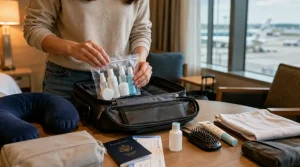
Travellers can reduce the risk of delays or confiscation by checking each stage of their itinerary.
Preparing for airport liquid rules:
- Check the departure airport’s current security page.
- Verify every connecting and return airport separately.
- Confirm the maximum capacity of each container.
- Check whether liquids can remain inside the cabin bag.
- Find out whether a transparent plastic bag is required.
- Empty metal, insulated and double-walled bottles when instructed.
- Put larger non-essential liquids in checked baggage.
- Keep prescriptions or medical letters accessible.
- Follow security officers’ instructions at the checkpoint.
Airport security limits are separate from an airline’s cabin-bag size and weight allowance. A two-litre container may pass security but still make the bag too large or heavy under the carrier’s baggage policy.
When any airport’s position is unclear, packing liquids in containers of 100ml or less remains the lowest-risk option.
What Problems Can Arise on Return and Connecting Flights?
The biggest practical risk is an inconsistent allowance across the itinerary. A full-size bottle accepted on the outbound journey may be refused when the passenger departs from another airport that retains the 100ml limit.
The Return-Flight Liquid Rule Trap
A passenger leaving Heathrow may carry a 500ml bottle through security, but that same bottle could be confiscated at a return airport enforcing the 100ml rule. Heathrow’s two-litre terminal security rules therefore advise passengers to check the requirements applying elsewhere in their journey.
Potential consequences include confiscated toiletries, checked-baggage charges, delays at security and difficulty carrying duty-free purchases through another checkpoint.
What Happens When Airports Apply Different Limits?
The strictest security checkpoint on the itinerary effectively determines which containers can survive the complete journey. Passengers should check the outbound airport, every transfer airport and the airport used for the return departure.
Arrival rules are usually less relevant than the requirements applied when the traveller next enters a security screening area.
Will More UK Airports Remove the 100ml Rule?

Further airports may relax their limits as scanner programmes, testing and regulatory approvals are completed. However, earlier national deadlines changed, and the presence of CT equipment alone does not guarantee that containers above 100ml are permitted.
The mixed position at Manchester, London City and Teesside demonstrates that procedures can move in both directions. Travellers should rely on current passenger guidance rather than assuming that an airport mentioned in an older “100ml rule scrapped” report still operates a two-litre allowance.
Conclusion
The UK airports liquid rule changes make cabin-bag screening easier at Heathrow, Gatwick, Edinburgh, Birmingham, Bristol, Belfast International and Belfast City. Nevertheless, most UK airports still restrict individual containers to 100ml, and some allow liquids to remain in bags without increasing the permitted container size.
Passengers should check every airport involved in the journey, pay attention to metal-bottle restrictions and use 100ml containers whenever the return or connecting-airport rules are uncertain.
Frequently Asked Questions
Can Passengers Take a Full Reusable Water Bottle Through Security?
A full reusable bottle is permitted only where the airport’s liquid and container rules allow it. Metal or insulated bottles may still have to be empty, even at airports using the two-litre limit.
Does the Two-Litre Allowance Apply in Every Airport Terminal?
It applies only where the airport confirms that its relevant terminals operate the relaxed rule. Passengers should verify terminal-specific guidance before departure.
Can a Half-Empty 200ml Toiletries Bottle Pass Security?
Not at an airport enforcing the 100ml rule because the container’s total capacity is what matters. The amount remaining inside does not make an oversized container compliant.
Are Frozen Drinks Allowed in Cabin Baggage?
General UK guidance says frozen liquids cannot be carried in hand luggage. Partially melted products may also be treated as liquids and refused.
Can Several 100ml Containers Be Carried Together?
Yes, subject to the departure airport’s bagging and screening rules. Where a transparent bag is required, all containers must fit inside one resealable one-litre bag.
Are Empty Metal Water Bottles Allowed Through Security?
Empty metal bottles are generally allowed, although they may need separate screening. Several two-litre airports specifically require metallic or double-walled bottles to be empty.
Can Security Staff Refuse a Liquid Within the Published Limit?
Yes, security staff can carry out additional screening or refuse an item they cannot clear safely. Meeting the stated capacity limit does not override airport-security judgement.
Note: Airport security requirements can change at short notice. Passengers should check the official guidance for their departure, connecting and return airports before travelling.