
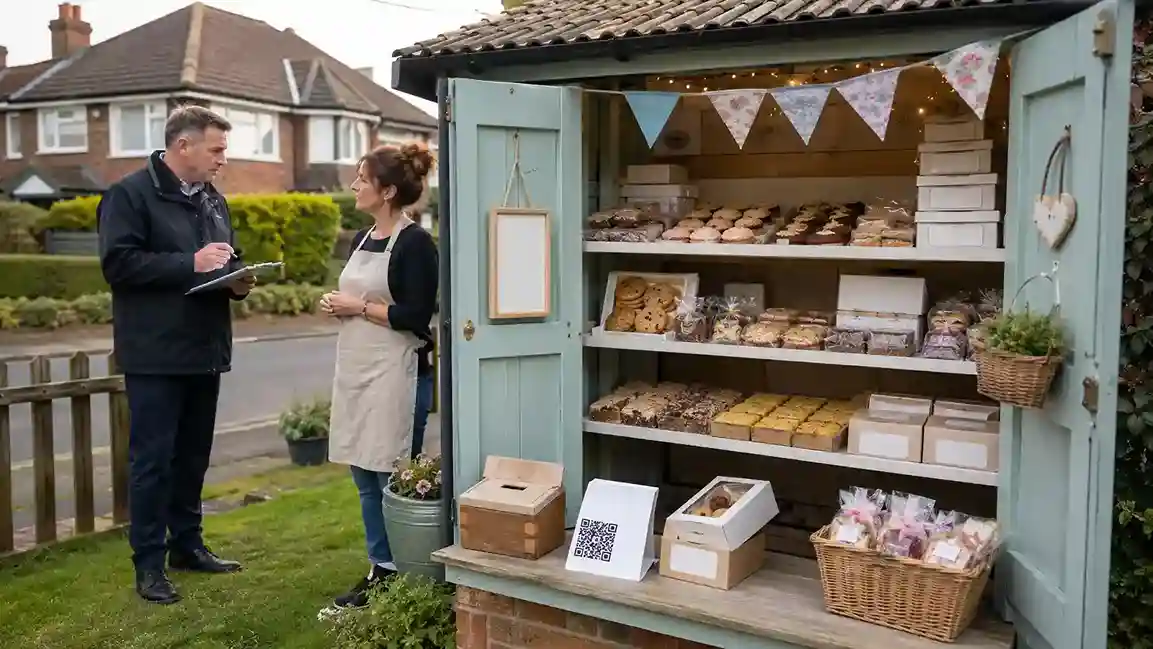
Cake sheds are growing across the UK because they offer home bakers a flexible way to sell homemade treats from gardens, driveways and roadside cupboards.
The UK cake sheds business trend is popular with customers who enjoy local cakes, honesty-box payments and supporting small businesses. However, the trend may be at risk as some councils review whether cake shed owners need street trading licences, food hygiene checks and stronger compliance.
Key takeaways:
- Cake sheds are small self-service stalls selling homemade bakes.
- Many are run as side hustles or home-based businesses.
- Social media is helping cake sheds attract wider local demand.
- Some councils may require street trading licences.
- Food registration, hygiene, allergen labelling and insurance are important.
- Extra licensing costs could threaten smaller cake shed businesses.
What Is the Cake Shed Trend in Britain?

Cake sheds are small self-service outlets, usually placed in front gardens, on driveways or near roadsides. They are stocked with home-baked goods and often work on trust.
Customers may pay by:
- Cash in an honesty box
- Bank transfer
- QR code payment
- Card payment link
Unlike a traditional bakery, a cake shed does not usually have a shop counter or a staff member serving customers all day. The appeal is that it feels personal, simple and local.
From Front Gardens to Roadside Treat Cupboards
Many cake sheds began as a way for home bakers to sell spare stock. A baker might have leftover brownies from a market, extra cupcakes from a celebration order or a batch of traybakes made for local demand.
Instead of letting those bakes go to waste, they are placed in a small shed for customers to buy.
Over time, some of these sheds have become much more organised. They now have regular opening hours, branded packaging, social media updates and loyal weekly buyers.
Why Do Honesty-box Cake Sheds Feel So Appealing?
The honesty-box system gives cake sheds a community feel. People like the idea of being trusted. They also enjoy the surprise of opening the shed door to see what is available that day.
One cake shed owner described how customers react when they visit:
“We have a little camera inside, you see a little happy dance. They’re opening the doors with glee to see what there is this week.”
That sense of joy is one reason cake sheds have spread so quickly.
Why Are Cake Sheds Becoming So Popular Across the UK?
Cake sheds are becoming popular because they combine convenience, community spirit and affordable indulgence.
For customers, they offer something different from supermarket cakes. The products often feel more homemade, more generous and more personal. For bakers, they offer a flexible way to sell without renting a shop or attending markets every weekend.
The trend also reflects the growth of local shopping. Many people like supporting independent businesses, especially when the owner lives nearby.
Social Media Demand and Local Discovery
Social media has played a major role in the rise of cake sheds. A short TikTok video showing a fully stocked shed can bring customers from nearby towns. Facebook groups also help people find local cake sheds and share recommendations.
One cake shed owner said,
“I’ve got quite a big social media presence. I’ll get messages off customers saying, ‘what have you got in the shed today? Because we are travelling from a bit further out’.”
This kind of online attention can turn a small home baking setup into a destination.
A Flexible Business Model for Parents and Home Bakers
Cake sheds are also attractive because they can fit around family life. Some owners open only on Fridays and Saturdays. Others restock during the day when they have time.
This flexibility is one reason many parents, especially mothers, are using cake sheds as a side hustle or full-time business.
One baker said,
“A lot of mums are doing it as a full-time job. They’re just popping up absolutely everywhere. There’s hundreds around the country now.”
How Are Cake Shed Businesses Turning Into Serious Side Hustles?

For some bakers, a cake shed starts as a small weekend project. For others, it quickly becomes a serious source of income.
Danielle Edgington set up her cake shed in Kings Heath, Birmingham, after previously selling baked goods at markets. Her shed became so popular that she left her job as a catering manager to work on the business full-time.
She said,
“It’s taken over my life.”
The Lavender Cake Shed reportedly brings in between £500 and £1,000 a week, with customers travelling from places such as Redditch and Solihull.
That level of demand shows how a simple shed can become a real business.
Weekly Takings, Repeat Customers and Community Support
The best-performing cake sheds often rely on repeat customers. Some people make a weekly visit part of their routine, while others travel after seeing daily stock updates online.
| Business Feature | How It Helps the Owner | Why Customers Like It |
| Honesty-box system | Reduces the need for constant staffing | Feels friendly and trust-based |
| Social media updates | Helps sell stock quickly | Shows what is available before travelling |
| Limited opening days | Makes workload more manageable | Creates anticipation |
| Local collection | Reduces delivery pressure | Convenient for nearby customers |
| Homemade products | Builds a personal brand | Feels fresher than mass-produced cake |
Cake sheds can also create a strong emotional connection between bakers and customers. People are not just buying cake; they are supporting someone local.
From Spare Bakes to Full-time Baking Businesses
Many cake shed owners begin by selling leftover bakes. But if demand grows, the shed can become the main part of the business.
Danielle said,
“I’d get up, I’d go to work in the morning and then I’d come home. I’d be baking all evening. So it just became too much.”
She added,
“I’ve just not been able to keep up with the demand so I’ve decided to go full-time.”
For some home bakers, the shed is no longer an add-on. It is the business.
What Types of Cakes and Bakes Are Usually Sold in Cake Sheds?
Cake sheds usually sell treats that are easy to package, portion and display. The most successful items tend to be colourful, indulgent and suitable for quick takeaway.
Popular products include:
- Brownies and blondies
- Cookies
- Cupcakes
- Lemon drizzle slices
- Sprinkle cake
- Rocky road
- Flapjacks
- Traybakes
- Seasonal treats
| Product Type | Why It Works Well | Customer Appeal |
| Brownies | Easy to cut and package | Rich, indulgent and popular online |
| Cookies | Simple to display | Good for children and quick snacks |
| Lemon drizzle | Travels well | A familiar British favourite |
| Sprinkle cake | Colourful and nostalgic | Popular with families |
| Cupcakes | Visually attractive | Suitable for gifts and treats |
| Rocky road | Long-lasting | Good for impulse purchases |
The best products are usually those that look appealing on social media and can be safely stored for the selling period.
Why Could Cake Sheds Be at Risk?

Cake sheds may be at risk because some councils are reviewing whether they should be treated as street trading businesses.
Street trading rules are designed to regulate the sale of goods in public areas. The challenge is that cake sheds often sit on private property but may be accessed from a pavement, road or driveway.
This creates a grey area.
Street Trading Concerns and Local Council Reviews
Under the Local Government (Miscellaneous Provisions) Act 1982, councils can regulate street trading in certain areas. If a person sells or offers goods for sale in a street, they may need street trading consent or a licence.
Some councils are now considering whether cake sheds fall under those rules.
Council concerns may include:
- Whether customers queue on pavements
- Whether the shed affects road safety
- Whether the business causes parking issues
- Whether goods are being sold from or near a public highway
- Whether the setup is fair to other licensed traders
For councils, the issue is not necessarily that cakes are being sold. It is where and how the sale takes place.
The impact of licence fees on small cake shed owners
Licence fees could be a serious problem for smaller operators.
In Nottinghamshire, several cake shed owners were reportedly told they may need to pay more than £1,000 for a street trading licence or face a fine of a similar amount.
Heather Price, of The Retford Bakeshed, said,
“A licensing enforcement officer arrived and hand-delivered a notice to say I needed a street trading licence. I was flabbergasted.”
After local backlash, enforcement was paused while the council reviewed its policy. However, the situation shows how uncertain the future could be for some cake shed owners.
Heather said it would not be viable to continue if she had to pay the extra costs.
“Those extra requirements in themselves are too expensive to make it worthwhile,” she said.
Do Cake Shed Owners Need a Street Trading Licence?
There is no single answer that applies to every cake shed in the UK. Whether a licence is needed depends on the location, the local council’s policy and how the shed operates.
A cake shed placed entirely on private land may still attract council attention if customers access it from a public street or if trading affects public space.
| Cake Shed Situation | Possible Risk Level | Recommended Action |
| Shed fully inside private property | Lower, but not risk-free | Ask the council for written guidance |
| Shed next to a pavement | Higher | Check street trading rules |
| Customers queue on public land | Higher | Review layout and opening times |
| Daily trading from a roadside position | Higher | Seek council advice before continuing |
| Weekend-only sales from a driveway | Medium | Confirm local requirements |
| Pre-ordered cakes collected from home | Depends on setup | Check food business and collection rules |
Cake shed owners should not assume that another council’s decision applies in their area. Local interpretation can vary.
What Legal Requirements Should UK Cake Shed Owners Understand?

Cake shed owners need to understand the difference between a casual hobby and a food business. Once someone sells food regularly, they are likely to have legal responsibilities.
These responsibilities usually cover food safety, registration, allergen information, labelling, hygiene and insurance.
Food Business Registration
A person selling cakes regularly should usually register as a food business with their local authority. This normally applies even if the baking happens in a home kitchen.
Registration is usually free, but it is important because it tells the council that food is being prepared and sold from the premises.
Food Hygiene Ratings and Inspections
After registration, an environmental health officer may inspect the kitchen or business setup. They will usually look at cleaning, storage, food handling, pest control, cross-contamination and record keeping.
A cake shed owner should be able to show that food is prepared safely and stored correctly before sale.
Allergen Labelling and Food Safety
Allergen information is especially important for cake businesses.
Cakes often contain common allergens such as:
- Eggs
- Milk
- Wheat
- Nuts
- Soya
- Peanuts
- Sulphites in some ingredients
Customers need accurate information so they can make safe choices. This is particularly important when products are prepacked for direct sale.
Business Insurance and Customer Protection
Insurance is another important consideration. Cake shed owners may need public liability insurance and product liability insurance.
They should also check whether their home insurance allows business activity from the property.
| Requirement | Why It Matters | What Owners Should Check |
| Food business registration | Shows the council the business is operating | Register with the local authority |
| Hygiene training | Supports safe food handling | Complete suitable food safety training |
| Allergen information | Protects customers with allergies | Label products clearly |
| Insurance | Protects against claims | Consider product and public liability |
| Council guidance | Reduces licensing uncertainty | Ask for written confirmation |
| Tax records | Helps with HMRC responsibilities | Track income and expenses |
Good compliance helps protect both customers and the business.
How Much Does It Cost to Run a Cake Shed Business in the UK?
A cake shed may look low-cost, but running one properly involves several expenses. Ingredients, packaging, electricity, labels, cleaning supplies, marketing and insurance can all affect profit.
If a street trading licence is required, the cost could become much higher.
| Cost Area | Example Expenses | Business Impact |
| Shed setup | Shed, shelves, signs, locks, lighting | One-off startup cost |
| Baking ingredients | Butter, eggs, flour, sugar, chocolate | Ongoing cost affected by inflation |
| Packaging | Boxes, bags, labels, stickers | Needed for hygiene and presentation |
| Cleaning | Sanitiser, cloths, storage containers | Supports food safety |
| Marketing | Social media content, branding, photos | Helps attract customers |
| Insurance | Public and product liability cover | Protects the owner |
| Possible licensing | Street trading consent or licence fees | Could reduce profitability |
Some owners reinvest most of their early profits back into the shed.
Can Cake Sheds Still Be Profitable With Tighter Rules?

Cake sheds can still be profitable, but extra costs may change the business model.
For larger sheds with strong weekly sales, a licence fee may be manageable. For smaller weekend-only sheds, the same fee could make trading uneconomical.
One baker said,
“The cost can be anything from £1,000 to £3,000, so for some of the smaller sheds, perhaps that wouldn’t be viable for them.”
The challenge is that cake sheds work because they are flexible and relatively low-overhead. If they are treated like more formal street trading businesses, some owners may struggle.
However, clearer rules could also benefit serious bakers. They may help build customer confidence, reduce uncertainty and create fairer expectations across different areas.
How Can Cake Shed Owners Protect Their Business?
Cake shed owners can protect themselves by treating the business professionally from the start.
Keeping Paperwork Organised
Owners should keep records of registration, hygiene training, insurance, ingredients, allergen information, cleaning schedules and income.
This paperwork can help if a council officer asks questions.
Checking Local Council Guidance
Because local rules can vary, owners should contact their council directly. They should ask about food business registration, street trading consent, planning rules and any restrictions on signs or customer access.
Written guidance is better than relying on assumptions.
Building a Loyal Local Customer Base
Strong community support can make a big difference. Many cake shops succeed because customers want to support local bakers.
Owners can build trust by:
- Keeping the shed clean and tidy
- Displaying prices clearly
- Labelling allergens properly
- Posting accurate opening times
- Avoiding pavement obstruction
- Managing customer parking politely
- Responding professionally to questions
A cake shed may feel informal, but customers still expect safety, quality and reliability.
What Does the Future Look Like for UK Cake Sheds?
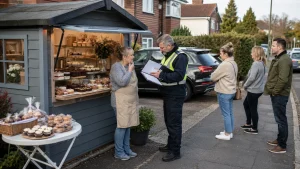
The future of cake sheds will likely depend on how councils respond as the trend grows.
Some councils may take a strict approach and require licences in certain situations. Others may decide that small sheds on private property do not need the same level of regulation as traditional street traders.
The trend may also become more professional. More cake shed owners may use card payments, printed labels, formal opening hours, food safety records and stronger branding.
The charm of cake sheds comes from their simplicity, but long-term success may depend on combining that charm with proper business standards.
Conclusion
The UK cake sheds business trend has grown because it offers something customers love: homemade treats, local trust and a sense of community.
For bakers, cake sheds can provide flexible income and a route into business without the cost of opening a shop. For customers, they offer a fun and personal way to buy cakes from someone nearby.
But the future is not guaranteed. As more sheds appear, councils are paying closer attention to licensing, street trading, hygiene and public safety. Some bakers may be able to adapt, while others could find the extra costs too difficult.
Cake sheds are unlikely to disappear completely. However, the next stage of the trend may be more regulated, more professional and more dependent on clear local guidance.
For now, cake sheds remain one of Britain’s sweetest side hustles, but owners will need to stay prepared if they want their businesses to last.
FAQs
Is it legal to sell cakes from a shed in the UK?
Yes, it can be legal to sell cakes from a shed in the UK, but the owner must follow food safety rules and check local council requirements. Depending on where the shed is placed and how customers access it, street trading rules may also apply.
Does a home baker need to register as a food business?
A home baker who sells cakes regularly should usually register as a food business with their local authority. This applies even if the business is small, part-time or run from a home kitchen.
Can a cake shed use an honesty box?
Yes, a cake shed can use an honesty box, but the payment method does not remove legal responsibilities. The owner still needs to consider food hygiene, allergen information, insurance, tax records and any local licensing rules.
What food hygiene certificate does a cake shed owner need?
There is no single certificate required in every situation, but cake shed owners should have suitable food hygiene training. Many choose Level 2 or Level 3 food safety and hygiene training to show they understand safe food handling.
Do cake shed products need allergen labels?
Yes, allergen information should be clear and accurate. Cakes often contain allergens such as milk, eggs, wheat, nuts and soya. If items are prepacked for direct sale, labelling rules become especially important.
Can councils charge cake shed owners for street trading licences?
Councils may charge for street trading licences or consent if they decide the business falls under local street trading rules. Fees and rules vary by area, so owners should ask their local council for written advice.
Is a cake shed a good business idea for parents?
A cake shed can be a good business idea for parents because opening times can be flexible. However, it still requires baking time, cleaning, stock control, marketing, food safety compliance and customer management.
How can cake shed owners attract more local customers?
Cake shed owners can attract more customers by posting regular stock updates, using clear photos, keeping reliable opening hours, offering popular bakes and encouraging local word of mouth. Social media can be especially useful for reaching nearby towns and villages.