

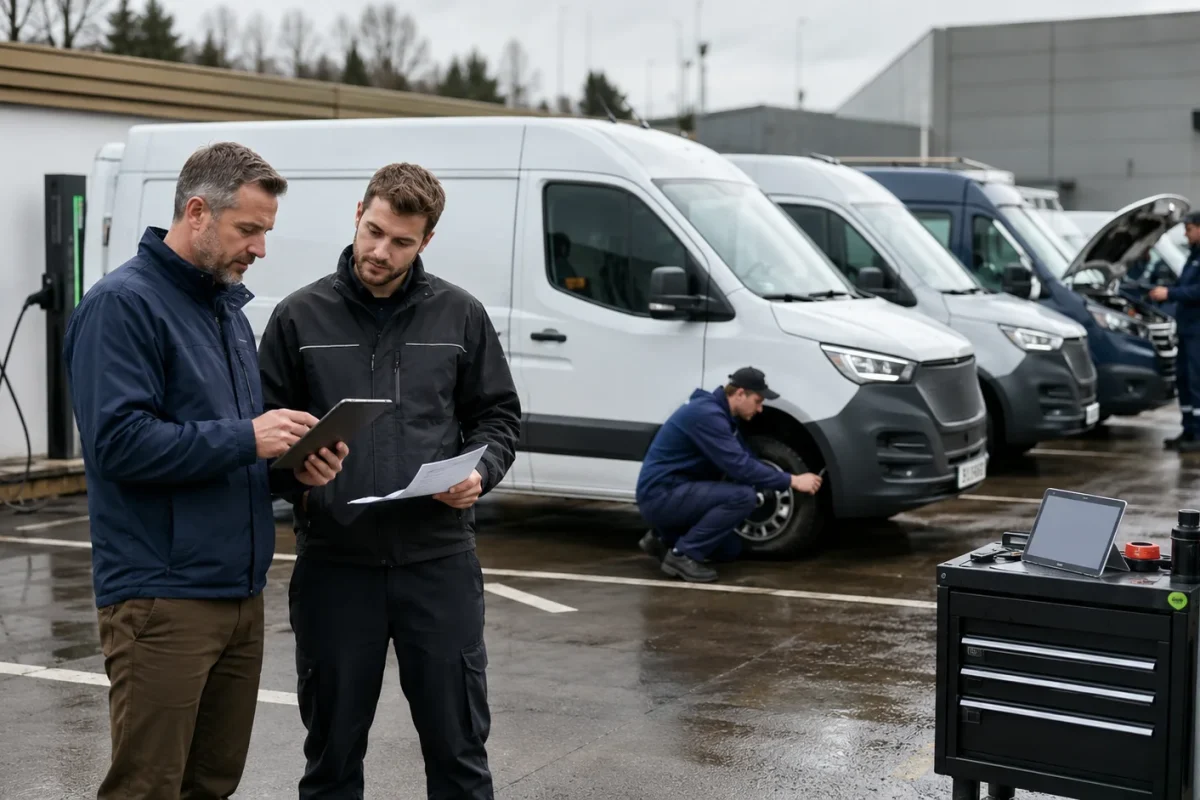
Since 1 June 2026, eligible zero-emission vans weighing more than 3.5 tonnes and up to 4.25 tonnes have been tested under Class 7 MOT rules in England, Scotland and Wales.
The reform removes several requirements that previously treated battery-electric vans like heavier commercial vehicles.
Alongside the MOT change, qualifying vehicles may benefit from simpler driving licence rules and exemptions from certain tachograph, drivers’ hours and road transport working-time requirements.
However, the exemptions are not universal. Vehicle weight, propulsion type, trailers, journey location and business use can all affect which rules apply.
What Are the New UK Electric Van MOT Changes?
Before 1 June 2026, a zero-emission goods vehicle exceeding 3.5 tonnes could enter the heavy vehicle testing system, even when the additional weight came mainly from its battery.
That meant a battery-electric version of a conventional van could face different testing rules from a diesel model performing almost exactly the same work.
The 2026 reform allows eligible zero-emission goods vehicles with a design gross weight or maximum authorised mass of between 3,501kg and 4,250kg to use Class 7 MOT testing.
This places them closer to the standard van testing system.
| Compliance Area | Previous Position | Current Position |
| Statutory vehicle test | Heavy vehicle testing could apply | Class 7 MOT for eligible vehicles |
| First test for a new vehicle | Generally after one year under the heavier testing system | Normally three years after registration |
| Continuing test cycle | Annual testing | Annual MOT after the first test |
| Testing fee | Heavy vehicle testing charges applied | Class 7 fee capped at £58.60 |
| Testing locations | Heavy vehicle testing facilities | Participating Class 7 MOT stations with suitable equipment |
| Driver compliance | Heavier-vehicle rules could be triggered | Certain domestic GB exemptions now apply |
Businesses should not assume that an existing test date has automatically been cancelled or reset. Fleet managers should check the official MOT or testing record for every affected vehicle.
Which Electric Vans Qualify?
The Class 7 reform applies where the vehicle is:
- A goods vehicle.
- Genuinely zero-emission at the point of use.
- Above 3,500kg but no more than 4,250kg maximum authorised mass or design gross weight.
- Being operated in England, Scotland or Wales.
Battery-electric vans will normally be the most common vehicles within this category. Qualifying hydrogen fuel-cell goods vehicles may also be covered where they satisfy the legal zero-emission definition.
The following vehicles do not automatically benefit:
- Diesel, petrol or LPG vans.
- Plug-in hybrids.
- Conventional hybrids.
- Range-extender vehicles containing a combustion engine.
- Vehicles exceeding 4,250kg.
- Vehicles that do not meet the relevant goods-vehicle definition.
- Vehicles operating under rules that apply in Northern Ireland or another jurisdiction.
The figure that matters is the vehicle’s official maximum authorised mass, sometimes described as its design gross weight. It is not the vehicle’s empty or unladen weight.
Why Were the Rules Changed?
Battery packs make electric vans heavier than comparable diesel vehicles. In some cases, a battery-electric van can cross the 3.5-tonne threshold while offering a similar load area and performing the same delivery, maintenance or service work as the diesel model it replaces.
The previous system could therefore penalise a business for selecting a zero-emission drivetrain rather than for operating a genuinely heavier class of commercial vehicle.
The consequences could include:
- Earlier statutory testing.
- Higher testing costs.
- Fewer convenient testing locations.
- Tachograph requirements.
- More complicated drivers’ hours compliance.
- Additional driver training.
- Greater administrative pressure.
Before the reforms were completed, AA Fleet Director Duncan Webb described the application of truck-style rules as an “absolute blocker” to electric van adoption.
Following the announcement of the broader changes, Logistics UK Chief Executive Ben Fletcher described the reform as a “victory for the environment and common sense”.
How Did the 4.25-Tonne Electric Van Rules Develop?
The new rules resulted from several years of temporary allowances, consultation and legislation.
| Date | Development |
| 2018 | An allowance was introduced enabling some Category B drivers to operate qualifying alternatively fuelled vehicles up to 4.25 tonnes, subject to conditions including additional training. |
| October 2023 | The government announced its intention to remove the five-hour training requirement and revise towing restrictions. |
| 2024 | The legislative process was delayed by the general election. |
| 24 December 2024 | The Zero Emission Vans: Regulatory Flexibility consultation opened. |
| 25 February 2025 | Secondary legislation relating to the driving licence changes was laid before Parliament. |
| 3 March 2025 | The regulatory flexibility consultation closed. |
| 10 June 2025 | The revised Category B licence and towing provisions took effect. |
| 24 November 2025 | The consultation response was published. Of those answering the testing question, 82%, or 146 out of 179 respondents, supported Class 7 testing. |
| 26 January 2026 | Draft regulations covering testing, tachographs and drivers’ hours were laid. |
| 11 May 2026 | The regulations were formally made. |
| 1 June 2026 | The MOT, tachograph and drivers’ hours reforms came into force in Great Britain. |
The 2024 consultation considered more than MOT testing. It also addressed drivers’ hours, tachographs and speed limiters, which is why the final regulatory package matters to fleet operators as well as MOT providers.
When Is the First MOT Due?
A new qualifying zero-emission goods vehicle will normally need its first Class 7 MOT three years after registration. It must then be tested annually.
This is a significant change from the heavier testing system, under which the first annual test could be required after one year.
For a business purchasing a new vehicle, the reform can remove two statutory tests during the first three years of ownership.
Nevertheless, the three-year period is not a maintenance exemption. Businesses remain responsible for ensuring that every vehicle is safe and roadworthy whenever it is used.
How Much Does a Class 7 Electric Van MOT Cost?
The maximum permitted fee for a Class 7 MOT is £58.60. An MOT station can charge less than this amount, but it cannot charge more for the test itself.
| Number of Vehicles | Maximum Class 7 Test Fees per Annual Cycle |
| 1 | £58.60 |
| 10 | £586 |
| 25 | £1,465 |
| 50 | £2,930 |
These figures cover the test fee only. They do not include:
- Repairs.
- Replacement parts.
- Chargeable retests.
- Vehicle collection or delivery.
- Staff time.
- Lost productivity.
- Replacement-vehicle hire.
Government estimates suggested that some operators could save up to 60% on testing costs. That figure should be treated as a possible saving rather than a guarantee.
The actual result will depend on the operator’s previous testing arrangements, fleet size, location and downtime costs.
Can Every Class 7 MOT Centre Test a 4.25-Tonne Electric Van?
No. A station may be authorised to conduct Class 7 MOTs but still lack suitable equipment for a vehicle weighing up to 4.25 tonnes.
The testing station needs enough space, appropriate access and equipment with a sufficient safe working load.
In a survey of testing stations, approximately 80% of respondents reported having a vehicle hoist. Among that group, 79% said their hoist had a safe working load above 4,250kg.
That still leaves a meaningful number of stations unable or unwilling to accept the heaviest eligible vans.
A testing station can also decline a vehicle if its actual condition or load means it cannot be examined safely. Operators should not send a fully laden van without confirming the station’s requirements.
Before booking, ask:
- Can the station test a zero-emission Class 7 van with a 4,250kg maximum authorised mass?
- Does the lift or inspection equipment have a sufficient safe working load?
- Are there vehicle height, wheelbase or access restrictions?
- Must tools, stock or other cargo be removed?
- Can the station accommodate the van’s charging cable or specialist bodywork?
- What documents should the driver bring?
Do You Need a Special Licence for a 4.25-Tonne Electric Van?
Since 10 June 2025, a driver with a full Category B licence can drive a qualifying zero-emission vehicle weighing up to 4.25 tonnes without obtaining an additional licence category.
The previous requirement to complete five hours of additional training has been removed. The entitlement is not normally displayed as a separate category on the driver’s photocard.
The change is particularly useful for businesses because it allows more existing drivers to operate heavier electric vans without moving into the conventional goods-vehicle licensing system.
The provision is not limited to panel vans. Depending on their design and use, it can cover qualifying zero-emission cars, SUVs, vans and small trucks that remain within Category B rules.
Minibuses are subject to additional conditions. An operator should not assume that every 4.25-tonne electric minibus can be driven solely because the driver holds Category B entitlement.
Employers should also remember that legal licence entitlement does not establish occupational competence. A 4.25-tonne van may handle differently from a smaller vehicle, particularly when loaded.
Familiarisation training, reversing assessments and load-security instruction remain sensible fleet measures.
What Are the Towing Rules?
Category B drivers can tow a trailer with an eligible zero-emission vehicle, subject to the vehicle’s approved towing limit and the driver’s entitlement.
Under the revised provisions, the combined authorised mass can be as high as 7,000kg where:
- The qualifying zero-emission vehicle does not exceed 4,250kg.
- The trailer does not exceed 3,500kg.
Drivers who passed their test before 1 January 1997 may have a higher combined entitlement of up to 8,250kg, depending on the categories shown on their driving record.
The important distinction is that driving licence entitlement and tachograph exemption are different questions. A driver may be licensed to tow a combination while the journey still triggers tachograph or drivers’ hours requirements.
Businesses must also check:
- The van manufacturer’s towing limit.
- The trailer’s plated weight.
- The gross train weight.
- The axle limits.
- The nose weight.
- The load security.
- The insurance conditions.
Are Tachographs Still Required for 4.25-Tonne Electric Vans?
From 1 June 2026, a qualifying zero-emission goods vehicle used for business journeys within Great Britain can be exempt from the assimilated drivers’ hours and tachograph regime where the total permitted mass, including any trailer, is more than 3.5 tonnes but no more than 4.25 tonnes.
These operations instead fall under the relevant GB domestic drivers’ hours rules.
Unlike some older exemptions, this new provision does not contain a 100km-from-base restriction.
However, businesses should not translate this into “electric vans never need tachographs”. A tachograph may still be required where:
- A trailer takes the combination’s permitted mass above 4.25 tonnes.
- The journey involves Northern Ireland.
- The vehicle travels internationally.
- The vehicle does not meet the zero-emission definition.
- Another aspect of the operation falls within the assimilated regime.
- The operator cannot rely on a relevant exemption.
| Journey or Vehicle Situation | Likely Compliance Position |
| Qualifying van, business journey wholly within Great Britain, no trailer and not above 4.25t | New exemption may apply |
| Van and trailer with total permitted mass no more than 4.25t | Exemption may apply if all other conditions are met |
| Trailer takes total permitted mass above 4.25t | Do not assume the exemption applies |
| Journey between Great Britain and Northern Ireland | Tachograph and drivers’ hours rules may apply |
| International journey | Check the rules for the complete journey |
| Hybrid or range-extender van | Not covered by the zero-emission exemption |
Fleet policies should classify journeys before vehicles are dispatched. The licence held by the driver is not enough to determine the tachograph position.
What Has Changed for Drivers’ Hours and Working Time?
Qualifying domestic GB operations are no longer automatically placed under assimilated drivers’ hours rules simply because battery weight takes the vehicle above 3.5 tonnes.
Instead, GB domestic drivers’ hours requirements apply where the new exemption is available.
This reduces record-keeping and administrative pressure, but it does not remove every limit on driving or working time. Businesses must still manage fatigue and comply with applicable domestic hours, general working-time, employment and health and safety obligations.
The specific road transport working-time rules connected to the assimilated drivers’ hours regime may no longer apply to an exempt journey. General protections governing rest, working time and safe systems of work continue.
Operators should update policies carefully instead of deleting every reference to working-time control.
Have Speed Limiter Requirements Been Removed?
No. Speed limiter requirements were included in the consultation, but the final package did not remove the requirement from relevant vehicles.
During the consultation, 51% of respondents opposed removing speed limiters, while 37% supported removal.
Where a speed limiter is legally required on an N2 zero-emission vehicle, it must generally continue to restrict the vehicle to approximately 90km/h, or 56mph. Its operation may also form part of the updated Class 7 MOT inspection.
Businesses should therefore not disable or alter a limiter because the vehicle has moved into Class 7 testing.
What Does a Class 7 MOT Check on an Electric Van?
Class 7 testing continues to examine essential roadworthiness items, including:
- Brakes.
- Steering.
- Suspension.
- Tyres and wheels.
- Lights and electrical equipment.
- Seat belts.
- Body structure.
- Registration plates.
- Mirrors and visibility.
- Doors and load-area security.
- Relevant warning indicators.
The applicable tyre standard is also important. Class 7 vehicles generally require at least 1.6mm of tread across the central three-quarters of the tyre around its complete circumference.
That is different from the 1mm threshold commonly associated with heavier commercial-vehicle testing.
An MOT is not a complete electric-vehicle health assessment. The move to Class 7 has not introduced a full diagnostic test covering:
- Usable battery capacity.
- Battery degradation.
- Thermal-management performance.
- Charging speed.
- High-voltage isolation under every operating condition.
- The condition of every charging-port component.
A van can pass its MOT while still having a deteriorated battery or charging problem. Operators should arrange manufacturer servicing or a separate EV diagnostic inspection where battery health matters.
Keeping a vehicle compliant is also a continuous duty. A valid test certificate does not remove the responsibility to maintain the parts of a vehicle that must remain in good condition between tests.
What Government Grants Are Available?
Purchase grants can reduce the upfront cost of eligible electric vans and trucks. As of September 2026, the main maximum discounts are:
| Vehicle Category | Maximum Grant |
| Small van below 2,500kg | 35% of purchase price, up to £2,500 |
| Large van from 2,500kg to 4,250kg | 35% of purchase price, up to £5,000 |
| Truck above 4.25t and up to 12t | Lower of £15,000 or 20% |
| Truck above 12t and up to 18t | Lower of £37,000 or 40% |
| Truck above 18t and up to 26t | Lower of £52,000 or 40% |
| Truck above 26t | Lower of £81,000 or 40% |
Eligibility depends on the individual model, scheme conditions, available funding and the purchaser’s circumstances. Limits applying to large enterprises in Northern Ireland may differ.
Businesses should confirm grant eligibility before signing an order because vehicle lists, funding levels and scheme rules can change.
How Do the Changes Affect Total Fleet Costs?
The MOT saving is helpful, but it should not be assessed in isolation. Businesses should compare the complete cost of ownership across the expected operating life of the van.
That calculation should include:
- Purchase price after any grant.
- Finance or leasing costs.
- Usable payload.
- Workplace charging installation.
- Electricity prices.
- Public charging.
- Servicing and repairs.
- Tyres.
- Insurance.
- MOT fees.
- Vehicle downtime.
- Replacement-vehicle costs.
- Expected resale value.
Payload deserves particular attention. The 4.25-tonne allowance compensates for battery weight, but it does not permit operators to exceed the van’s plated limits.
Drivers should understand axle weights and the difference between cargo volume and legal payload.
Range modelling should also reflect real operating conditions. Load, temperature, speed, heating, air conditioning and regenerative braking can all affect energy consumption.
The principles involved in how EV driving modes influence battery range are also relevant when businesses model electric van routes.
What Should Fleet Operators Do Now?
The rules are already in force, so affected businesses should review their procedures rather than wait for the next MOT reminder.
1. Audit Every Vehicle
Record each van’s:
- Registration number.
- Propulsion type.
- Maximum authorised mass.
- Registration date.
- Current test status.
- Trailer use.
- Normal operating territory.
2. Confirm the Correct Test Date
Check the current official record for every eligible vehicle. Do not assume that a previously scheduled heavy vehicle test has automatically moved to a new date.
3. Find a Suitable Class 7 Station
Confirm that the station has sufficient lifting capacity, access and space for the specific van.
4. Update Driver Records
Verify Category B entitlement and any older acquired rights. Record vehicle familiarisation and load-security training separately from licence entitlement.
5. Review Towing Operations
Check trailer weights, gross train weight, manufacturer limits and whether the combination remains within the tachograph exemption.
6. Classify Cross-Border Journeys
Flag routes involving Northern Ireland or another country before dispatch. These journeys may require different drivers’ hours and tachograph arrangements.
7. Update Working-Time Policies
Move eligible domestic journeys to the correct GB rules while retaining appropriate fatigue, rest and general working-time controls.
8. Maintain EV-Specific Inspection Routines
Continue scheduled servicing and introduce checks for charging equipment, warning indicators, high-voltage components and battery performance where appropriate.
9. Recalculate Total Cost of Ownership
Include grants, Class 7 MOT fees, charging, payload, insurance and downtime when comparing electric and diesel vehicles.
Could the Changes Encourage More Businesses to Adopt Electric Vans?
The reforms remove several operational barriers at the same time.
A fleet operator can potentially benefit from:
- Standardised Category B driver access.
- No compulsory five-hour licence training.
- A later first MOT.
- Lower statutory testing fees.
- More testing locations.
- Reduced tachograph administration on qualifying domestic journeys.
- Purchase grants for eligible vehicles.
The changes do not resolve every challenge. Electric van operators must still consider charging access, route length, winter range, payload and purchase price.
However, the regulations make it less likely that a business will be penalised simply because a battery makes its zero-emission van heavier than the diesel vehicle it replaces.
FAQs
Do Electric Vans Still Need an MOT in the UK?
Yes. The reform changes the test category for eligible zero-emission goods vehicles; it does not remove the MOT requirement.
What Vehicle Weights Are Covered?
The Class 7 extension covers qualifying zero-emission goods vehicles with a maximum authorised mass or design gross weight above 3,500kg and no more than 4,250kg.
When Did the New MOT Rules Start?
The changes came into force in England, Scotland and Wales on 1 June 2026.
When Is the First MOT Due?
A new qualifying vehicle normally needs its first MOT three years after registration and annually afterwards. Existing operators should check the recorded due date for each vehicle.
How Much Does the MOT Cost?
The maximum Class 7 MOT test fee is £58.60. Repairs and some retests can cost extra.
Can Every Class 7 Station Test a 4.25-Tonne Van?
No. The station must have suitable access and equipment with sufficient lifting or inspection capacity.
Are Plug-in Hybrids Included?
No. Vehicles with a petrol, diesel or LPG engine, including hybrids and range extenders, do not qualify as zero-emission vehicles for this reform.