

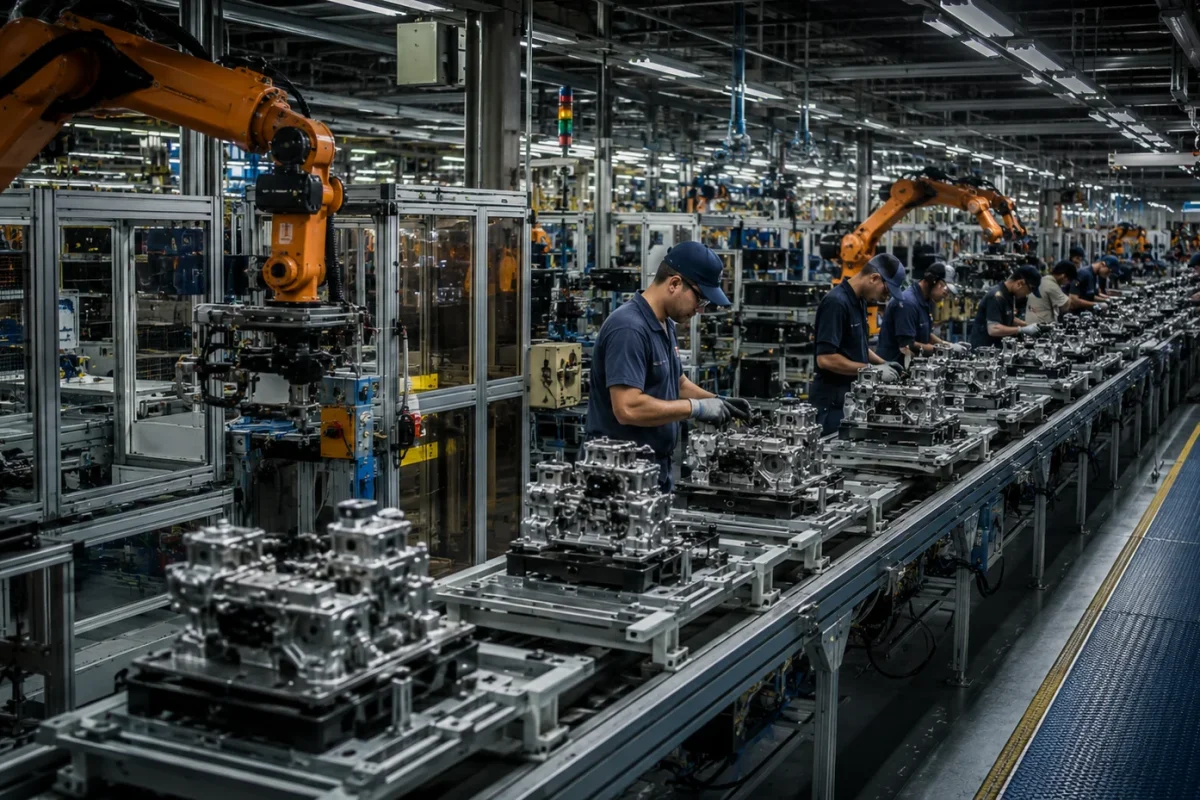
The series of workers involved in flow production is called an assembly line or production line. This system is commonly used to manufacture large quantities of standardised products efficiently.
In flow production, products move continuously through different stages while workers and machines complete specific tasks.
Assembly lines help businesses improve productivity, reduce costs, and maintain consistent product quality.
Key Highlights
- The series of workers in a flow production is called an assembly line
- Products move continuously through production stages
- Assembly lines improve efficiency and reduce costs
- Commonly used in the automotive, food, and electronics industries
- Ideal for producing identical or standardised products
- Supports high-volume manufacturing with consistent quality
What Is the Series of Workers in Flow Production Called?
The series of workers involved in flow production is called an assembly line or production line. In this system, workers and machines are arranged in sequence, with each completing a specific task before the product moves to the next stage.
Assembly lines are used to manufacture large quantities of similar products efficiently. By dividing work into smaller tasks, businesses can improve production speed, consistency, and overall efficiency.
Many assembly lines also use conveyor belts, robotics, and automated machinery to support continuous production and reduce delays.
“Assembly line systems remain one of the most efficient ways to achieve high-volume production while maintaining consistent product quality,” says Martin Hughes, Manufacturing Operations Consultant.
The use of assembly lines transformed industrial manufacturing during the twentieth century and continues to play a major role in modern business operations today.
What Is an Assembly Line in Flow Production?
An assembly line is a structured manufacturing arrangement where products move through a series of workstations. At each stage, a worker or machine completes a particular task before passing the item to the next station.
The Role of Workers on a Production Line
Workers on an assembly line are responsible for carrying out specialised tasks repeatedly. For example, in a car factory, one worker may fit wheels while another installs doors or electrical systems. This division of labour allows workers to develop expertise in their assigned tasks, helping production run more smoothly.
Because tasks are repeated continuously, businesses can produce goods much faster than using individual craftsmanship or job production methods.
How Machines and Automation Support Assembly Lines?
Modern flow production relies heavily on machinery and automation. Conveyor belts transport products between stages, while robotic systems may complete tasks such as welding, packaging, or quality inspections.
Automation provides several benefits:
- Faster production speed
- Improved product consistency
- Lower labour costs
- Reduced production errors
- Continuous operation with minimal downtime
Although automation improves efficiency, businesses still require skilled staff to monitor machinery, maintain systems, and oversee quality control.
As a result, successful assembly lines combine human labour with advanced technology to maximise productivity.
How Does Flow Production Work?
Flow production operates through a continuous sequence of manufacturing stages. Raw materials enter the system at one end, and finished products emerge at the other after passing through multiple workstations.
Each stage is carefully timed so that products move steadily without interruption. Businesses often design production lines so every task takes approximately the same amount of time. This balance helps prevent delays or bottlenecks within the manufacturing process.
A typical flow production process may involve:
| Stage | Activity |
| Raw materials | Materials enter the production system |
| Component assembly | Parts are fitted together |
| Quality checks | Products are inspected for faults |
| Finishing process | Painting, packaging, or labelling |
| Final output | Completed products prepared for distribution |
This organised structure helps manufacturers achieve high production volumes while maintaining standardised quality.
Industries producing soft drinks, packaged foods, electronics, bicycles, and household goods frequently use this system because customer demand remains steady throughout the year.
Flow production is particularly suitable for mass-market products that require low unit costs and efficient production schedules.
Why Is It Called Flow Production?
The term “flow production” comes from the continuous movement or “flow” of items through the manufacturing process. Products travel smoothly from one stage to another without stopping for long periods.
Unlike job production, where products may be made individually, flow production focuses on uninterrupted operations. Once the process begins, products continue moving through the system until they are completed.
This continuous movement offers several operational advantages. It reduces waiting time between tasks, lowers handling costs, and improves productivity. Businesses can also forecast production more accurately because every workstation follows a consistent routine.
In many factories, conveyor belts physically move products between workstations. In highly automated industries, robotic systems and computer-controlled machinery ensure products continue moving efficiently throughout the production cycle.
What Are the Key Features of Flow Production?
Flow production has several distinct characteristics that separate it from other manufacturing methods.
Continuous Production and Standardised Products
Flow production is designed for producing large quantities of identical goods. Businesses use it when demand is high and products require standardised specifications.
Examples include:
- Cars
- Chocolate bars
- Soft drinks
- Electronics
- Shampoo bottles
- Packaged foods
Because products are standardised, businesses can maintain consistent quality across every item produced.
Why Division of Labour Matters in Manufacturing?
Division of labour is a core feature of assembly line systems. Workers focus on one task repeatedly rather than building an entire product themselves. This specialisation increases efficiency because employees become highly skilled in their specific duties.
Other key characteristics include:
| Feature | Explanation |
| Automation | Machinery supports production processes |
| High output | Large volumes produced quickly |
| Capital intensive | Heavy investment in machinery |
| Repetitive tasks | Workers repeat the same activities |
| Continuous workflow | Products move constantly through stages |
These characteristics make flow production ideal for businesses targeting mass markets and aiming to minimise production costs.
“Flow production allows manufacturers to achieve economies of scale that would be difficult with smaller production methods,” explains Sarah Collins, Industrial Systems Analyst.
Even though the system is highly efficient, it also requires careful planning and maintenance to avoid production interruptions.
What Are Examples of Assembly Lines in Flow Production?
Assembly lines are used across a wide range of industries worldwide. Many products consumers use every day are manufactured through flow production systems.
Car manufacturers such as Toyota and Ford rely heavily on assembly lines to build vehicles efficiently. Different sections of the car are added sequentially as the chassis moves through the factory.
Food and beverage companies also depend on production lines. Bottling plants fill, seal, and package thousands of drinks every hour using automated machinery and conveyor systems.
Clothing manufacturers use flow production to produce garments quickly and consistently. Retail brands with global demand often depend on assembly line systems to maintain stock levels and reduce costs.
The table below highlights common industries using flow production:
| Industry | Example Products |
| Automotive | Cars and motorcycles |
| Food manufacturing | Packaged foods and snacks |
| Beverage production | Soft drinks and bottled water |
| Electronics | Mobile phones and televisions |
| Clothing | Fashion garments and uniforms |
These industries benefit from the speed, consistency, and cost efficiency that assembly lines provide.
What Are the Advantages of Flow Production?
Flow production offers several important benefits for businesses producing goods on a large scale. It is particularly valuable for companies aiming to reduce costs and improve efficiency.
Advantages of flow production include:
- High production volumes
- Lower cost per unit
- Consistent product quality
- Faster manufacturing times
- Efficient use of machinery
- Reduced waste and delays
Because products move continuously through the system, businesses can complete production much faster than with manual or customised methods.
Why Do Large Businesses Prefer Flow Production?
Large companies often prefer flow production because it allows them to serve mass markets efficiently. Businesses producing high-demand products benefit from economies of scale, meaning costs decrease as production increases.
Automated systems also help businesses operate continuously, including overnight and during weekends in some industries. This improves output while reducing long-term labour costs.
Another major advantage is quality consistency. Since products follow the same manufacturing process every time, businesses can maintain reliable standards across all units produced.
However, despite these advantages, businesses must also consider the challenges associated with assembly line manufacturing.
“The greatest strength of flow production is its ability to combine speed, efficiency, and standardisation within a single manufacturing process,” notes David Turner, Supply Chain Director.
Companies investing in flow production often gain a strong competitive advantage in price-sensitive markets.
What Are the Disadvantages of Flow Production?
Although flow production is highly efficient for large-scale manufacturing, it also comes with several disadvantages. One major issue is the high setup and maintenance cost.
Businesses often need to invest heavily in machinery, conveyor belts, automation systems, and factory infrastructure before production can begin.
Another drawback is limited flexibility. Since assembly lines are designed to produce standardised products, making changes or customising items can be difficult and time-consuming. This makes flow production less suitable for bespoke or personalised goods.
Other common disadvantages include:
- Production delays if the machinery breaks down
- Repetitive tasks that may reduce worker motivation
- Expensive repairs and maintenance costs
If one section of the production line stops working, the entire manufacturing process can be disrupted.
Can Repetitive Work Affect Employee Motivation?
Assembly line work often involves repetitive tasks, which may affect employee satisfaction and motivation over time. Workers repeating the same activity throughout the day can experience boredom and reduced engagement.
Businesses, therefore, need strong management practices to maintain morale and productivity. Some companies rotate workers between tasks or introduce team-based systems to improve job satisfaction.
Despite these challenges, many businesses continue using flow production because the efficiency gains often outweigh the disadvantages.
How Is an Assembly Line Different from Other Production Methods?
Assembly line production differs from other manufacturing methods because it focuses on continuous production, standardised products, and high efficiency.
In flow production, products move through a fixed sequence of stages, with workers or machines completing specific tasks repeatedly.
This system is commonly used in industries such as automotive, electronics, and food manufacturing.
Comparison of Production Methods:
| Production Method | Main Feature | Common Industries |
| Job Production | Custom-made individual products | Furniture, specialist engineering |
| Batch Production | Products made in groups or batches | Bakeries, clothing, printing |
| Cell Production | Small teams complete sections of work | Electronics, manufacturing |
| Flow Production | Continuous large-scale production | Automotive, food production |
Unlike job or batch production, assembly lines are designed for high-volume manufacturing with minimal variation, helping businesses reduce costs and improve production speed.
Why Do Businesses Use Assembly Lines in Flow Production?
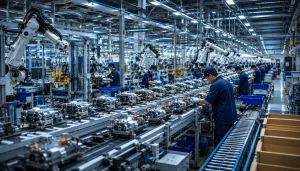
Businesses use assembly lines in flow production because they improve efficiency, reduce costs, and increase output. In this system, workers and machines perform specific tasks as products move continuously through production stages. This structured process helps manufacturers produce large quantities of standardised goods quickly and consistently.
Assembly lines are widely used in industries such as automotive, electronics, food processing, and clothing manufacturing because they support mass production and help businesses meet ongoing consumer demand.
Key Benefits of Assembly Lines
Businesses benefit from:
- Faster production times
- Lower cost per unit
- Improved product consistency
- Reduced material waste
- Better productivity through automation
By streamlining manufacturing and maintaining continuous workflow, assembly lines remain one of the most effective systems for large-scale production.
Meeting High Consumer Demand Efficiently
Assembly lines help businesses meet continuous consumer demand by enabling fast, large-scale production while keeping products affordable.
Since machinery and workstations are arranged in sequence, products move efficiently through the manufacturing process with minimal delays and lower handling costs.
Flow production also supports business growth because companies can increase output by upgrading machinery or expanding production lines.
Industries such as automotive manufacturing, electronics, and packaged food production rely heavily on assembly lines because they provide a practical, efficient, and cost-effective manufacturing solution.
Is Flow Production Suitable for Every Business?
Flow production is not suitable for every type of business. It works best for companies producing large quantities of standardised products with consistent demand.
Small businesses producing customised goods may struggle to justify the high investment costs associated with assembly line systems. Flexible production methods such as job or batch production are often more appropriate in these situations.
Businesses must also consider product variety. If customers expect personalised designs or frequent product changes, flow production may become inefficient because assembly lines are difficult to modify quickly.
Nevertheless, for companies operating in mass markets, flow production remains one of the most effective ways to achieve high output, lower costs, and consistent quality.
Conclusion
In flow production, the series of workers involved in manufacturing products is known as an assembly line or production line. This system enables products to move through multiple stages, with each worker or machine completing a specific task efficiently.
Assembly lines are essential in industries such as automotive, electronics, clothing, and food manufacturing because they support mass production, reduce production costs, and maintain consistent quality.
While flow production can require high setup costs and repetitive tasks, it remains one of the most efficient methods for producing standardised products at scale.
Frequently Asked Questions
What is another name for flow production?
Flow production is also known as continuous production because products move continuously through the manufacturing process.
Is an assembly line the same as a production line?
Yes, the terms assembly line and production line are often used interchangeably in manufacturing.
Why are workers given repetitive tasks in flow production?
Repetitive tasks improve efficiency and allow workers to specialise in one stage of production.
What products are commonly made using flow production?
Cars, soft drinks, packaged foods, electronics, and clothing are commonly produced using flow production.
Why is flow production important in manufacturing?
Flow production helps businesses produce large quantities quickly while reducing costs and maintaining quality.
What happens if an assembly line stops working?
If one machine or stage fails, the entire production process may stop until repairs are completed.
Is flow production more capital-intensive or labour-intensive?
Flow production is generally capital-intensive because it relies heavily on machinery and automation.