

A 15-month pension transfer delay is unusually long compared with the time taken for most straightforward UK pension transfers. MoneyHelper says a pension transfer often takes around two to six weeks, although providers can have up to six months to action certain transfer requests. A transfer lasting well over a year therefore deserves a clear explanation from the provider.
That does not automatically mean the pension company has broken the rules. Complex safeguarding checks, missing information, defined benefit requirements, problems with the receiving scheme and periods awaiting regulated financial advice can all extend the process.
After 15 months, however, the saver should know exactly what is preventing completion, which provider currently has the next action, when each piece of information was requested and whether avoidable inactivity has occurred. If those questions cannot be answered satisfactorily, a formal complaint may be appropriate.
Why Are 15-Month Pension Transfer Delays Being Discussed in 2026?
Long pension transfer times have received greater attention because regulators and the government are looking at whether current transfer safeguards strike the right balance between stopping scams and allowing legitimate transfers to proceed efficiently.
The FCA’s pension transfer review, last updated in July 2026, found large differences between straightforward transfers and those requiring additional checks. It also warned that unnecessary delays can affect investment opportunities, retirement planning, annuity rates and administrative costs.
At the same time, the Department for Work and Pensions opened a consultation in June 2026 proposing changes to the rules introduced in 2021. The proposals are intended both to strengthen protection against emerging scams and reduce unnecessary friction affecting genuine pension transfers.
This means a very long delay should now be considered in two ways. The first question is whether important anti-scam or regulatory checks genuinely required extra time. The second is whether poor communication, unnecessary duplication or administrative inactivity made the delay longer than necessary.
How Long Should a Pension Transfer Normally Take?
There is no single completion time for every pension transfer.
MoneyHelper says transfers often take between two and six weeks, while providers can have up to six months to action a transfer request. More complicated cases can take longer, particularly where safeguards, defined benefit rights or additional information are involved.
| Transfer Situation | Possible Timescale or Issue |
| Straightforward Defined Contribution Transfer | Often around two to six weeks |
| Transfer Without Additional FCA Checks | Many firms average within 10 days |
| Transfer Requiring Extra Checks | Some firms average 41 to 80 days |
| Defined Benefit Transfer | May take longer because of CETV and advice requirements |
| 15-Month Transfer | Unusually long and should have a clear explanation |
The six-month period should not be treated as a standard target for every pension transfer. The FCA does not prescribe one universal transfer time for the firms it regulates. Instead, firms are expected to execute requests within a reasonable time and avoid foreseeable harm through poor or slow service.
Defined benefit transfers can also involve extra steps. A cash equivalent transfer value, or CETV, is usually valid for three months. Where a defined benefit pension worth over £30,000 is being transferred into a defined contribution scheme, regulated financial advice is normally required before the transfer can proceed.
What Do FCA Figures Show About Pension Transfer Times?
The FCA’s review provides one of the clearest official comparisons for judging whether a transfer is moving unusually slowly.
Its study covered 18 life insurers administering more than 12 million individual personal pension policies, representing roughly 80% of individual personal pensions held by life insurers. The firms received nearly one million pension transfer requests during the 12-month period examined.
The FCA found:
- More than three-quarters of firms completed all transfer requests within 20 days on average
- More than three-quarters of firms completed transfers needing no additional checks within 10 days
- The fastest average for transfers without additional checks was five days
- Half of firms averaged between 41 and 80 days where additional checks were necessary
- Other firms with extra checks reported averages between 26 and 160 days
The figures demonstrate why it is important not to compare a complicated transfer directly with a simple electronic one. However, even the upper ranges reported by the FCA are far shorter than 15 months in most circumstances.
Why Can a Pension Transfer Take 15 Months?
A transfer can accumulate delays at several stages rather than being held up by one single problem.
Pension Scam And Safeguarding Checks
Providers are required to consider whether a transfer could expose the saver to a pension scam.
Depending on the circumstances, a red flag can prevent the statutory transfer from proceeding, while an amber flag can require the saver to receive Pension Safeguarding Guidance before continuing.
Checks can involve:
- The Receiving Scheme’s Regulatory Status
- Unusually High Or Unclear Charges
- High-Risk Or Unregulated Investments
- Cold Calling Or Unsolicited Contact
- Pressure To Transfer Quickly
- Unregulated Financial Advice
- Missing Evidence Requested By The Existing Scheme
These pension-transfer rules are separate from welfare-benefit investigations, although the government’s wider anti-fraud activity can also be seen through measures such as the DWP benefit fraud crackdown. For pension transfers specifically, it is the pension scam safeguards and transfer regulations that determine whether additional checks are required.
Missing Documents And Provider Delays
Transfers may also stall because one provider is waiting for information from the other.
Common problems include:
- Unsigned Forms
- Incorrect Policy Numbers
- Outdated Identification
- Missing Receiving-Scheme Details
- Unverified Bank Information
- Missing Adviser Confirmation
- Documents Sent To The Wrong Department
Bank verification should not automatically be treated as suspicious. Financial accounts frequently contain descriptions that are not immediately recognisable.
For example, identifying what SumUp is on a bank statement can help distinguish an ordinary payment-processing reference from a transaction that genuinely requires investigation.
The important question is not simply whether information was missing. It is how quickly the provider identified the problem and informed the saver.
Defined Benefit Pension And CETV Issues
Defined benefit transfers usually involve more steps than ordinary defined contribution transfers.
A saver may need to obtain a CETV, arrange regulated financial advice, provide evidence that advice was received and complete the transfer before the quoted CETV expires.
If the CETV expires while the transfer is delayed, a new value may be required. That replacement value could be higher or lower than the original. A change in value does not automatically create a right to compensation, because it still has to be shown that an avoidable failure caused the original transfer opportunity to be lost.
How Do Red And Amber Flags Affect Pension Transfers?
DWP’s review of the 2021 transfer regulations examined approximately 290,000 completed transfers during 2022.
It found that around 2,400 transfers received at least one amber flag. Importantly, 96% of those transfers still proceeded, while 4% did not.
The three most frequently recorded amber flags were:
- Overseas Investments Included In The Scheme at 57%
- High-Risk Or Unregulated Investments at 15%
- Unclear Or High Scheme Charges at 10%
Only about 300 of the 290,000 completed transfers had at least one red flag. DWP also reported more than 12,600 Pension Safeguarding Guidance appointments between December 2021 and February 2023.
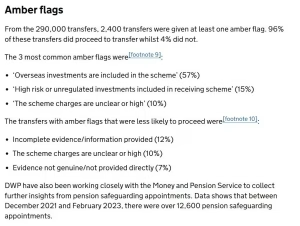
Official DWP data showing how red and amber flags can affect pension transfers and trigger additional safeguarding checks.
Are Pension Transfer Rules Changing in 2026?
The DWP launched a consultation on 9 June 2026 proposing amendments to the transfer regulations. The consultation closed on 21 July 2026. As of October 2026, the GOV.UK consultation page still describes these measures as proposals and says a government response will be published, so they should not yet be treated as fully implemented rules.
Key proposals include:
- Removing the Overseas Investment Amber Flag because many legitimate pension schemes hold overseas investments
- Reducing Repeated Safeguarding Appointments where evidence shows the saver completed appropriate Money and Pensions Service guidance during the previous 12 months
- Introducing A New SSAS Red Flag where evidence supplied does not demonstrate the required employment link
- Allowing Reputable Pension Schemes to satisfy the First Condition under a broader proposed test
The proposed changes are designed to reduce unnecessary friction while retaining protection where there is genuine evidence of scam risk.
This consultation relates to pension transfers rather than State Pension entitlement. That distinction matters because wider retirement-policy debates, including the UK State Pension increase campaign, concern a separate part of the UK pension system.
The DWP consultation applies to England, Scotland and Wales. Occupational pension policy operates differently in Northern Ireland.
DWP’s 2026 consultation outlines proposed changes to pension transfer safeguards, amber flags and repeated safeguarding checks.
Does An Electronic Pension Transfer Take Less Time Than A Paper Transfer?
Usually, yes.
The FCA found that transfers processed through a digital platform generally proceeded faster than manual paper applications. Most firms in the review used the Origo Transfer Service, an electronic system that allows connected pension businesses to transfer funds between providers.
Most firms using Origo processed more than 80% of their transfers through the platform.
Paper transfers were more likely where:
- One Provider Was Not Connected To Origo
- The Transfer Was More Complicated
- Manual Documents Were Required
- Additional Checks Could Not Be Completed Electronically
Anyone experiencing a very long delay can therefore ask the provider whether the transfer is being processed electronically or manually and whether moving between systems has contributed to the delay.
What Should You Do After A 15-Month Pension Transfer Delay?
After 15 months, continuing to make general customer-service calls is unlikely to be enough. The aim should be to create a written record showing where the transfer has been held up.
Check Who Is Holding Up The Transfer
Ask both the existing and receiving provider:
- What Information Are You Waiting For?
- When Was It Requested?
- When Was The Last Response Received?
- What Action Was Taken Afterwards?
- Who Currently Has The Next Action?
- Is Anything Still Required From Me?
Do not accept a vague statement such as “we are waiting for the other provider” without dates or details.
Build A Timeline And Keep Evidence
Record:
- Date The Transfer Was Requested
- Date Forms Were Submitted
- Date Each Provider Confirmed Receipt
- Dates Additional Information Was Requested
- Dates Information Was Supplied
- CETV Date And Expiry Date
- Dates Of Safeguarding Checks
- Dates Of Adviser Correspondence
- Dates You Chased The Transfer
- Any Long Periods With No Recorded Action
This makes it much easier to distinguish legitimate processing time from avoidable inactivity.
Ask Whether The Transfer Is Electronic Or Manual
If the transfer is being handled manually, ask why.
Where both schemes support an electronic transfer platform, it may be reasonable to ask why a paper process was necessary and whether that contributed to the delay.
When Should You Make A Formal Complaint?
A complaint becomes increasingly reasonable when the provider cannot clearly explain the delay, repeatedly fails to act on supplied information or allows long periods to pass without meaningful progress.
Pension Provider Or Scheme Complaint
Send a written complaint explaining:
- When The Transfer Started
- What Information You Supplied
- Which Periods Of Delay Appear Avoidable
- What Explanations You Have Received
- Whether You Have Suffered Financial Loss
- What Resolution You Want
For occupational schemes, the appropriate process may involve the scheme’s Internal Dispute Resolution Procedure.
Financial Ombudsman Or Pensions Ombudsman
The correct escalation route depends on the type of pension and organisation involved.
The Financial Ombudsman Service can deal with many complaints involving FCA-regulated financial businesses.
For most complaints, the business has up to eight weeks to investigate. A consumer normally has six months from the date of the final response to refer the matter to the Financial Ombudsman.
The Pensions Ombudsman deals with many complaints concerning the administration and management of occupational and personal pension schemes.
Where several organisations contributed to the delay, separate complaints may sometimes be necessary.
Can You Claim Compensation For A Delayed Pension Transfer?
Possibly, but a long delay does not automatically mean compensation is due.
A successful claim will normally depend on showing:
- A Failure Or Maladministration Occurred
- That Failure Caused A Financial Loss Or Significant Distress And Inconvenience
Lost Investment Growth
A saver might argue that their money would have been invested differently if the transfer had completed on time.
For example, assume the existing pension was worth £100,000 when the transfer should reasonably have completed. If the intended new investment would later have been worth £108,000 while the existing pension reached £103,000, the apparent difference would be £5,000.
That does not automatically mean £5,000 is payable.
Evidence would be needed showing:
- When The Transfer Should Have Completed
- What Investment Would Probably Have Been Chosen
- When The Investment Would Have Been Made
- What Charges Would Have Applied
- How The Existing Pension Actually Performed
- Whether The Provider’s Failure Caused The Difference
Compensation assessments are intended to reconstruct what would probably have happened, not use hindsight to select the best-performing investment.
Distress And Inconvenience
Compensation can also sometimes recognise significant distress and inconvenience caused by maladministration.
The amount is case-specific. There is no automatic compensation tariff simply because a transfer lasted 15 months.

What Do Real Pension Ombudsman Cases Show?
A 2025 Pensions Ombudsman determination involving the Stream International (NI) Ltd Employee Benefits Plan demonstrates why responsibility for a delayed transfer can be divided between different organisations.
The Ombudsman partly upheld the complaint against Aviva after finding that delay and communication failures amounted to maladministration.
The complaint was also upheld against the scheme trustees because they failed to provide information needed by the ceding scheme, causing financial loss.
This is important for anyone dealing with a 15-month transfer.
The question is not simply:
“Which company had my pension?”
The better question is:
“Which organisation was responsible for each period of delay?”
A transferring provider might cause one part of the delay while the receiving scheme, adviser or trustee causes another. A detailed timeline helps separate those periods.
Should You Cancel A Delayed Pension Transfer And Start Again?
Not automatically.
After waiting 15 months, restarting may appear attractive, but withdrawing the existing application could create additional complications.
Possible consequences include:
- Losing An Existing CETV
- Needing A Fresh Transfer Valuation
- Repeating Identity Checks
- Repeating Safeguarding Checks
- Completing New Forms
- Obtaining Further Financial Advice
- Changing The Transfer Value
- Restarting Administrative Timescales
Before cancelling, ask both pension providers to confirm in writing what would happen to the existing application and whether any completed checks or documents could still be used.
For a substantial defined benefit transfer, regulated financial advice may also be appropriate before making an irreversible decision.
FAQs About 15-Month Pension Transfer Delays
Is A 15-Month Pension Transfer Delay Normal?
No. Most straightforward pension transfers take much less time. A 15-month delay does not automatically prove wrongdoing, but the provider should be able to explain each significant stage of the delay.
Is There A Six-Month Time Limit For Pension Transfers?
MoneyHelper states that providers can have up to six months to action a pension transfer request, although many transfers complete much sooner. The exact legal position can depend on the pension type and circumstances.
Can An Amber Flag Delay A Pension Transfer?
Yes. An amber flag can pause a transfer until the saver completes Pension Safeguarding Guidance. It does not necessarily mean the transfer will ultimately be refused.
Can I Complain After Waiting More Than A Year?
Yes. If the provider cannot properly explain or resolve the delay, a written formal complaint can be made. The appropriate escalation route then depends on the type of provider or pension scheme involved.
Can I Claim Compensation For A Delayed Pension Transfer?
Potentially. Compensation may be possible where maladministration or another actionable failure caused measurable financial loss or significant distress and inconvenience. A 15-month delay by itself does not guarantee compensation.
Who Is Responsible If Two Pension Providers Are Involved?
Responsibility may change during the transfer. Ask both providers for dates showing when information was requested, received and acted upon. This can reveal which organisation was responsible for individual periods of inactivity.