

If this appears as a UK driving theory question, the expected answer is the seat belts. In Great Britain, seat belts that a vehicle is legally required to have must be properly maintained, and their anchorage points must also remain secure.
However, this does not mean seat belts are the only car parts drivers have a legal responsibility to look after. Your vehicle must remain roadworthy as a whole whenever you use it on the road.
Why Are Seat Belts the Correct Theory-Test Answer?

The question “What part of the car does the law require you to keep in good condition?” is designed to test knowledge of a specific legal requirement concerning seat belts.
Regulation 48 of the Road Vehicles (Construction and Use) Regulations 1986 deals specifically with the maintenance of seat belts and their anchorage points in Great Britain.
The principle is straightforward: where a vehicle is required to have a seat belt, that safety equipment must remain fit for its intended purpose.
For a learner revising multiple-choice questions, the simplest answer to remember is:
Seat belts must be kept in good condition.
The reason is obvious from a safety perspective. A belt may look like a relatively simple part of the vehicle, but it needs to restrain an occupant during a sudden stop or collision. Damage to the webbing, buckle, retractor or mounting point can reduce its ability to do that effectively.
What Counts as a Seat Belt Being in Good Condition?
A seat belt should not merely be present. It should work correctly and be free from significant defects.
The current DVSA MOT inspection manual instructs testers to examine seat belt webbing for cuts, damage, fluffing, fraying and signs of overstretching. Testers also check that the locking mechanism works, the buckle releases correctly and retracting belts operate as intended.
Common warning signs include:
- frayed or badly worn webbing
- significant cuts in the belt
- a buckle that will not lock securely
- a release mechanism that does not work correctly
- a belt that will not retract properly
- an insecure anchorage point
- visible stretching or weakening of the webbing
You should not wait until an MOT test to deal with one of these problems. If a belt is damaged or fails to operate properly, have it inspected and repaired or replaced as appropriate.
Can a Damaged Seat Belt Fail an MOT?

Yes. Significant seat belt defects can result in an MOT failure.
Under DVSA MOT criteria, a statutory seat belt that is missing is classed as a major defect. Significantly stretched, damaged or weakened webbing is also a major defect, as are a faulty buckle, an incorrectly functioning belt and a defective retractor. An insecure seat belt anchorage can also result in failure.
| Seat belt problem | Possible MOT outcome |
| Required belt missing | Major defect |
| Webbing significantly damaged or weakened | Major defect |
| Buckle not functioning correctly | Major defect |
| Retractor not working properly | Major defect |
| Anchorage loose | Major defect |
| Anchorage structure likely to detach in a collision | Dangerous defect |
This is why simply checking that every seat has a belt is not enough. The complete restraint system needs to function correctly.
What About Seat Belt Anchorage Points?
Seat belt anchorage points matter just as much as the belt itself.
An anchorage is the part of the vehicle structure to which the belt is secured. A perfectly intact belt cannot provide its designed protection if the mounting point is badly corroded, loose or structurally weakened.
During an MOT inspection, testers examine the load-bearing structure around seat belt anchorage points. Significant deterioration around these areas can be categorised as a major defect, while an anchorage that is likely to become detached in a collision can be considered dangerous.
This is particularly worth checking on older cars where corrosion may develop around structural mounting areas.
Are Seat Belts the Only Parts You Must Maintain by Law?

No. Seat belts are the specific answer to this theory-test-style question, but your wider legal responsibility extends to the condition of the whole vehicle.
GOV.UK states that drivers are responsible for making sure their vehicle is always safe to drive, or “roadworthy”. Importantly, a car can still be unsafe even when it has a valid MOT certificate.
The Highway Code’s vehicle maintenance guidance tells drivers to pay particular attention to safety-related equipment including:
- brakes
- steering
- lights
- seat belts
- windscreen wipers and washers
- demisters
- tyres
- warning systems
- exhaust systems
It also states that certain items, including lights, number plates, windscreens and windows, are subject to specific legal requirements.
So, for an exam question, remember seat belts. For real-world driving, remember roadworthiness as a whole.
What Should You Check Before Driving?

You do not need to dismantle your vehicle before every journey, but basic checks can identify obvious safety problems.
GOV.UK recommends checking every time you drive that the windscreen, windows and mirrors are clean, the lights work and the brakes operate properly. Tyres should also have sufficient tread and be free from relevant cuts and defects.
For cars and light vans, the legal minimum tyre tread depth is 1.6 mm across the central three-quarters of the tread around the entire circumference.
A useful routine is to check:
- Seat belts – buckle each one and look for obvious cuts or fraying.
- Tyres – inspect tread, pressure and visible damage.
- Lights – check headlights, indicators, brake lights and other required lamps.
- Brakes – investigate unusual behaviour, warning lights or poor braking immediately.
- Visibility – keep mirrors, windows and the windscreen clear.
- Wipers and washers – make sure they can keep the windscreen clear.
MOT requirements can also differ according to vehicle type. Businesses running heavier zero-emission vans, for example, may find the recent electric van MOT changes useful when planning vehicle testing and compliance.
Does a Valid MOT Mean Your Car Is Automatically Roadworthy?
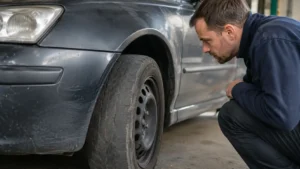
No. An MOT certificate does not guarantee that a car remains safe for the entire following year.
An MOT reflects the condition of tested components at the time of inspection. A tyre could subsequently become damaged, a bulb could fail or a seat belt could develop a fault.
Official guidance therefore makes clear that you remain responsible for ensuring the vehicle is safe whenever you drive it. Driving a vehicle in a dangerous condition can lead to a fine of up to £2,500, three penalty points and a possible driving ban.
That distinction is useful for both theory-test preparation and everyday driving: passing an MOT does not transfer responsibility for maintenance away from the driver.
Why This Question Can Be Confusing?
The wording can make learners think they need to choose the car component that is most important for safety. That is not quite what the question is testing.
Brakes and tyres clearly have important legal requirements of their own.
But where this particular theory-style question asks which part must be “kept in good condition”, the intended answer is generally seat belts because of the specific legal maintenance requirement applying to the restraint system.
The safest way to remember it is:
Theory-test answer: seat belts.
Real-world responsibility: keep the whole vehicle roadworthy.
FAQs
What part of the car does the law require you to keep in good condition?
The expected theory-test answer is the seat belts. Required seat belts and their anchorage points must be properly maintained, while drivers also have a broader responsibility to keep the vehicle roadworthy.
Do seat belts have to work to pass an MOT?
Yes. A required seat belt that does not function correctly can result in an MOT failure. Testers inspect the webbing, buckle, retractor and anchorage as applicable.
Will a frayed seat belt fail an MOT?
It can. DVSA guidance requires testers to assess webbing for fraying, cuts, damage and weakening. Significant deterioration can be classified as a major defect.
Do I still need to maintain my car after it passes an MOT?
Yes. You remain responsible for keeping the vehicle roadworthy between MOT tests. A valid MOT does not guarantee that the vehicle is currently safe to drive.
What other car parts should be checked regularly?
Tyres, brakes, lights, steering, visibility equipment and other safety systems should all receive regular attention. The Highway Code specifically highlights items including lights, brakes, steering, seat belts, wipers and washers.
What is the legal tyre tread depth for a car in the UK?
For cars in Great Britain, the minimum is 1.6 mm across the central three-quarters of the tread and around the entire circumference. Tyres must also be free from relevant defects.
Can I drive if one seat belt is damaged?
A damaged required seat belt should be repaired before the vehicle is used where the defect could make the vehicle unsafe or non-compliant.
The exact legal position can depend on the vehicle, the seat concerned and the nature of the defect, so serious belt or anchorage damage should be inspected professionally.