
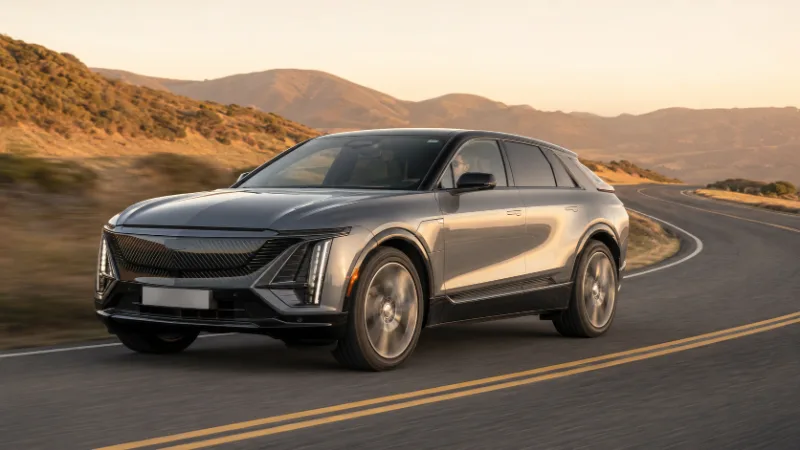
Yes, Cadillac LYRIQ driving modes can affect real-world battery usage, but they do not change the battery’s physical capacity or official EPA range.
Tour Mode normally provides the most predictable efficiency. Sport Mode and the LYRIQ-V’s V-Mode can consume more energy when their sharper responses are used aggressively.
Snow/Ice Mode prioritises traction, while My Mode allows selected driving characteristics to be personalised.
However, temperature, motorway speed, wheel and drivetrain configuration, preconditioning and driving style usually affect range more than the selected mode alone.
What Is the Official 2027 Cadillac LYRIQ Range?
Cadillac’s current 2027 specifications provide significantly more detail than a simple claim that the LYRIQ can travel “more than 300 miles”.
| 2027 LYRIQ Configuration | Official Range | Power |
| Single-motor RWD | 326 miles | 365 hp |
| Dual-motor AWD with standard 11.5 kW onboard charging | 319 miles | 515 hp |
| Dual-motor AWD with available 19.2 kW onboard charging | 303 miles | 515 hp |
| LYRIQ-V dual-motor AWD | 285 miles | Up to 615 hp |
These are EPA estimates rather than guaranteed distances. The figures are produced under standardised testing conditions and are intended to help buyers compare vehicles.
The difference between the AWD figures should not be interpreted as the 19.2 kW onboard charger directly consuming 16 miles of range while driving. Cadillac lists the charging options as part of different vehicle configurations, which may include other equipment, wheels and specification changes.
The broader pattern is clear: RWD delivers the longest official range, AWD trades some efficiency for extra traction and power, and the LYRIQ-V sacrifices additional range for performance.
Large battery packs also add considerable vehicle weight. The same issue affects commercial EVs and has contributed to changes in how some heavier electric vans are treated under UK MOT rules.
What Driving Modes Are Available in the Cadillac LYRIQ?

The standard LYRIQ offers four principal driving modes: Tour, Sport, Snow/Ice and My Mode. The LYRIQ-V adds V-Mode for more detailed performance configuration.
| Mode | What Changes | Likely Efficiency Effect | Best Used For |
| Tour | Balanced accelerator, steering and chassis responses | Usually the most predictable and efficient | Daily driving and longer journeys |
| Sport | Sharper acceleration and steering response | Can increase consumption when the extra response is used | More engaging road driving |
| Snow/Ice | Softer pedal tuning and traction-focused vehicle responses | No guaranteed range benefit; winter conditions usually reduce efficiency | Snowy, icy or slippery roads |
| My Mode | Allows selected driving characteristics to be personalised | Depends on the chosen settings and driving behaviour | Drivers wanting a customised setup |
| V-Mode | Adjusts accelerator, brake, suspension, steering and sound settings | Performance-focused settings can use more energy | LYRIQ-V performance driving |
Driving modes do not create separate battery capacities or EPA ratings. A 326-mile LYRIQ does not suddenly become a 280-mile model simply because Sport Mode is selected.
The actual difference depends on what the driver does with the changed response.
Does Tour Mode Give the Cadillac LYRIQ Its Longest Range?
Tour Mode is normally the best setting for drivers who want smooth, predictable and efficient everyday performance.
Its balanced accelerator response makes it easier to avoid abrupt power demands. This can be particularly useful in urban traffic, where repeated acceleration has a noticeable effect on consumption.
Tour Mode does not unlock additional battery capacity. It simply provides a calibration that makes efficient driving easier.
A driver travelling at a steady 75 mph in Tour Mode may still consume more energy than someone driving at 60–65 mph in Sport Mode. Aerodynamic drag increases rapidly with speed, so motorway pace can outweigh the relatively small difference created by a driving mode.
Tour Mode is therefore the sensible default, but it cannot overcome high speed, low tyre pressure, cold temperatures, strong headwinds or heavy acceleration.
Does Sport Mode Reduce Cadillac LYRIQ Range?
Sport Mode can reduce real-world range, but selecting it does not automatically produce a fixed percentage loss.
The mode provides a sharper accelerator response and more performance-focused driving feel. If the driver frequently uses that responsiveness for rapid acceleration, electricity consumption will rise.
The effect may be much smaller during steady-speed driving. Once the vehicle is cruising at a constant motorway speed, factors such as aerodynamic drag, temperature, elevation and wind can matter more than the selected mode.
It is therefore misleading to claim that Sport Mode always cuts range by a specific number of miles. The most accurate conclusion is that Sport Mode makes higher consumption easier, while driving behaviour determines how much additional energy is actually used.
What Does Snow/Ice Mode Do to Battery Efficiency?
Snow/Ice Mode is designed for control rather than maximum range. It modifies pedal tuning and other vehicle responses to help reduce wheel slip on slippery surfaces.
The softer power delivery may prevent wasteful wheelspin, but that does not make Snow/Ice Mode an efficiency mode.
When it is needed, the car is usually also dealing with several range-reducing conditions:
- Low battery temperature
- Cabin heating demand
- Denser cold air
- Wet, snowy or slushy roads
- Winter tyres
- Reduced tyre pressure
- Additional resistance from snow
These factors usually have a much greater effect than Snow/Ice Mode itself. The mode should be selected for stability and control, not to extend the distance between charges.
Can My Mode Be Configured for Better Range?
My Mode allows drivers to create a more personalised combination of vehicle settings. Available adjustments can vary by model year and equipment, but may include accelerator feel, steering, braking feel, suspension and vehicle sound.
For a more efficient configuration, the driver can generally select a gentler accelerator response and avoid unnecessarily performance-focused settings. Steering weight and artificial sound settings are unlikely to transform range on their own.
Regenerative braking and One-Pedal Driving should not be confused with the main drive-mode calibration. They may be accessed through related vehicle controls, but their function is different.
The most efficient My Mode setup is one that encourages smooth acceleration, anticipatory driving and minimal use of the friction brakes.
What Is V-Mode in the Cadillac LYRIQ-V?
The LYRIQ-V includes a dedicated V-Mode that is not available on the standard model.
V-Mode allows drivers to save performance-oriented preferences for the accelerator pedal, brake pedal, suspension, steering and sound enhancement. It can also provide access to more aggressive performance settings, including the conditions required for the vehicle’s maximum output.
The 2027 LYRIQ-V produces up to 615 hp and 650 lb-ft of torque in its highest-performance configuration. Its EPA-estimated range is 285 miles, compared with as much as 326 miles for a RWD standard LYRIQ.
That difference is not caused by V-Mode alone. The V model has dual motors, performance hardware, different chassis tuning and higher-output capability. Using its full performance repeatedly will nevertheless increase consumption and reduce the distance available from a charge.
What Real-World Efficiency Can LYRIQ Drivers Expect?
Owner reports provide a more practical picture than the official range figure alone. They should be treated as examples rather than controlled test results because model year, drivetrain, wheels, tyres, elevation and weather differ between vehicles.
| Driving Scenario | Reported Efficiency | Approximate Full-Pack Range at 102 kWh |
| Mild-weather motorway driving at 65–75 mph | 2.4–2.5 mi/kWh | 245–255 miles |
| Winter motorway driving at approximately 20–35°F | 2.0–2.2 mi/kWh | 204–224 miles |
| Local or city winter driving | 2.5–3.0 mi/kWh | 255–306 miles |
| Extreme cold with poor preconditioning | Around 1.7 mi/kWh | Approximately 173 miles |
| Brief, slow stop-start sections | Occasionally 6–8 mi/kWh | Not suitable for estimating whole-trip range |
The calculated ranges are theoretical full-to-empty figures. Drivers should not use the entire battery as a journey target, particularly in winter or on routes with limited chargers.
Very high 6–8 mi/kWh readings may appear during short, slow journeys, downhill sections or periods with considerable energy recovery. They are not representative of a complete charge cycle and should not be used to predict 600–800 miles of range.
How Can Drivers Calculate Their Own LYRIQ Range?
A useful estimate can be produced by multiplying recent efficiency by the approximate battery capacity:
Estimated range = mi/kWh × 102 kWh
For example:
2.4 mi/kWh × 102 kWh = approximately 245 miles
For a vehicle starting at 80%:
2.4 mi/kWh × 102 kWh × 0.80 = approximately 196 miles
If the driver wants to arrive with a 10% reserve:
2.4 mi/kWh × 102 kWh × 0.70 = approximately 171 miles
This method is often more useful than relying entirely on the dashboard range estimate. The dashboard calculation is influenced by recent driving, temperature, climate use and route conditions, which is why owners sometimes call it a “guess-o-meter”.
The 102 kWh figure should still be treated as an approximation. Battery buffers, temperature and battery-management decisions can affect how much energy is accessible during a particular journey.
Why Does the EPA Range Differ From Motorway Reality?
EPA testing represents a controlled combination of operating conditions. It does not reproduce every owner’s daily route.
A driver may see less than the official range when a journey includes sustained 70–75 mph driving, freezing temperatures, strong headwinds, hills, winter tyres or continuous cabin heating. Conversely, efficient local driving in mild weather may produce a result close to or above the EPA figure.
Motorway driving can be particularly demanding for an EV. Regenerative braking has fewer opportunities to recover energy, while aerodynamic resistance remains high throughout the journey.
This explains why an owner can achieve approximately 2.9 mi/kWh around town but only 2.4 mi/kWh during a longer high-speed trip. The battery has not deteriorated during the journey; the operating conditions have changed.
How Much Range Can Cold Weather Cost the LYRIQ?
A winter reduction of approximately 20–30% is a reasonable planning assumption for many cold-weather journeys. Losses can exceed 40% when several difficult conditions occur together, including extreme cold, high motorway speeds, headwinds, winter tyres and inadequate preconditioning.
At 2.5 mi/kWh, the simple 102 kWh calculation produces approximately 255 miles. At 1.7 mi/kWh, it falls to about 173 miles—a reduction of around 82 miles.
Cold weather affects range for several reasons. A cold lithium-ion battery cannot accept or release energy as efficiently, the cabin requires heating, tyre pressure can fall and cold air increases aerodynamic resistance.
Drivers should check tyre pressure regularly because underinflated tyres increase rolling resistance. More general information about regular tyre and vehicle-condition checks can also help owners maintain a safe and efficient vehicle.
How Does Preconditioning Protect Winter Range?
Preconditioning prepares the vehicle before departure instead of waiting until the journey has started.
When the LYRIQ is connected to a suitable charger, drivers can set charging completion, departure and cabin-preconditioning preferences through the vehicle’s charging controls.
This allows more of the initial heating demand to be supported by grid power rather than taking all the required energy from the traction battery after departure.
For the best results:
- Connect the vehicle to a Level 2 charger.
- Set the target charge level.
- Schedule the required completion or departure time.
- Set the cabin-preconditioning preference.
- Leave while the vehicle is still warm and connected or soon after the scheduled time.
- Use the built-in navigation when travelling to a DC fast charger so the vehicle can prepare the battery when supported.
Preconditioning does not eliminate winter range loss. It reduces the energy penalty at the beginning of the journey and helps the battery operate closer to its preferred temperature.
The difference between a 20% winter reduction and a loss approaching 40% is not guaranteed to come from preconditioning alone. Speed, journey length and weather remain important, but preconditioning is one of the strongest practical measures available to owners.
Does Preconditioning Work With a Level 1 Charger?
A standard 120V Level 1 connection can provide roughly 1.4 kW and Cadillac indicates that it may add around three miles of range per hour under suitable conditions.
That amount of power can help, but it may not keep pace with the combined demand of cabin heating and battery thermal management during severe cold. The vehicle may draw some energy from the battery even while connected, or its state of charge may increase very slowly.
Level 2 charging is far better suited to scheduled winter preparation. Depending on the equipment, the 2027 LYRIQ supports 11.5 kW or an available 19.2 kW AC onboard charging rate. Cadillac also supplies a dual-level cord capable of up to 7.7 kW when connected to a suitable 240V outlet.
Level 1 is useful for light daily mileage, but owners relying on it in a cold climate should not expect the same preconditioning performance as a properly installed Level 2 system.
How Does the Ultium Energy Recovery System Work?
The LYRIQ’s thermal system does more than use simple resistive heating.
GM’s Ultium Energy Recovery system uses a heat pump to capture and redistribute heat from the battery, electric drive components, power electronics, cabin and surrounding environment. That recovered energy can support cabin heating and battery temperature management.
GM has stated that the platform-wide system can provide as much as 10% more range than a comparable vehicle without energy recovery. This is not a guaranteed 10% increase on every LYRIQ journey, but it shows why the thermal system matters.
GM’s EV development programmes include testing across extremely low temperatures, including conditions around -40°C. This type of validation demonstrates that the systems are designed to function in severe environments; it does not mean the vehicle will retain its full EPA range at -40°C.
Does Regenerative Braking Always Increase Range?
Regenerative braking captures part of the vehicle’s kinetic energy while slowing and returns it to the battery. It is particularly useful during urban stop-start driving.
However, regeneration cannot recover every unit of energy previously used for acceleration. Avoiding unnecessary acceleration and deceleration is more efficient than accelerating hard and attempting to recover the energy later.
On an open road, gentle coasting can sometimes be more efficient than strong regeneration. In traffic, One-Pedal Driving can make it easier to slow smoothly without using the friction brakes.
The greatest losses occur when braking is too hard for the regenerative system to handle and the mechanical brakes must dissipate energy as heat.
Which Factors Affect LYRIQ Range More Than Drive Mode?
The most influential factors are usually:
- Ambient and battery temperature
- Motorway speed
- Acceleration behaviour
- Headwinds and rain
- Hills and elevation changes
- Wheel and tyre choice
- Tyre pressure
- Cabin heating and air conditioning
- Passenger and luggage weight
- Roof-mounted accessories
- Battery preconditioning
- RWD, AWD or LYRIQ-V configuration
Changing from Sport to Tour may help, but slowing from 75 mph to approximately 65 mph can produce a more noticeable improvement during a long journey.
Which Cadillac LYRIQ Mode Is Best for Daily Driving?
Tour Mode is the best general setting for most journeys because it provides a balanced combination of comfort, control and predictable energy use.
Sport Mode is appropriate when the driver wants sharper responses. Snow/Ice Mode should be reserved for slippery conditions, while My Mode is suitable for drivers who prefer a personalised configuration.
LYRIQ-V owners can use V-Mode for performance-focused settings, but Tour remains the more appropriate choice when preserving range is the priority.
The safest approach is to select the mode for the road conditions and control energy consumption through smooth driving, sensible speed and effective preconditioning.
Frequently Asked Questions
Does Sport Mode Reduce Cadillac LYRIQ Range?
Sport Mode can reduce range when its sharper accelerator response leads to faster acceleration and more frequent high-power use. It does not apply a fixed range penalty simply by being selected.
Which LYRIQ Driving Mode Gives the Best Range?
Tour Mode normally provides the most predictable efficiency. However, temperature, motorway speed and driving behaviour can affect range more than the selected mode.
How Much Range Does Cold Weather Cost the LYRIQ?
Many owners experience a reduction of approximately 20–30% in cold weather. Losses can exceed 40% in severe conditions involving high speeds, strong heating demand and poor preconditioning.
Does LYRIQ Preconditioning Work on Level 1 Charging?
It may provide a limited benefit, but a typical 120V Level 1 connection supplies only around 1.4 kW. In severe cold, it may not keep pace with the vehicle’s heating demand. Level 2 charging is more effective.
What Is the Real-World Efficiency of a Cadillac LYRIQ?
Owner reports commonly show around 2.4–2.5 mi/kWh during mild-weather motorway driving and approximately 2.0–2.2 mi/kWh on cold winter motorways. Extreme conditions can reduce it towards 1.7 mi/kWh.
Does Snow/Ice Mode Save Battery Power?
Snow/Ice Mode is intended to improve control on slippery roads, not maximise range. Cold temperature, snow, winter tyres and cabin heating normally have a greater effect on consumption.
Does One-Pedal Driving Increase LYRIQ Range?
It can improve energy recovery in stop-start traffic by reducing reliance on mechanical brakes. On open roads, smooth coasting may sometimes be more efficient than repeatedly applying strong regeneration.
How Far Can the 2027 Cadillac LYRIQ-V Travel?
The 2027 LYRIQ-V has an EPA-estimated range of 285 miles. Real-world distance will depend on speed, weather, tyres, climate use and how frequently its performance is used.